Top Small-Cap ETFs Reviewed by a CFA Charterholder (Plus the Two I Own)
About this article: This article is based on Ethan’s video, originally published on July 27, 2026. Because the written version was published later, returns, yields and fund details reflect data available at the time of the video and have likely changed since. Please check each fund’s website for current figures.
Factor Investing Series: you’re reading Part 4 of 11
Part 1: Momentum Investing Explained
Part 2: SPMO vs MTUM
Part 3: Small-Cap Investing Explained
Part 4: Top Small-Cap ETFs (you’re here)
Part 5: Value vs Growth Stocks
Part 6: Best Value ETFs
Part 7: Quality Factor Investing Explained
Part 8: Top International Quality ETFs
Part 9: Top U.S. Quality ETFs
Part 10: Minimum Volatility Investing Explained
Part 11: Best Low Volatility ETFs
You asked for a professional-level review of the top small-cap ETFs, so that’s what this is. And I’ll cap it off with the two small-cap investments I own personally, since that was the top request in the comments on the last video.
Welcome back to our series on factor investing, which covers how, why and when each investment factor works, and the top ETFs focused on each one. In the last part, I covered how small-cap investing works and why I find small caps so interesting right now.
The Short Version
Small-cap value: DFAT and AVUV (active, still cheap) tie as my top picks; VBR is my top passive option.
Small-cap growth: SBH Small Cap Growth (a mutual fund, WTSGX) on the active side; VBK on the passive side.
Core small cap: DFAS for active; SCHA and SPSM tie for passive.
International: AVDS for active; VSS (or SCHC with minimal emerging markets) for passive.
What I own: American Funds SMALLCAP World Fund, plus TNA, a 3x leveraged ETF I manage actively. TNA is not a buy-and-hold investment.
How Much Do Professional Portfolios Hold in Small Caps?
One thing the last part missed, based on your comments, was portfolio sizing. I can’t tell you what’s right for your situation, but I can show how professional allocators use small caps. I pulled four target-date 2065 funds (built for people planning to retire around 2065) and four growth-oriented funds of funds. These aren’t recommendations, just a sampling of the range professionals use.
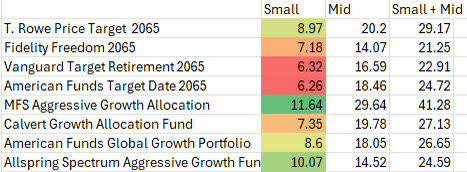
Small- and mid-cap allocations in eight professionally managed portfolios. Source: Morningstar.
Three caveats: many of these are only 80–90% stocks, so a 100% stock portfolio would scale the numbers up a bit; everyone defines small caps differently; and there’s no single “right” amount. According to Morningstar, these portfolios generally hold around 10% in pure small caps, or 20–30% if you add small and mid caps together.
Best Small-Cap Value ETFs: DFAT, AVUV and VBR
On the active side, it’s a tie between DFAT and AVUV, two funds that do more or less the same thing. VBR, the Vanguard Small-Cap Value ETF, is my top passive option, but I prefer the active ones, and here’s why.
Although DFAT and AVUV are technically actively managed, they’re still very cheap: 0.28% and 0.25% a year, or $2.80 and $2.50 per $1,000 invested, not much more than the passive options. They’re cheap because Dimensional (better known as DFA) and Avantis aren’t flying analysts around the country to meet company management teams. Their funds are managed mostly quantitatively and usually overweight the value, small-cap and profitability factors. Put simply, they screen for companies that are cheaper, smaller and more profitable than average, so it’s probably no surprise that small-cap value is an area where they’ve historically done very well.
So why pay a little extra? Because comparing the mutual fund versions of DFAT and VBR, which go back further than the ETFs, Dimensional has absolutely crushed Vanguard for over 25 years.
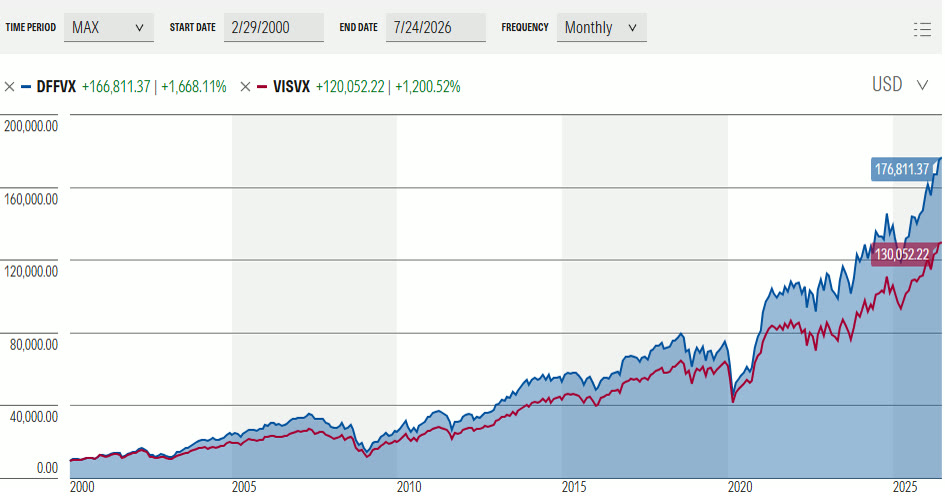
The mutual fund versions since 2000: Dimensional (blue) versus Vanguard small-cap value (red).
AVUV hasn’t been around nearly as long, and normally that would rule it out for me, because I want to see consistency over time. But it takes a very similar approach to DFA, has beaten both DFAT and VBR fairly handily since its inception, and costs slightly less than DFAT, so I don’t have a compelling argument against it. In my opinion, all three are very solid small-cap value options.
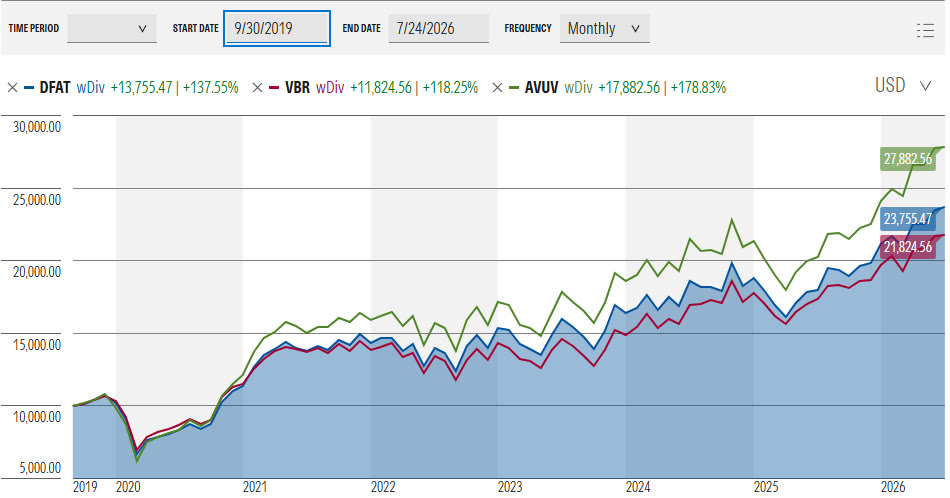
Since 2019: AVUV (green) ahead of DFAT and VBR.
Best Small-Cap Growth Funds: SBH Small Cap Growth and VBK
VBK, the Vanguard Small-Cap Growth ETF, is pretty self-explanatory. At 0.05% you can’t get much cheaper, and impressively, since its inception in 1998 it has never trailed the Russell 2000, the main small-cap benchmark, over any 10-year period. Now that is consistency. (The comparison fund, MDSKX, is the oldest Russell 2000 index fund, the one the iShares ETF IWM is based on.)
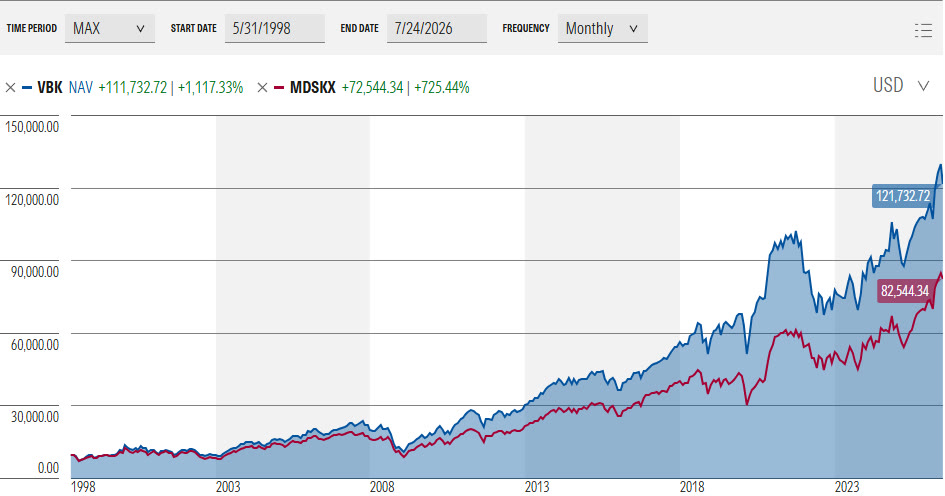
VBK (blue) versus the Russell 2000 (red) since 1998.
On the active side, many of the best small-cap funds either close to new investors or lose their portfolio managers to retirement, after which you never really know what you’ll get. So finding one I’m comfortable with is hard, but I think a strong case can be made for the SBH (Segall Bryant & Hamill) Small Cap Growth Fund, WTSGX. Yes, it’s much more expensive, at a little over 1%, and it’s a mutual fund, not an ETF. If either rules it out for you, that’s fine by me. These are my honest evaluations of funds in the small-cap universe, not advice, and everyone has different goals and preferences.
I don’t know much about the company, but I did find it interesting that they buried the fact that they had just won the Zephyr PSN Top Guns Manager of the Decade award way down at the bottom of their website. I’d never heard of the award, but there’s something refreshing about a company that’s humble about its accomplishments instead of blasting you with misleading ads.
Their approach looks for companies with stable growth prospects, higher and more consistent sales and cash flow growth than peers, and durable competitive advantages — in essence, quality growth companies. Hundreds of funds say something similar, though, so that’s not what attracted me. It was really two things:
Results: as consistently as VBK has beaten the Russell 2000, WTSGX has beaten VBK by a similar margin since its inception in 2013.
Repeatability: anyone can screen for past results, and great managers often retire. Here, the two portfolio managers running the fund today have run it the whole time. I can’t guarantee the results will repeat, but that’s a positive signal.
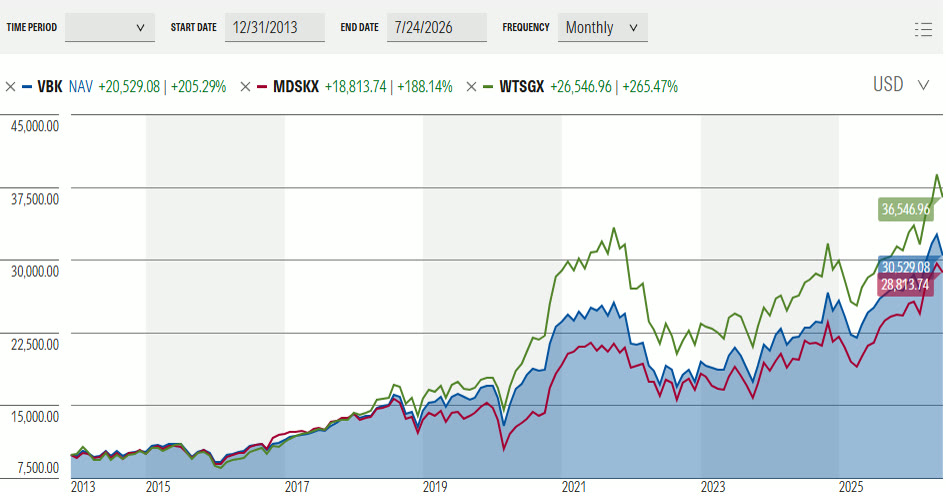
Since 2013: WTSGX (green) ahead of VBK (blue) and the Russell 2000 (red).
Best Core Small-Cap ETFs: DFAS, SCHA and SPSM
My top core small-cap fund is DFAS, the Dimensional US Small Cap ETF, on the active (or quasi-active) side, with a tie between SCHA and SPSM on the passive side. By the way, whenever I mention a DFA ETF and you’re wondering about a very similar one from Avantis, I probably don’t have a preference; they’re very similar.
DFAS takes a very similar approach to DFAT, just less value-oriented. It still leans toward value compared with the passive ETFs, but not as much. The main difference between SCHA and SPSM is their benchmarks: SCHA tracks the Dow Jones U.S. Small-Cap Total Stock Market Index, and SPSM tracks the S&P SmallCap 600. I have no real insight into which will do better long term, so either seems like a fine passive core option.
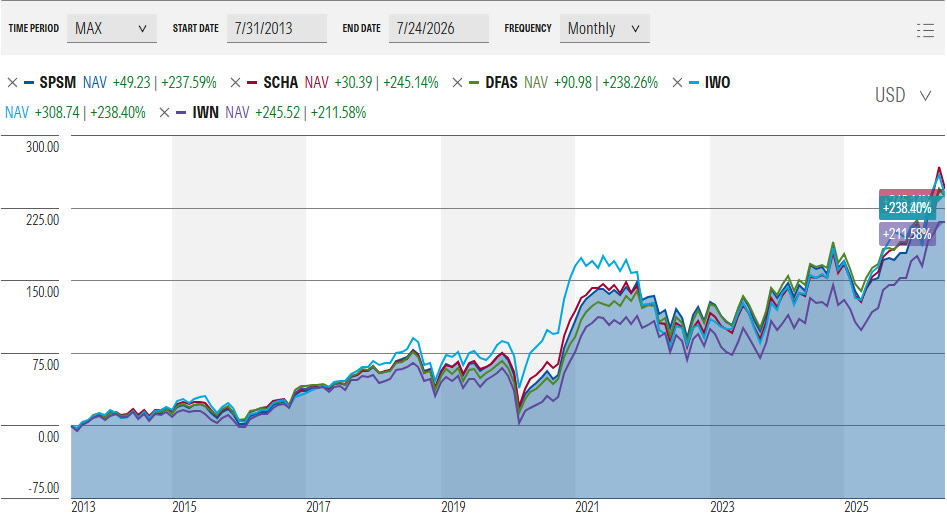
Since 2013: SPSM, SCHA and DFAS have all been close.
I don’t have a strong preference between them and DFAS either; they’ve all been pretty close since SPSM launched in 2013. You could maybe give DFA an edge, since small-cap growth (IWO) has beaten small-cap value (IWN) over that time and DFA leans toward value — so it put up similar results while its style was out of favor. But we’re splitting hairs, and it costs 0.26% instead of 0.03%.
Best International Small-Cap ETFs: AVDS, VSS and SCHC
On the active side, there’s not much that’s been consistently good and is still open to new investors. But if you like the DFA and Avantis approach, both recently launched international small-cap ETFs. DFA’s is slightly more expensive and has had slightly less impressive results in their short histories, so I give the edge to the Avantis International Small Cap Equity ETF, AVDS (0.30%). It has ranked in the top 16% of international small and mid-cap funds over the past three years, which is nearly its whole track record, so I don’t know how much to read into it. It probably comes down to whether you believe in that kind of strategy for the long run.
On the passive side, VSS, the Vanguard FTSE All-World ex-US Small-Cap ETF, would be my top option because it includes emerging markets, a big part of the non-U.S. market with more upside than developed markets — presumably what you’re after with small caps. If you’d rather have very little emerging markets exposure, SCHC does that for the same price: 0.06%.
The Two Small-Cap Investments I Own
That brings us to the two I own personally: American Funds SMALLCAP World Fund and TNA. One or both may well not be for everyone, but here’s why I own them.
TNA: A 3x Leveraged Small-Cap ETF
Technically TNA is passive, but it’s not something I’d ever buy and hold passively. I think it needs to be actively managed by the investor. It’s a 3x leveraged small-cap ETF with a 1.05% expense ratio, but it’s so volatile that the fee probably isn’t a main consideration.
Surprisingly, buying and holding it since its 2008 inception — which almost anyone, including me, would tell you is probably not a good idea — would actually have worked out, if it didn’t give you a heart attack along the way. The S&P 500 fell just over 50% from its 2007 peak to its 2009 trough, which is a big decline. Well, 50% rises and drops are common for this fund.
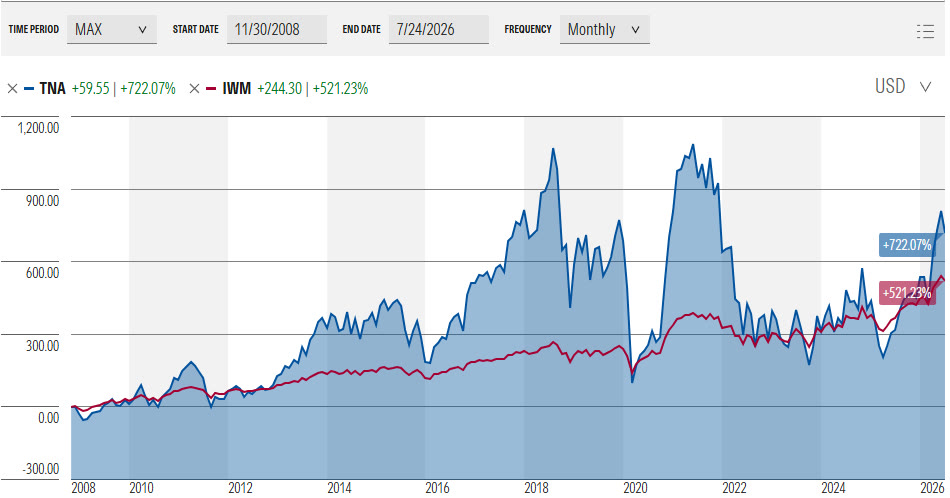
TNA (blue) versus IWM (red) since 2008: 50% swings in both directions are routine.
To use it successfully, I think you have to be willing to sell high and miss some upside if you sell too early, and buy low and add more if you buy too early and it keeps falling. It’s certainly not for everyone. We’ve covered my process — how I identify opportunities, when and how much to buy and sell, and how to handle the emotions that come with it — in two earlier videos on the channel: When to Sell an ETF and How to Profit From Stock Market Volatility.
American Funds SMALLCAP World Fund
If I could own only one small-cap investment for the rest of my life, it would be American Funds SMALLCAP World Fund. Yes, it costs over 1% (1.07% for the F-1 shares as of 11/04/2026, actually cheaper than average for a global small-cap fund), and yes, it’s a mutual fund rather than an ETF, but in my opinion the positives far outweigh the negatives.
Small caps aren’t like large caps: there are far more of them, and they’re not well known. The fund’s benchmark, the MSCI ACWI Small Cap, has over 6,000 companies. Bottom-up active managers try to beat their index by picking the companies that will do best and avoiding the ones that won’t, and that’s a lot easier with 6,000 little-known companies all over the world — if you can dedicate the resources. They have: the fund has 17 portfolio managers, and I believe over 100 analysts.
That’s a huge advantage, especially in global small caps. In U.S. large caps, how much better can you really know Apple and Microsoft than everyone else? In global small caps, there are so many companies and so few people paying attention that I think it’s much easier to find good ones other investors are missing.
So I like that SMALLCAP World is global and looks for the best opportunities anywhere, that it dedicates far more resources to finding them than anyone else, and that it has a strong, proven record since 1990. It’s one of the oldest global small-cap funds out there, and it has beaten its benchmark net of fees since inception, as have nearly all of American Funds’ actively managed equity funds. That’s why I believe it’s their process that sets them apart, and it’s what gives me confidence in their ability to keep producing strong long-term results. I’d love to compare it with an index fund, but the index is so broad that no passive mutual fund or ETF even attempts to track it.
All My Small-Cap Picks in One Place
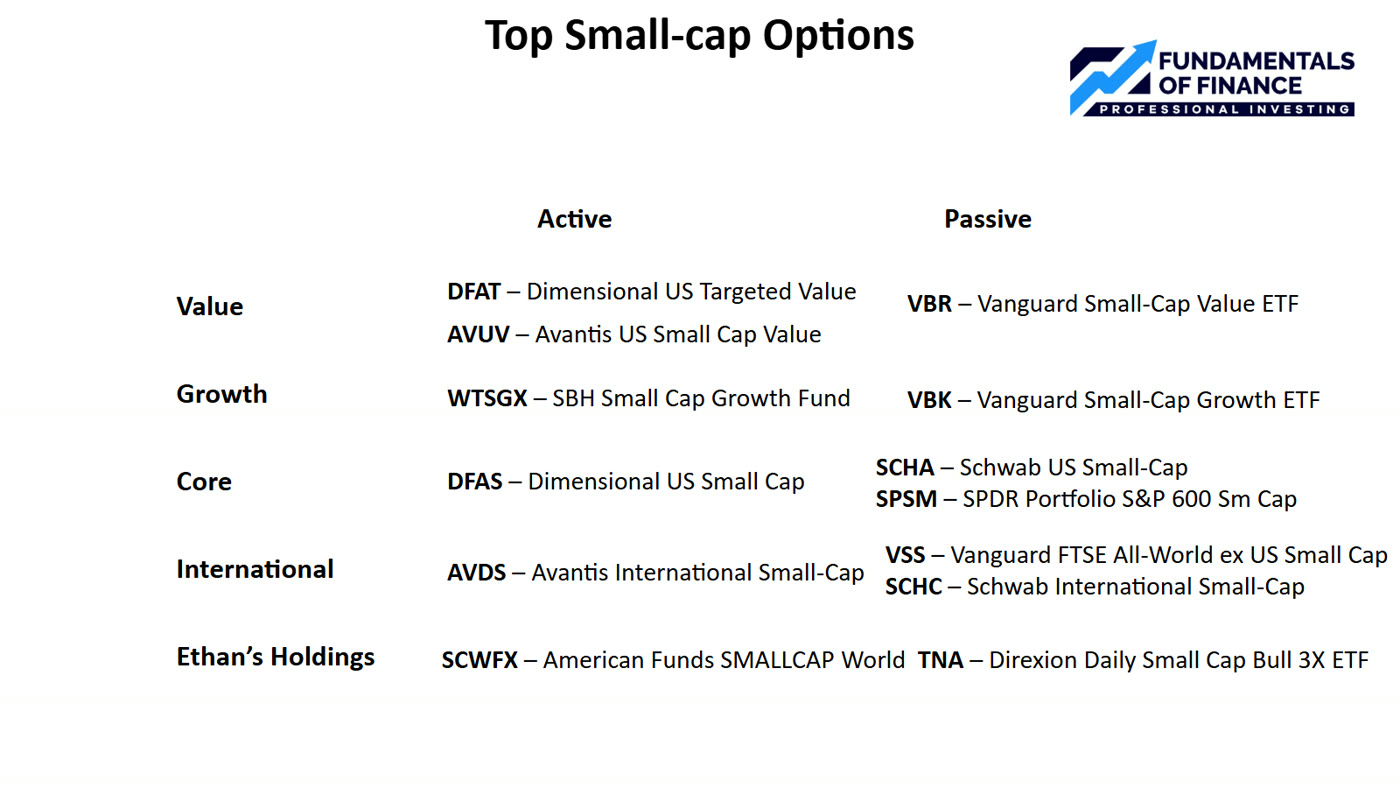
My top active and passive small-cap options by category.
Value: DFAT or AVUV (active, 0.28% / 0.25%); VBR (passive, 0.05%).
Growth: WTSGX, SBH Small Cap Growth Fund (active mutual fund, a little over 1%); VBK (passive, 0.05%).
Core: DFAS (active, 0.26%); SCHA or SPSM (passive, 0.03%).
International: AVDS (active, 0.30%); VSS or SCHC (passive, 0.06%).
What I own: American Funds SMALLCAP World Fund; TNA (3x leveraged, actively managed, not for buy and hold).
American Funds SMALLCAP World Fund is my top choice for small-cap exposure, but in my opinion any of these could be reasonable, depending on preferences.
Watch the Full Video
Want to Go Deeper? In the Fundamentals of Finance Academy, Ethan breaks down funds and current market events on a live call every other week, and members get the full archive of recorded calls. Learn more about the Academy →
This article is for educational purposes only and is not investment advice. Ethan is a CFA charterholder, but nothing here is a recommendation to buy or sell any security, and it does not take your personal situation into account. Past performance does not guarantee future results. Charts of index returns are for illustration only and don’t reflect the fees, expenses or taxes of any actual investment. Performance data and fund details are as of 07/27/2026 and will change; check each fund’s website for current figures.
