Why Value Stocks Could Crush Growth Stocks Over the Next Decade
About this article: This article is based on Ethan’s video, originally published on August 10, 2026. Because the written version was published later, returns, yields and fund details reflect data available at the time of the video and have likely changed since. Please check each fund’s website for current figures.
Factor Investing Series: you’re reading Part 5 of 11
Part 1: Momentum Investing Explained
Part 2: SPMO vs MTUM
Part 3: Small-Cap Investing Explained
Part 4: Top Small-Cap ETFs
Part 5: Value vs Growth Stocks (you’re here)
Part 6: Best Value ETFs
Part 7: Quality Factor Investing Explained
Part 8: Top International Quality ETFs
Part 9: Top U.S. Quality ETFs
Part 10: Minimum Volatility Investing Explained
Part 11: Best Low Volatility ETFs
Two gas stations sit across the street from each other, and one is $1 a gallon cheaper. Which do you go to? The cheaper one, right? But in the stock market, most investors have been choosing the expensive one for the past decade — often without realizing it — and in the long run that tends not to be a very good strategy. That’s growth versus value investing in a nutshell. In this part of our factor investing series, I’ll show why value investing has beaten growth in the long run, and why it could be in the early stages of an epic comeback that catches almost every investor off guard and out of position.
The Short Version
Value means cheap stocks, measured by what you pay for each dollar of earnings, cash flow or assets, not by share price.
Since 1927, U.S. value stocks have beaten growth stocks by about 4% a year on average, according to Dimensional.
The last decade-plus was one of value’s worst stretches ever, and investors now have well over $1 trillion more in growth funds than value funds.
The setup looks a lot like 1999, just before one of the greatest value comebacks on record, and value has been beating growth again since October 2025.
I’m Ethan, a CFA charterholder and investment professional. So far this series has covered momentum and small caps, plus the top ETFs for each. This part covers the value factor, the oldest, most researched and most famous factor of all. Warren Buffett built the greatest investment track record in history on it. His mentor, Benjamin Graham, basically invented it. Nobel Prizes have been won studying it, and entire firms like Dimensional and Avantis have been built around harvesting it.
And yet, over the last decade, a lot of very smart people have declared value investing dead. The last time everyone was saying that was 1999, when we were on the verge of one of the greatest value resurgences of all time. Those who fail to learn from history are doomed to repeat it.
What Is Value Investing?
At the most basic level, the value factor means that historically, over time, cheap stocks have beaten expensive stocks. But cheap doesn’t mean a low share price. A $5 stock isn’t necessarily cheaper than a $5,000 stock. What matters is how much you pay for each dollar of what the company actually produces: its earnings, its cash flows, its assets.
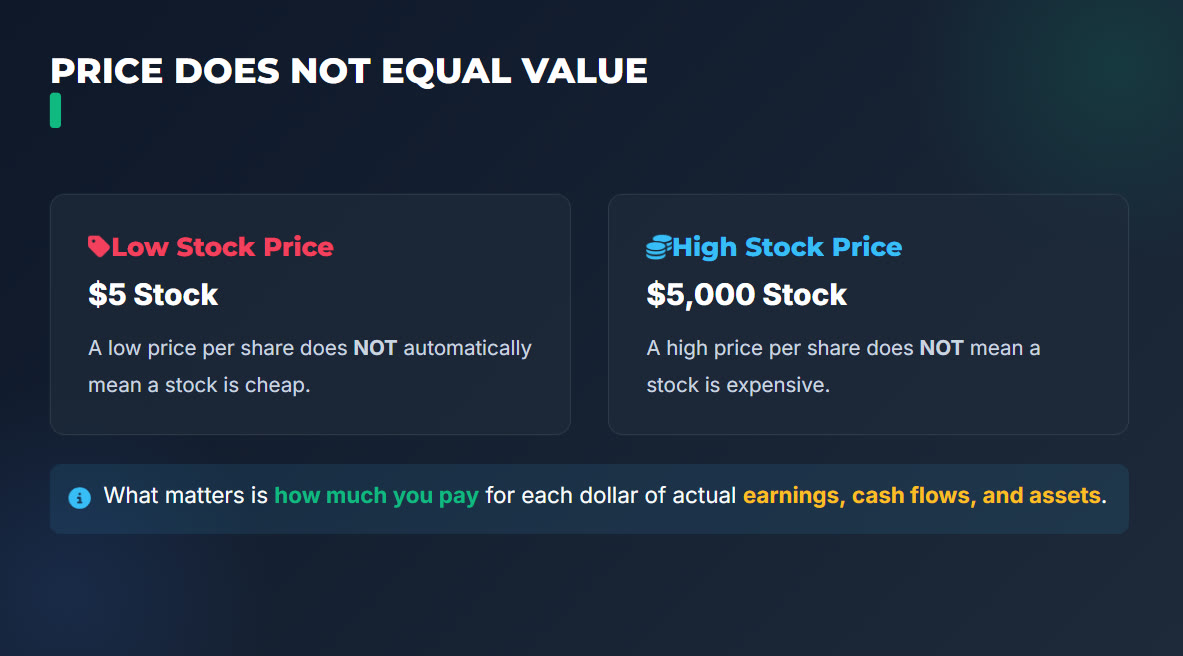
Price does not equal value: what matters is what you pay for each dollar of earnings, cash flow and assets.
That’s where the gas station example comes in. Same product; one station charges $5 a gallon and the other $4. Maybe the $5 gas is from a better brand, and maybe that’s true. But you’re paying 25% more. Will it give your car 25% better performance? Probably not.

The gas station example: paying 25% more doesn’t get you 25% more.
That’s the essence of it, and why it’s called value investing, not cheap investing. A beat-up old car isn’t better than a new Ferrari just because it’s cheaper, and a terrible company about to go bankrupt isn’t better than a great, profitable, fast-growing one. The better company should be more expensive. The key question is how much more. Value investing is about getting value for your money: the cheaper gas is a good value investment because the difference in price is much bigger than the difference in the product.
If you’re not doing your own in-depth financial analysis, the common ways to measure it are ratios like price-to-earnings (P/E), price-to-book and price-to-cash-flow. The lower they are, the less you’re paying for each dollar of earnings, book value or cash flow the company is expected to generate — in other words, the better value you’re getting.
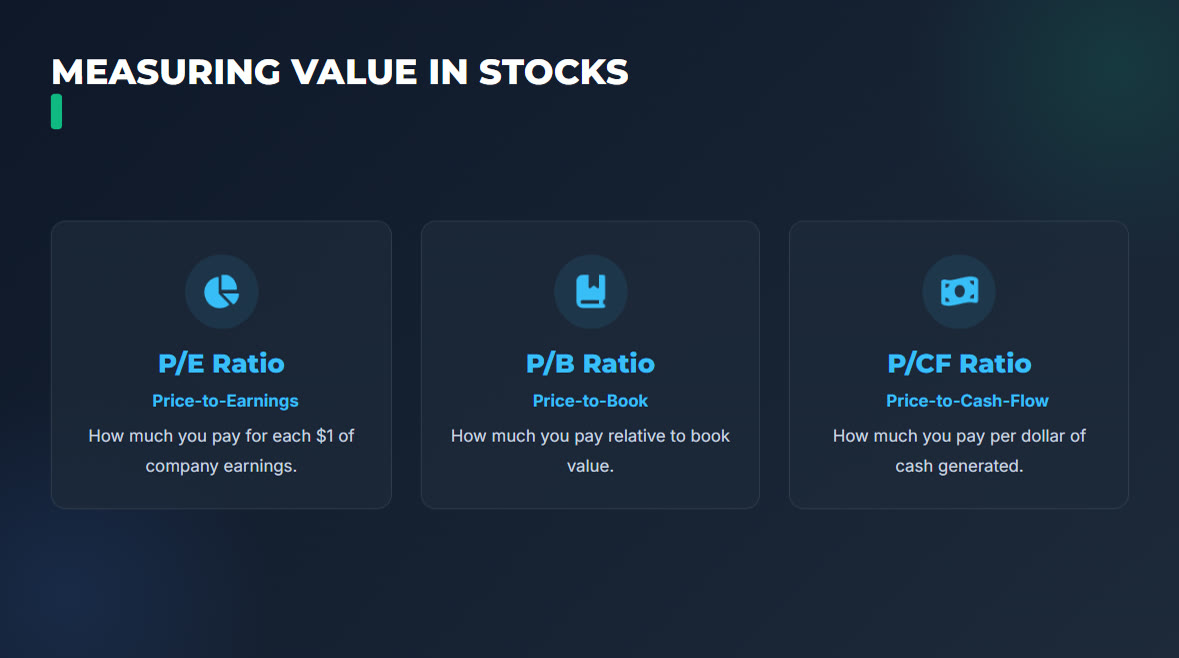
Three common ways to measure value: P/E, P/B and P/CF.
Why Has Value Beaten Growth Over Time?
Here’s the part that trips people up. If the market were perfectly rational, there’d be no free lunch: expensive stocks would be expensive for good reasons, cheap stocks would be cheap for good reasons, and it would all wash out. That’s not what the data says. According to Dimensional, going back to 1927, U.S. value stocks have beaten growth stocks by an average of about 4% per year.
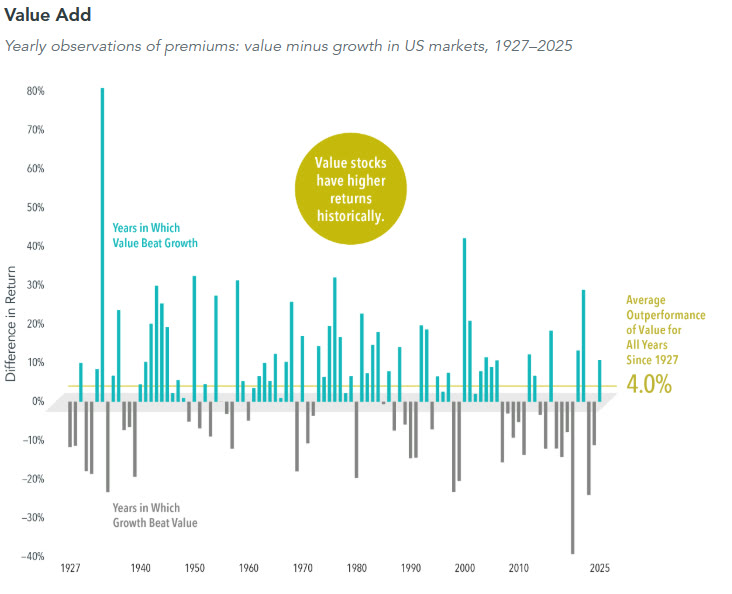
Yearly value-minus-growth premiums in U.S. markets since 1927, averaging about 4%. Source: Dimensional.
Why? The best explanation, in my opinion, is human nature. Investors chronically overpay for exciting stories and chronically underpay for boring ones. Expectations for popular, fast-growing companies get pushed so high that even good results can disappoint, while expectations for unloved companies get pushed so low that even mediocre results can be a positive surprise. Stocks are priced on future expectations, so value investing isn’t necessarily buying cheap or bad companies. It’s investing where you think the market is underestimating potential.
Why Value Has Struggled for a Decade
That brings us to the elephant in the room. The last decade-plus has been one of the worst stretches for value relative to growth in recorded market history.
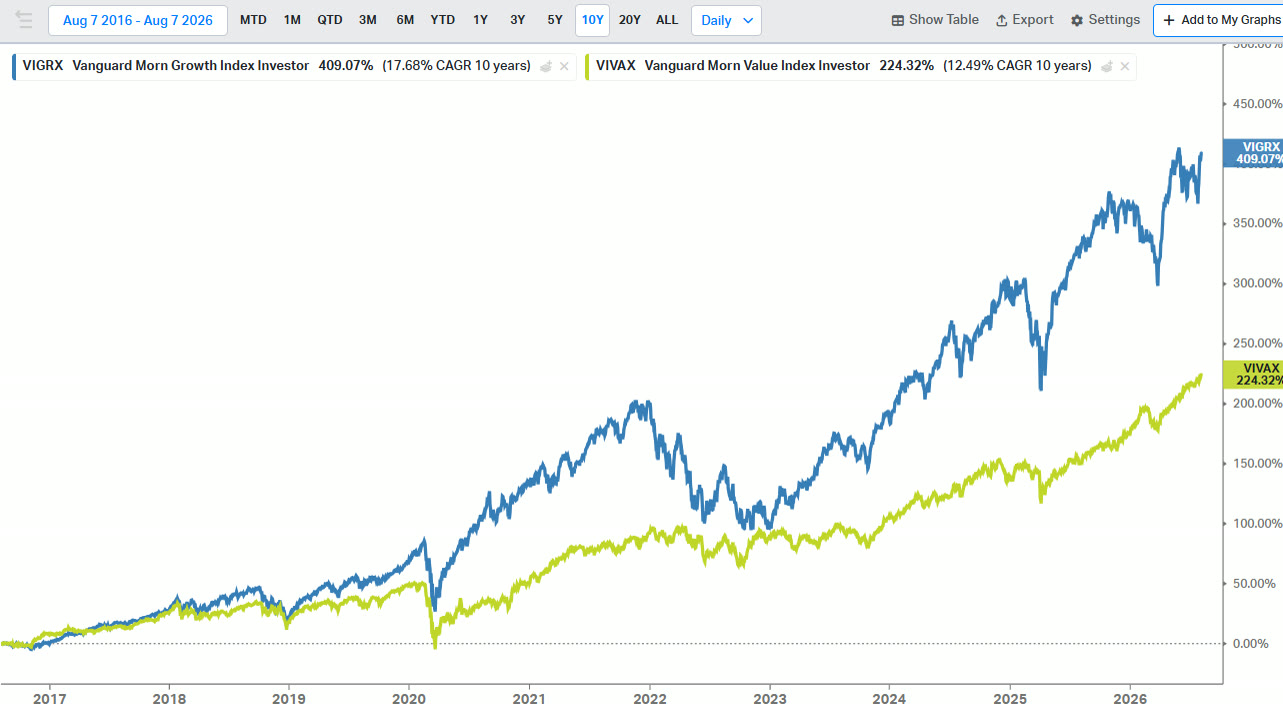
Growth (blue) versus value (yellow) over the last 10 years.
And investors are now heavily positioned toward growth. iShares investors have about $44 billion more betting on growth than value. Vanguard investors have about $38 billion more in growth than value. And QQQ, the darling of high-flying, tech-loving growth investors, has almost $400 billion more than SCHD, the prized possession of value-oriented dividend fans. These are just a few of many examples: all told, there’s well over a trillion dollars more in growth-oriented ETFs and mutual funds than value-oriented ones — the biggest industry-wide style bet of all time.
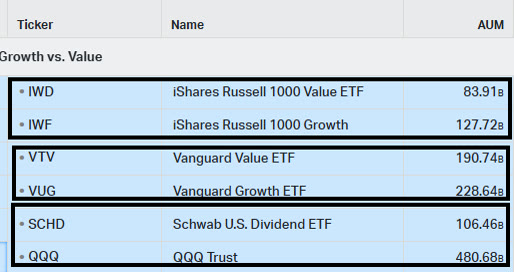
Assets in matched growth and value ETFs: growth wins every pairing.
So are growth stocks just better now, because nothing matters anymore besides AI and momentum? I doubt it, because we’ve seen this movie before.
We’ve Seen This Before: The Dot-Com Era
In the late 1990s, during the first tech bubble, value went through an almost identical stretch. The only thing that mattered was the internet. P/E ratios were “broken” because many internet companies had no earnings, so analysts switched to price-to-sales to justify riding the hype train, instead of asking what price might be too high for a company that wasn’t making any money.
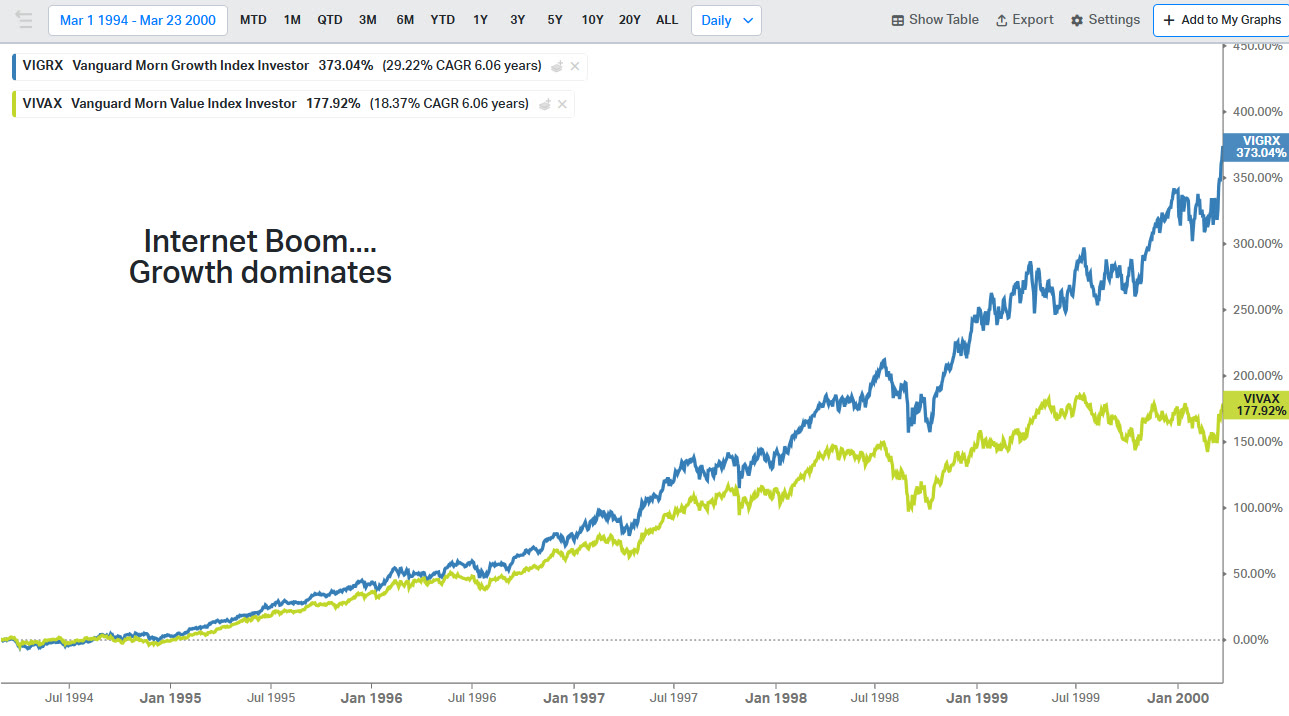
The 1990s internet boom: growth dominates.
Famous value investors were retiring, closing their funds or being called dinosaurs. Barron’s even ran a story in December 1999 headlined “What’s Wrong, Warren?”, suggesting Buffett might be losing his touch. Less than three months later, in March 2000, the internet bubble burst, and value went on an epic run while growth actually went negative — for a decade.
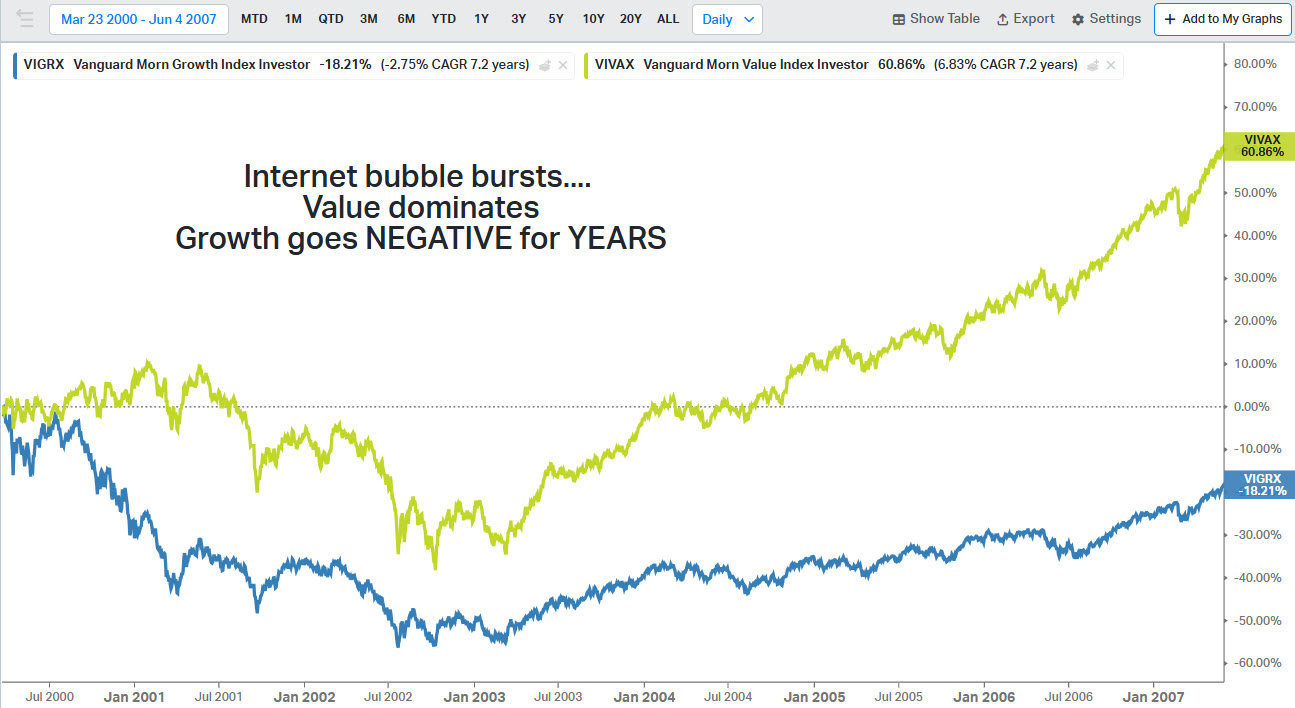
After the bubble burst: value dominates, and growth goes negative for years.
The Next Booms: Smartphones, COVID and AI
Then came the next internet boom. The iPhone launched in 2007 and 4G mobile internet in 2010. New technology plus cheap financing from ultra-low interest rates after 2008 created the golden age for internet businesses that everyone had expected 10 years earlier: social media, streaming, food delivery, ride hailing, cloud computing, e-commerce. All these users of the internet built businesses that couldn’t have existed without everyone having ultra-fast internet at their fingertips. Then, in 2020, rates fell even lower and digital growth sped up even more, since digital businesses were pretty much the only ones allowed to operate. Nobody was going to the movies, but everyone watched Tiger King on Netflix.
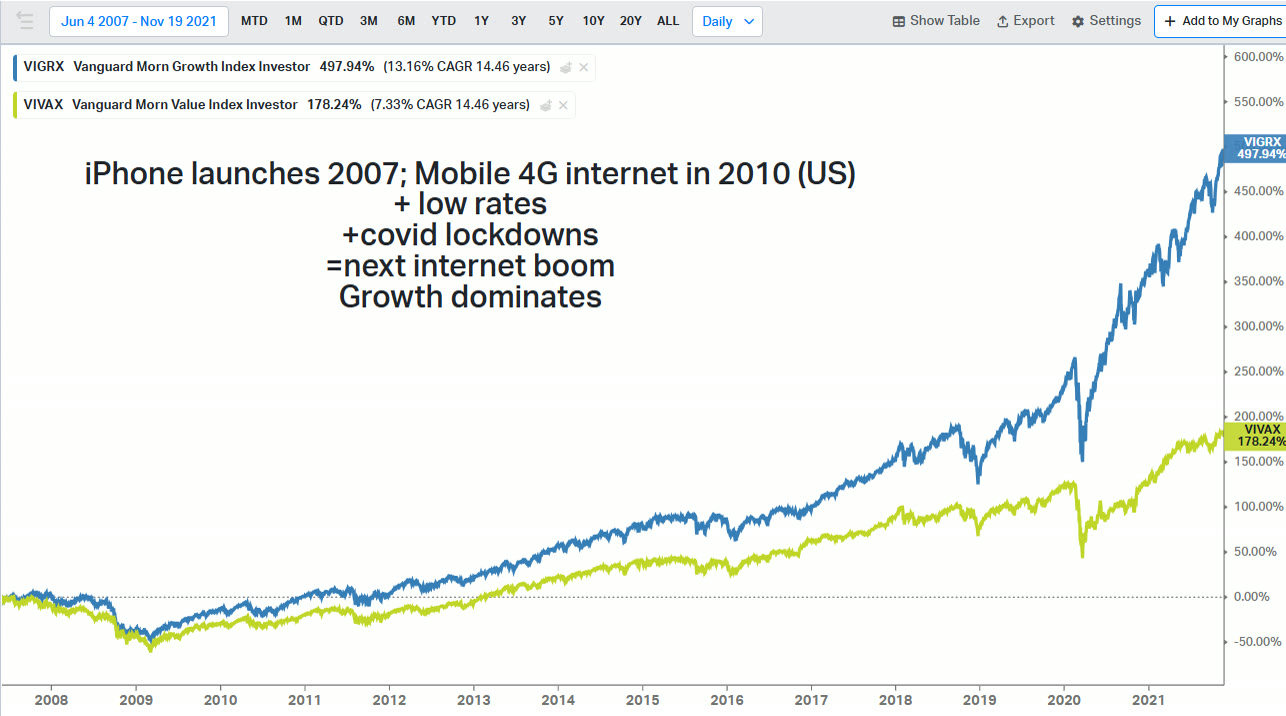
2007–2021: smartphones, low rates and lockdowns fuel the next internet boom, and growth dominates.
That lasted more than a decade, until COVID ended, and so did its effects on growth and value. Shortages met surging demand to get out and do things, while the rapid growth of digital everything quickly became a thing of the past. That led to high inflation, which led to rapidly rising interest rates, and the low-rate world that boosted growth stocks was over. Unprofitable businesses that relied on borrowing suddenly had to pay 8–10% interest instead of 3–5%, just as their growth rates were tumbling. Meanwhile, boring value-oriented banks, which could lend at those higher rates, suddenly looked much better — as did energy, aerospace and commodity companies that had been in the dumps when planes weren’t flying and factories were shut. Value beat growth by over 33% in just over a year. But the party ended faster than usual, because growth investors found a new shiny toy.
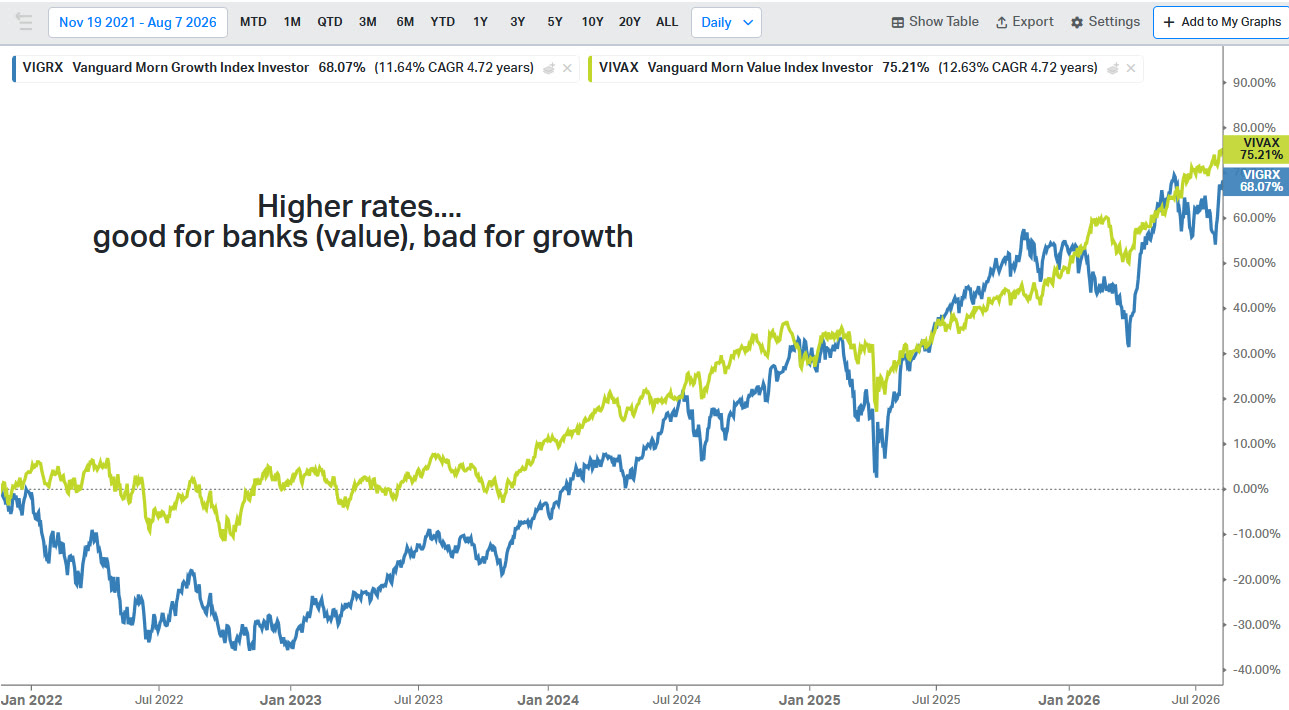
2022: higher rates help banks (value) and hurt growth.
This time it was ChatGPT. Now AI is the only thing that matters, just like the internet — so you should put all your money in AI companies, just like the late 1990s, right? And value investing is dead?
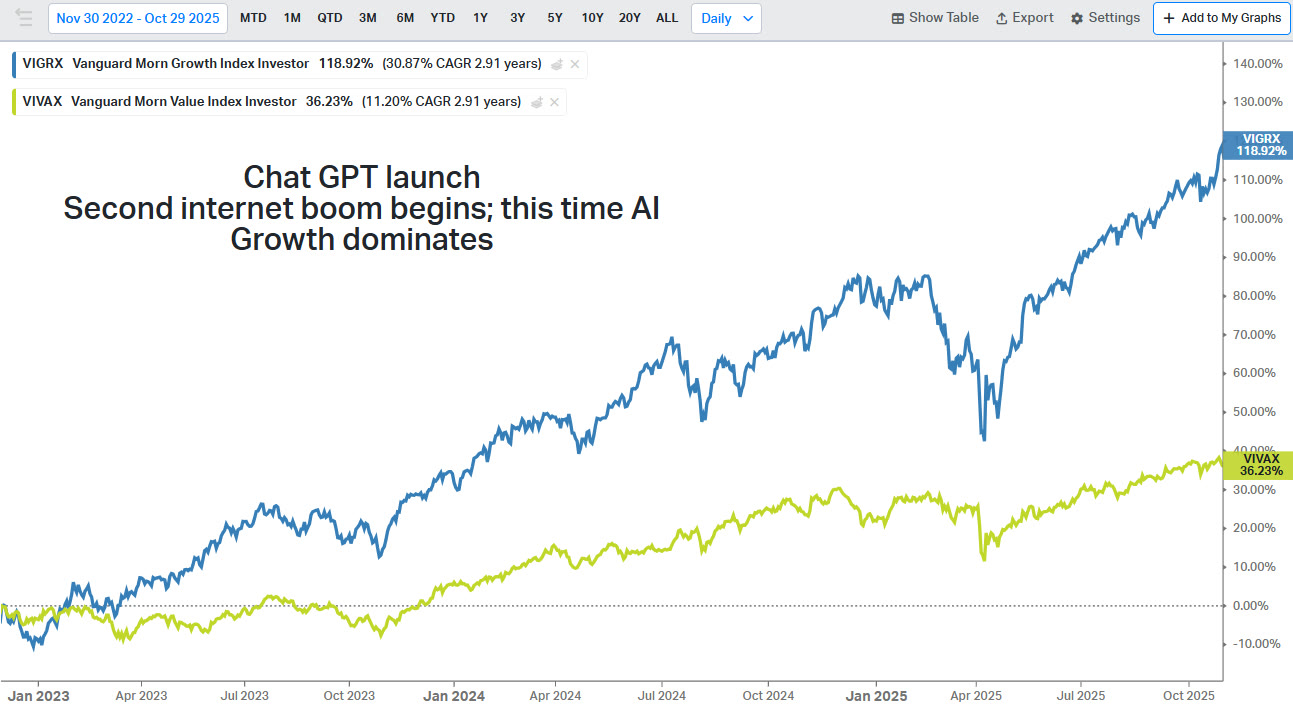
After ChatGPT: the second internet boom begins, this time AI, and growth dominates again.
Not so fast. Since October 2025, investors have started questioning how much return all this AI spending will actually generate for the hyperscalers. The Magnificent 7 have been essentially flat, and value has begun to dominate growth again. We published a video on exactly this three days before that peak, and that’s pretty much what’s been happening since.
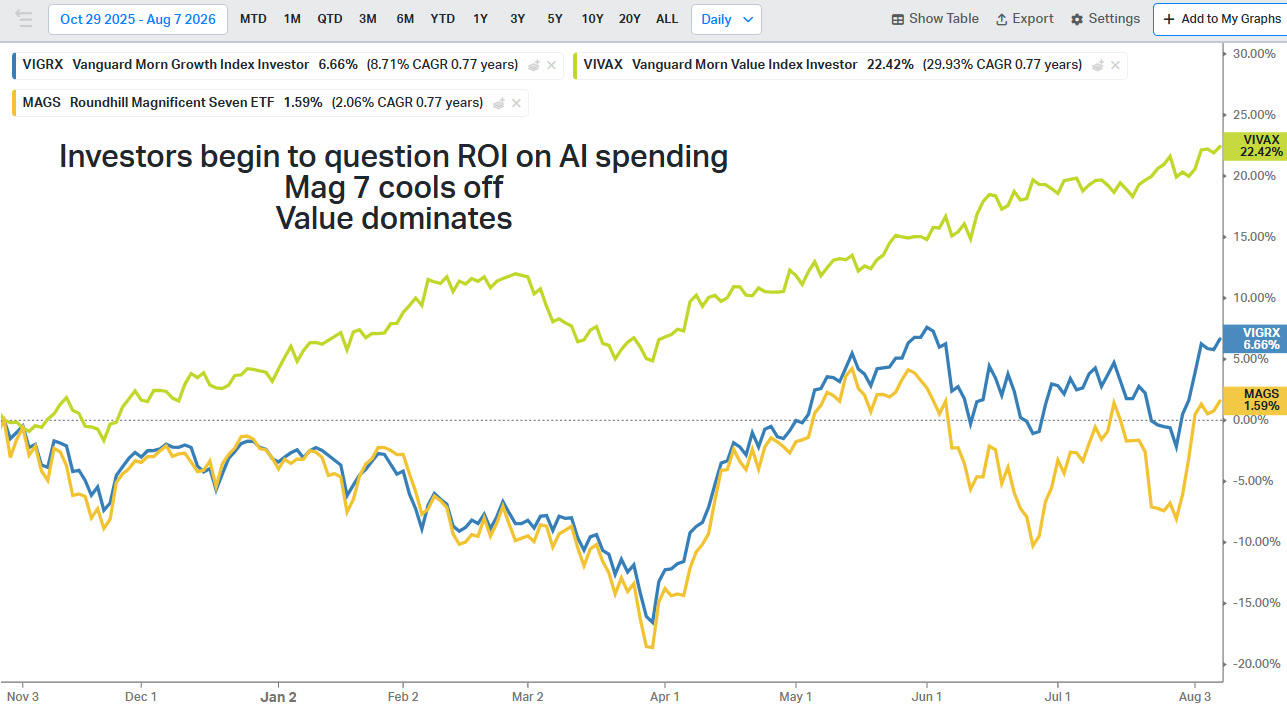
Since October 2025: investors question AI spending, the Mag 7 cools off, and value (yellow) dominates.
Short-Term Bounce or a Lasting Value Rally?
So is this another short-term reversal like 2022, or the start of a longer, more sustainable value rally like the one after the first tech bubble burst? The short answer is I don’t know, but I think it’s more likely to be the latter, and here’s why.
2022 was driven mostly by sharply rising interest rates, a shorter-term phenomenon, and that value rally ended because rates stopped rising and a massive new tech investment opportunity appeared with ChatGPT. The 2000–2007 environment was driven by a reset of expectations about how fast a hot new technology would grow, after they’d gotten way ahead of themselves. That’s much more similar to the setup today.
Forward P/E ratios — the price investors pay for each dollar of next year’s estimated earnings — hit a record gap between growth companies and value companies in 1999. The next-highest gaps came in 2021, right before the big 2022 value rally, and in 2025, right before the latest one.
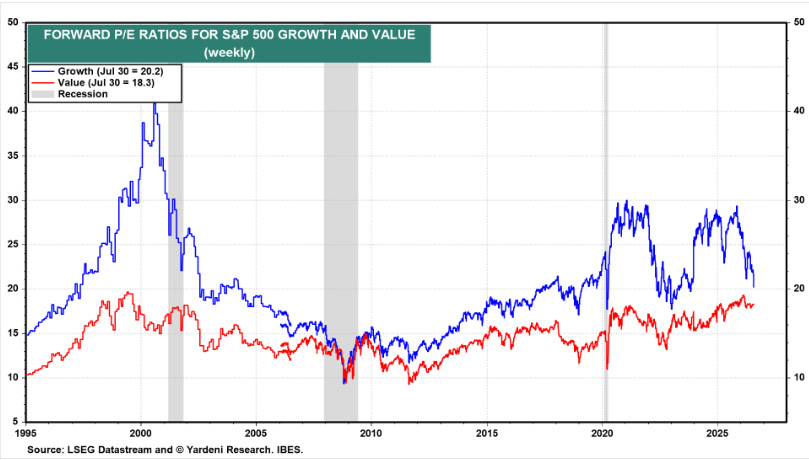
Forward P/E ratios: S&P 500 growth (blue) versus value (red). Source: LSEG Datastream and Yardeni Research.
You might be thinking, “OK Ethan, but the valuation gap is back to normal and nothing like 1999.” Yes — but that’s only half the equation. Remember how, in 1999, many internet companies weren’t profitable, so investors switched to price-to-sales? If there’s no “E” (earnings), a P/E can get pretty high. Today, P/E ratios for growth companies look reasonable because people expect runaway, record earnings growth from them compared with value companies. Remember, P/E compares today’s price with expected future earnings.
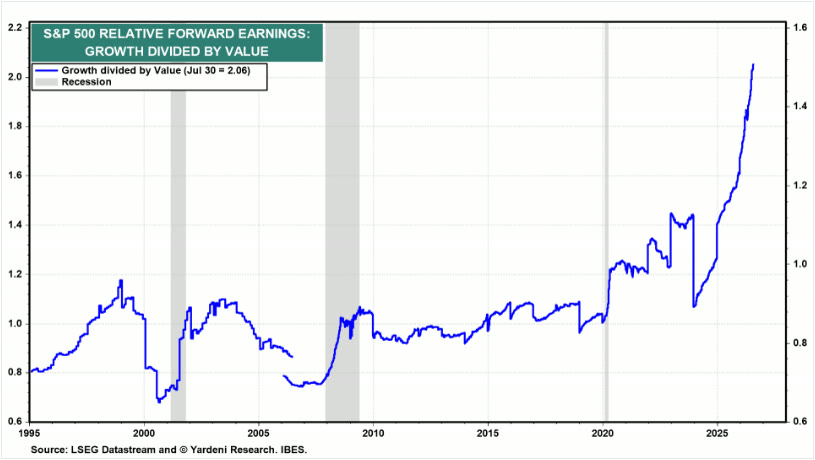
Growth’s expected earnings relative to value’s: a record high. Source: LSEG Datastream and Yardeni Research.
So valuations might not be crazy if growth companies grow earnings twice as fast relative to value companies as at any time in the last 30 years. But if they don’t meet those lofty expectations, prices are likely to come down, and that could lead to a more sustainable stretch of value beating growth.
Value Could Win Even If AI Doesn’t Bust
Here’s what almost no one is talking about, and what I think could be different this time: even if AI doesn’t have a big bust like the internet did, value companies could still go on a multi-year run against growth.
Remember the long rally for growth companies driven by all the users of the internet? There may well be new fast-growing companies built around AI too. But unlike the internet, which created demand for all kinds of new services from internet companies, AI is designed to replace a lot of those services. There’s a world where the big AI models get commoditized, the profits disappear, and the biggest long-term winners turn out to be the users of AI — health care companies, banks and plenty of other steady, low-growth businesses that suddenly find new ways to become more profitable.
It’s usually the enablers of a new technology that win early and its users that win in the long run. I don’t think that will change. But last time the users were mostly growth companies; this time I think a lot more of the value could be captured by — no pun intended — value companies.
A Theme We’ve Been Pounding the Table On
We’ve been making this general case on the channel for a while now:
December 19, 2024: we explained why small caps, also long out of favor, were due for a resurgence. So far that’s aged pretty well.
January 1, 2025: we explained why international stocks, also long out of favor, looked more attractive than they had in years. That one has aged even better: more than 20% excess return in a little over a year and a half.
A few months later: we argued biotech could be one of the biggest winners from AI, while everyone was still starry-eyed about the Mag 7. The biotech ETF I own has beaten the Mag 7 by over 40% since.
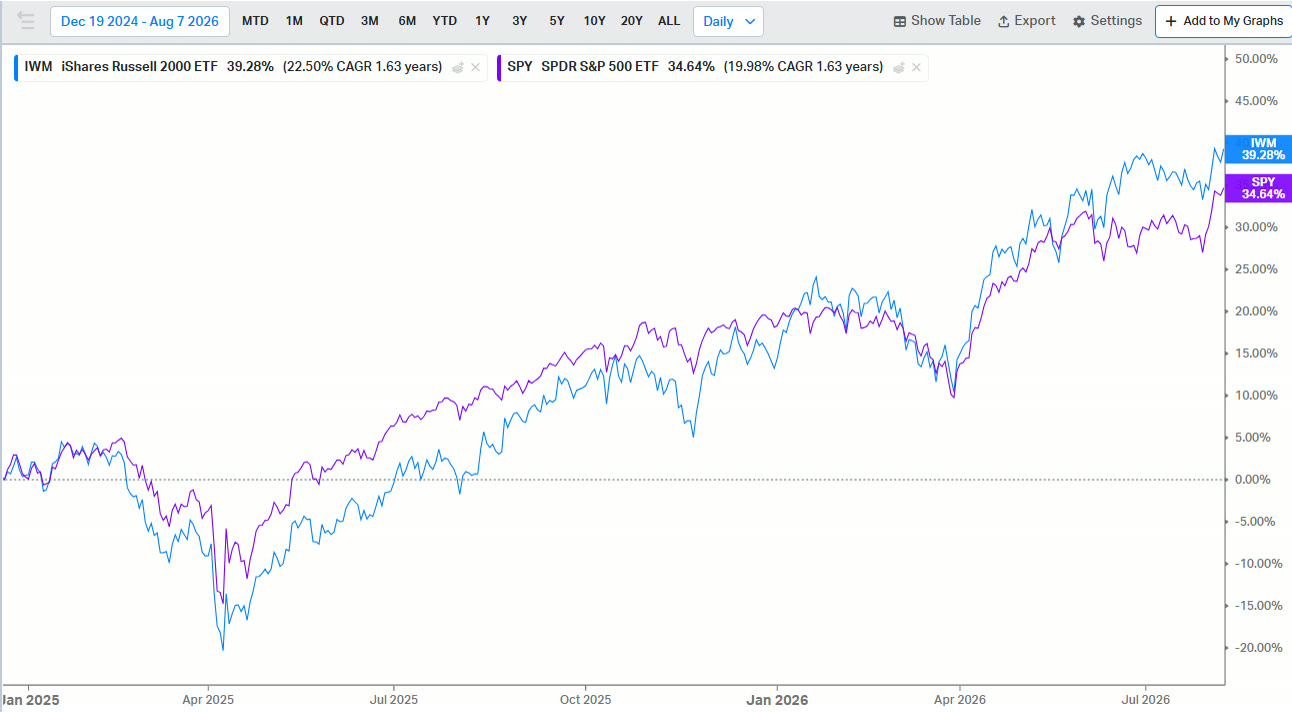
Small caps versus the S&P 500 since our December 2024 video.
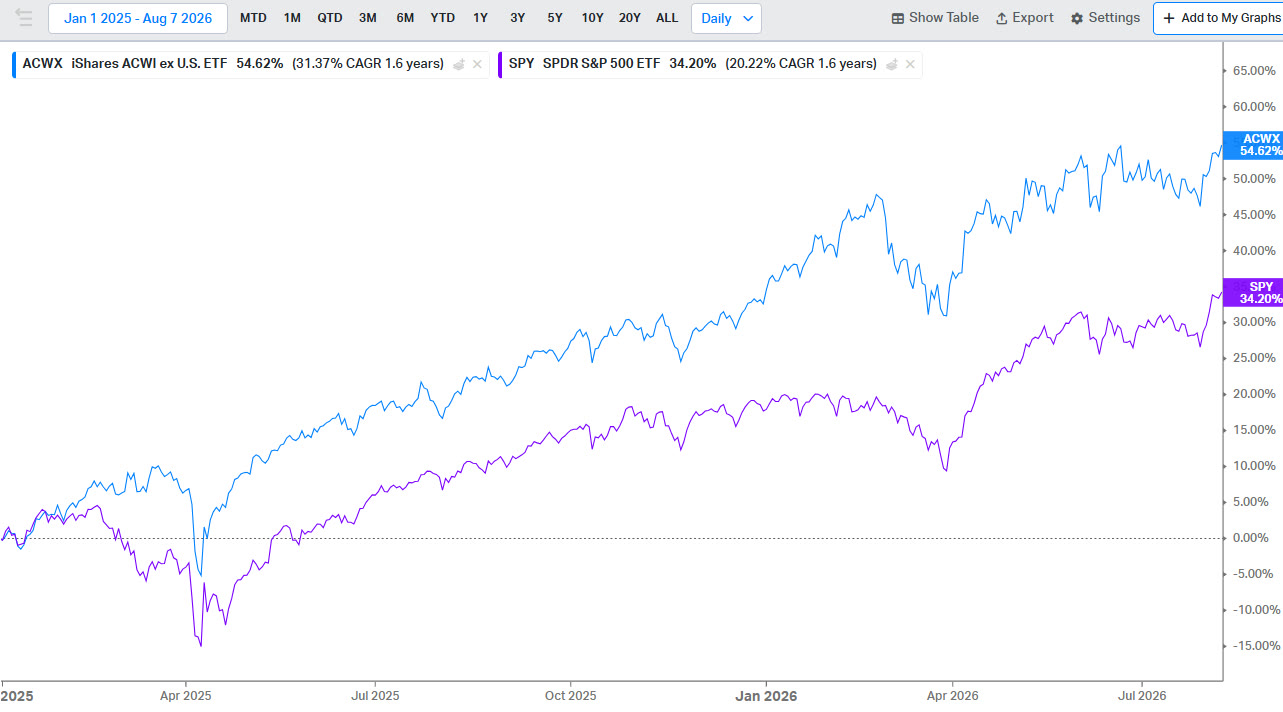
International stocks (blue) versus the S&P 500 (purple) since our January 2025 video.
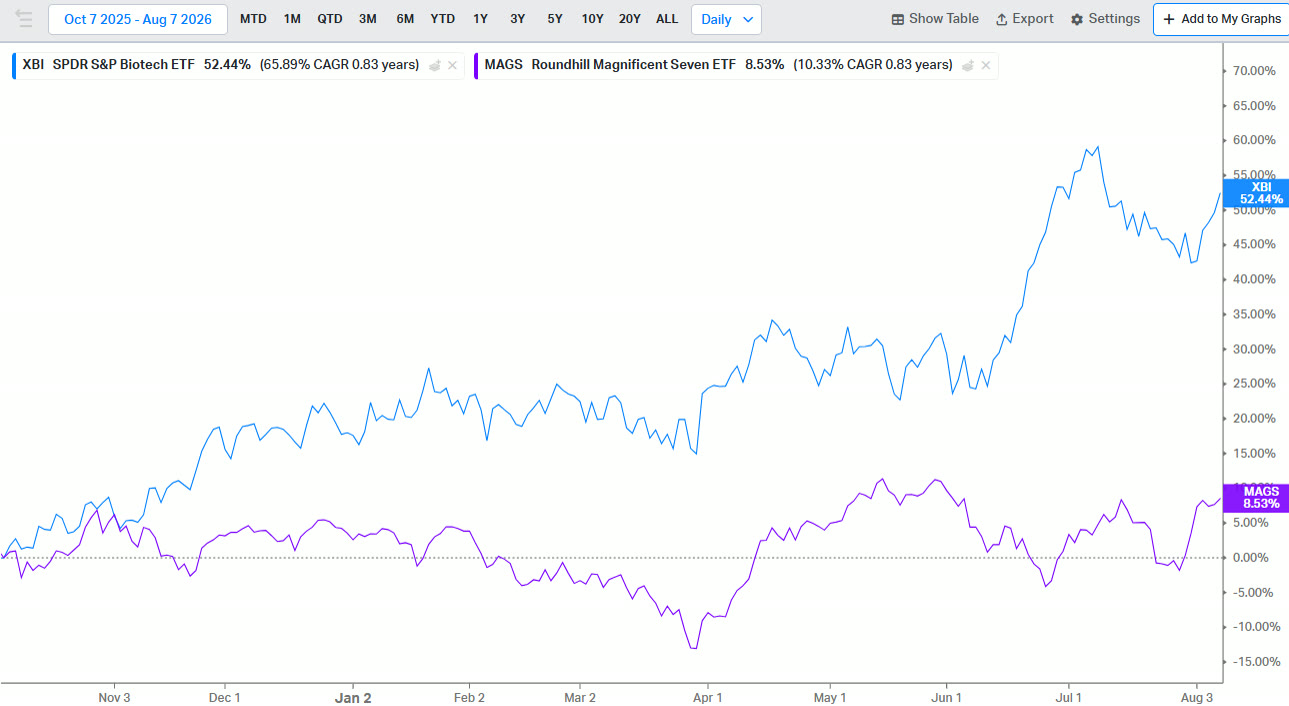
The biotech ETF (blue) versus the Mag 7 (purple) since that video.
I don’t have a crystal ball and I’m not always right. But I am an actual investment professional and chartered financial analyst, and I can promise that everything I say is well researched and what I actually believe. Everything we’re seeing suggests the next decade of market leadership could look very different from the last one. That’s not a short-term market call, and it’s not investment advice, but it is my honest professional opinion.
Next in the series: the top value ETFs.
Watch the Full Video
Want to Go Deeper? In the Fundamentals of Finance Academy, Ethan breaks down funds and current market events on a live call every other week, and members get the full archive of recorded calls. Learn more about the Academy →

This article is for educational purposes only and is not investment advice. Ethan is a CFA charterholder, but nothing here is a recommendation to buy or sell any security, and it does not take your personal situation into account. Past performance does not guarantee future results. Charts of index returns are for illustration only and don’t reflect the fees, expenses or taxes of any actual investment. Performance data and fund details are as of 08/10/2026 and will change; check each fund’s website for current figures.
