Small-Cap Investing Explained: Are Small-Cap Stocks Due for a Comeback?
About this article: This article is based on Ethan’s video, originally published on July 21, 2026. Because the written version was published later, returns, yields and fund details reflect data available at the time of the video and have likely changed since. Please check each fund’s website for current figures.
Factor Investing Series: you’re reading Part 3 of 11
Part 1: Momentum Investing Explained
Part 2: SPMO vs MTUM
Part 3: Small-Cap Investing Explained (you’re here)
Part 4: Top Small-Cap ETFs
Part 5: Value vs Growth Stocks
Part 6: Best Value ETFs
Part 7: Quality Factor Investing Explained
Part 8: Top International Quality ETFs
Part 9: Top U.S. Quality ETFs
Part 10: Minimum Volatility Investing Explained
Part 11: Best Low Volatility ETFs
Bigger isn’t always better — but in investing, bigger has been better for a long time. I think small caps could be due for a resurgence over the next 10 years, and in this part of our factor investing series I’ll explain why.
The Short Version
Small caps are smaller companies, and historically they’ve beaten large caps more often than not, even after adjusting for risk.
The last decade has been unusually good for large caps. By mid-2025 they’d beaten small caps by more than 6.5% a year for 10 years, close to the late-1990s extreme.
The main argument that small caps have stopped winning is the rise of passive investing. It’s logical, but the data doesn’t clearly support it.
Small caps own very different sectors than large caps, which could matter a lot if AI hype cools. This is a long-term view, not a short-term call.
I’m Ethan, a CFA charterholder and investment professional. The first two parts of this series covered momentum investing and the top momentum ETFs. This one covers small caps — small companies — which have been so successful at beating large caps over time that entire firms, like Avantis and Dimensional, have been built around the so-called small-cap premium (along with the value premium, which we’ll cover later).
What Are Small-Cap Investments?
Small-cap investments are stocks of smaller public companies, or funds that hold them. “Cap” is short for capitalization: a company’s market capitalization is how much it’s worth. So small caps are small companies and large caps are large ones. These aren’t small like your local laundromat, but they’re small enough that you probably haven’t heard of most of them. Each index defines them a little differently. S&P Dow Jones Indices, for example, calls the largest 500 companies large caps, the next 500 mid caps, and the 2,500 after that small caps.
Company size is also an investment factor. Factors are characteristics of companies that explain how they behave, and all of them have historically led to better risk-adjusted returns than a broad index like the S&P 500. They don’t all beat the market all the time, or in the same way, or in the same environments.
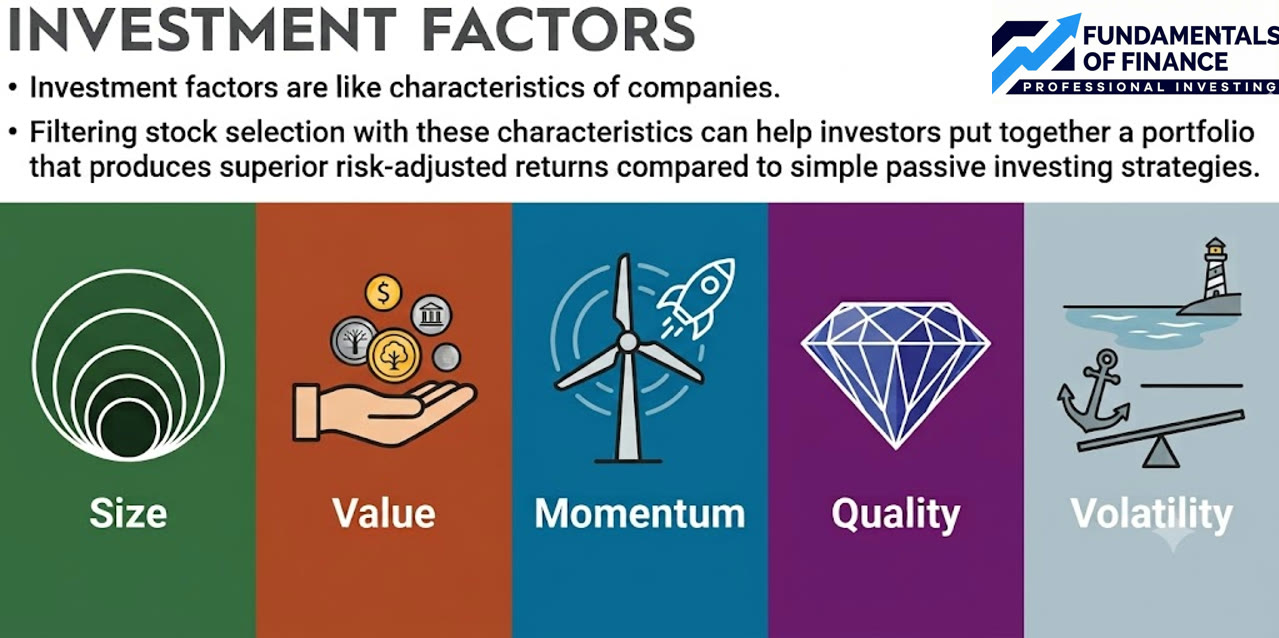
The size factor is the first of the five factors this series covers.
The size factor (or small-cap factor) means that over time, small caps have beaten large caps more often than not, even on a risk-adjusted basis.
Why Own Small Caps?
Their role in a portfolio is mainly long-term upside potential. Think about it: how many more locations can McDonald’s build? How many more burgers can it sell? It’s already global and well established; probably everyone you’ve ever met has tried McDonald’s.
Contrast that with In-N-Out. I don’t think it’s publicly traded, but if it were, it would probably be a small cap. Most of the country doesn’t have In-N-Out, and the rest of the world certainly doesn’t. So which has more growth potential from here: the giant that’s already established, or the small one still operating in less than half of the U.S.? The small one, right?
But while small caps have more long-term upside, they also have higher risk and tend to do poorly in stock market downturns. They’re not for everyone, and they’re not something I’d associate with short-term goals. This isn’t investment advice and it isn’t a short-term call. But for long-term investors — at least a five-year time horizon — I think small caps are an attractive complement to large caps that shouldn’t be overlooked, and I think they’re especially interesting right now.
Why Small Caps Have Lagged for a Decade
The last decade has been unusually good for large caps relative to small caps. Looking at rolling 10-year periods as far back as we can go, large caps beat small caps by a peak of about 7.5% a year in the 10 years ending March 1999 — basically the tech bubble. Then the bubble burst, and small caps went on a long run of much stronger returns as the big internet companies that had led the market all declined massively.
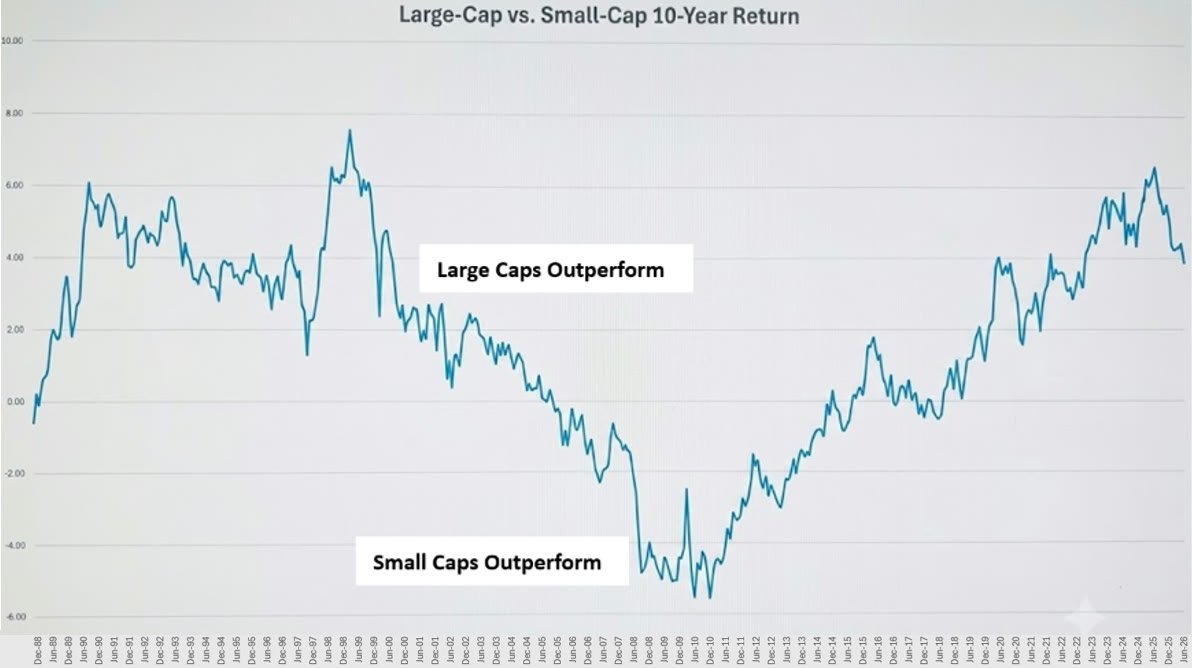
Rolling 10-year annualized total returns: S&P 500 minus Russell 2000. Above the middle, large caps (S&P 500) were ahead; below it, small caps (Russell 2000) were. Index returns don’t include fees or expenses, and you can’t invest directly in an index. Data as of 07/21/2026. Source: Morningstar.
At the peak in favor of small caps, they had beaten large caps by almost 6% a year over the 10-year periods ending in mid-2010 — almost exactly 10 years after the tech bubble burst in March 2000.
Now, we could be — and I think we are — in a new internet bubble, except this time it’s AI. The biggest companies have been capturing almost all of the S&P 500’s returns, we’re seeing headlines about record concentration at the top, and as of mid-2025 large caps had beaten small caps by more than 6.5% a year for 10 years. Sound familiar? There’s no guarantee we’ll see a similar reversal, but as Mark Twain is supposed to have said, history doesn’t repeat itself, but it often rhymes.
Have Small Caps Stopped Beating Large Caps?
The chief argument that they have is the rise of indexing. Most indexes are market-cap weighted, meaning the biggest share of the money goes to the biggest companies. SPY, for example, had about 7.8% of its assets in NVIDIA, 7.6% in Apple and 4.6% in Microsoft in mid-July 2026. There are 500 companies in it, so the smallest ones get basically nothing. And the share of investors choosing passive investing has been rising massively.
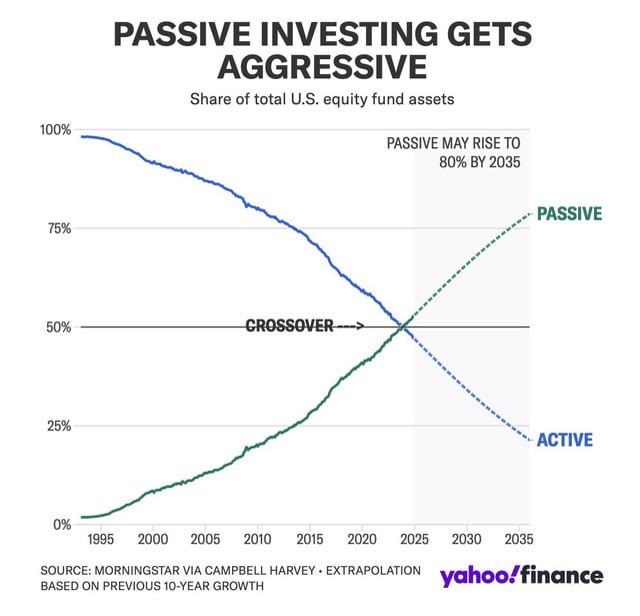
Passive funds’ share of U.S. equity fund assets has risen steadily for decades. Source: Morningstar via Yahoo Finance.
The argument goes like this. For every dollar a passive investor puts into something like SPY or VOO, the largest portion goes to the largest companies. Buying activity drives stock prices, so more buying in the largest companies pushes their prices up more than smaller companies’. As they grow, they become an even bigger part of the index, get an even larger share of the next dollar invested, and that feedback loop makes it harder and harder for small caps to beat large caps.
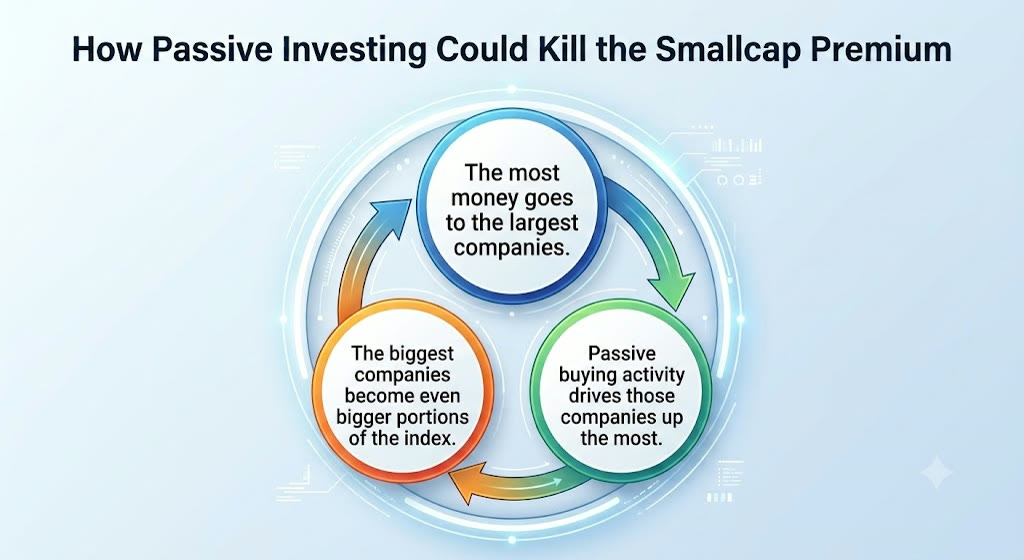
The feedback loop behind the “passive investing killed small caps” argument.
That’s perfectly logical, and it could have some impact over time. But the rise of passive investing has been remarkably steady — and it also covers that massive stretch of extreme small-cap outperformance in the 2000s. Comparing the steady passive line with the big swings in small-cap versus large-cap returns, I have a hard time concluding that one is driving the other.
I think a bigger driver of future returns is likely whether AI turns out to be a bubble. If it does, I don’t think any amount of passive 401(k) contributions will save big tech from a downturn. And when investors sell in a downturn and money flows out of passive funds, which companies get the most money pulled out? The biggest ones. It works both ways.
To be clear, I’m not claiming small caps will beat large caps in a stock market downturn. If I squint I can imagine a scenario where that happens, but it’s not common and I wouldn’t bank on it. Where I think small caps could do better is in the longer transition phase. That’s what we saw in the 2000s, as investors realized internet hype had gone too far and shifted their focus to the users of the internet rather than its providers — and to totally unrelated opportunities, like emerging markets, which also did very well then.
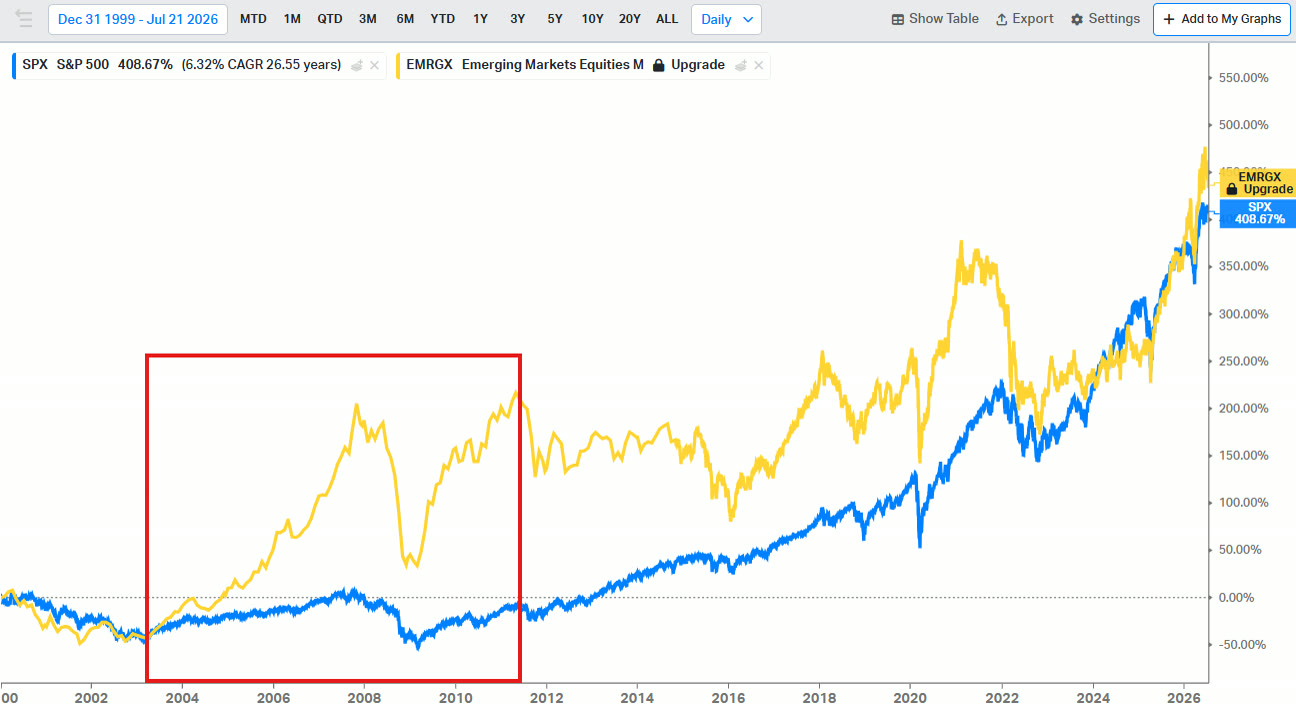
After the tech bubble, emerging markets (yellow) left the S&P 500 (blue) far behind through the 2000s.
The Underrated Difference: Sectors
I think the most underappreciated difference between small caps and large caps is their completely different sector makeup. As of July 16, 2026, large caps (measured by SPY) had 25 percentage points more tech exposure than small caps (measured by IWM). Not 25% in total; 25 points more. Large caps also had about 8 points more in communications, which includes AI-related companies like Meta.
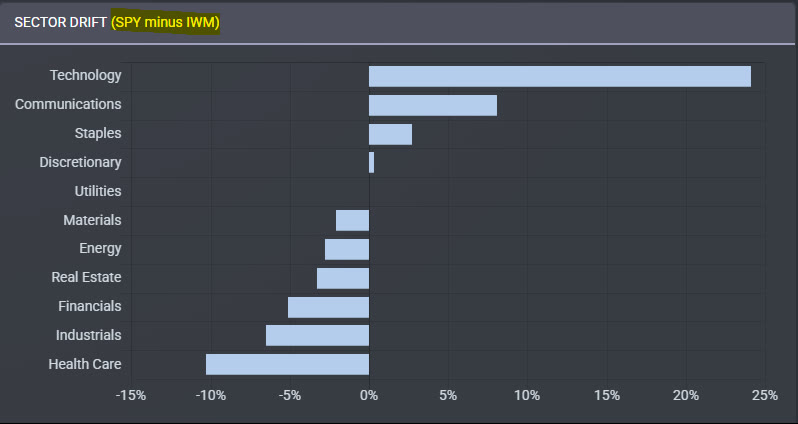
SPY minus IWM by sector: large caps are far heavier in tech; small caps in health care, industrials and financials.
Small caps had a lot more health care, industrials, financials and real estate — basically all the non-sexy, non-AI stuff the market has largely forgotten about. But guess what else those companies are? Potentially some of the biggest users of AI, to streamline their businesses and improve profitability. In fact, health care is small caps’ largest sector, and we argued in an earlier video that biotech could be one of the biggest long-term winners from AI. It wasn’t a short-term call, but I’d be remiss not to mention that the biotech ETF I own and highlighted there has beaten the Magnificent 7 by over 45% in less than a year since.
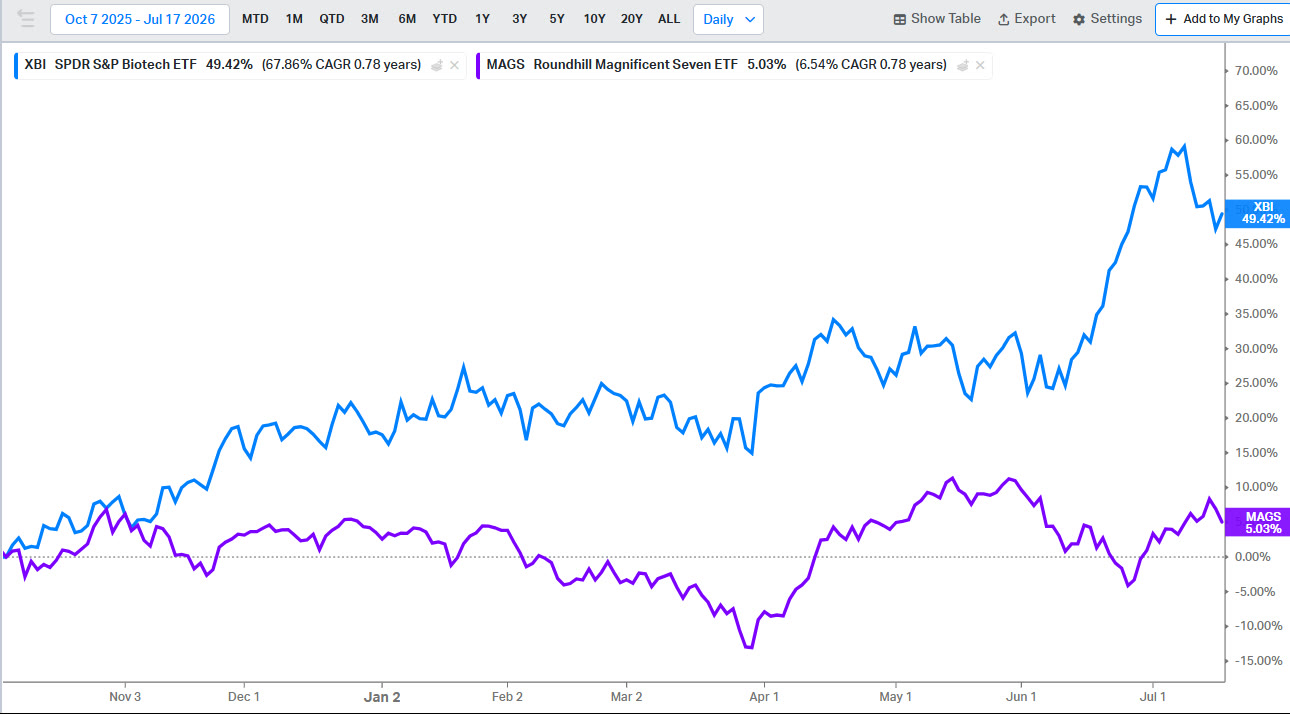
The biotech ETF (blue) versus the Magnificent 7 (purple) since that video.
What I Expect for Small Caps
I’m no oracle, but here’s what I expect:
Will they always beat large caps? No.
Will they still be volatile and probably struggle in most downturns? Yes.
Are they likely to have a resurgence against large caps over the next decade? I think there’s a good chance.
Market concentration is a double-edged sword. When the biggest companies make up a record share of the indexes, and they’re mostly exposed to the same risk — AI, in this case — that’s great while the good times last. But human nature is such that expectations eventually get ahead of themselves. We’re not going to wake up one day with every other industry gone and OpenAI and Alphabet running everything, just as the internet was a very real invention but Cisco and AOL don’t run the world today.
When expectations go too far and have to come down, things less exposed to the overhyped AI winners are likely to do better. And if AI really is what most of us think it is, then in the long run it may well be the users of it that build the next fast-growing businesses, the way Netflix and Meta did with the internet. Just like Netflix and Meta in 1999, many of those future AI winners are either too small for you to have heard of or don’t exist yet. If they exist, they’re probably small caps. If they don’t, they’ll probably start as small caps when they go public.
The bottom line: I think small caps are due for a rebound, and long-term growth investors shouldn’t be ignoring them. Looking at each factor’s performance over each of the last 15 years, small caps are the only factor that hasn’t ranked in the top three in the past 10 years — in fact, not since 2013. Every factor has its day in the sun sometimes, but small caps have had an unprecedented streak of being out of favor, and I think that’s likely to end. That’s not a short-term market call, and it’s not advice, but it is my honest professional opinion.
Next in the series: the top small-cap ETFs.
Watch the Full Video
Want to Go Deeper? In the Fundamentals of Finance Academy, Ethan breaks down funds and current market events on a live call every other week, and members get the full archive of recorded calls. Learn more about the Academy →

This article is for educational purposes only and is not investment advice. Ethan is a CFA charterholder, but nothing here is a recommendation to buy or sell any security, and it does not take your personal situation into account. Past performance does not guarantee future results. Charts of index returns are for illustration only and don’t reflect the fees, expenses or taxes of any actual investment. Performance data and fund details are as of 07/21/2026 and will change; check each fund’s website for current figures.
