The Best Value ETFs Reviewed by a CFA Charterholder (And Why SCHD Isn't My #1)
About this article: This article is based on Ethan’s video, originally published on August 19, 2026. Because the written version was published later, returns, yields and fund details reflect data available at the time of the video and have likely changed since. Please check each fund’s website for current figures.
Factor Investing Series: you’re reading Part 6 of 11
Part 1: Momentum Investing Explained
Part 2: SPMO vs MTUM
Part 3: Small-Cap Investing Explained
Part 4: Top Small-Cap ETFs
Part 5: Value vs Growth Stocks
Part 6: Best Value ETFs (you’re here)
Part 7: Quality Factor Investing Explained
Part 8: Top International Quality ETFs
Part 9: Top U.S. Quality ETFs
Part 10: Minimum Volatility Investing Explained
Part 11: Best Low Volatility ETFs
Some people might look at a car and say, “That $150,000 car used to be $250,000 and it’s barely been used — what a great value!” Others would say, “Are you crazy? Who pays $150,000 for a car?” Just as there are different ways to define value in life, there are different ways to define it in investing. In this part of our factor investing series, I cover the top ETFs across three broad value categories: traditional value, dividend value and intrinsic value.
If you’re new here, I’m Ethan, a chartered financial analyst with more than a decade of experience evaluating funds for a living. So far the series has covered momentum and the top momentum ETFs, small caps and the top small-cap ETFs, and value investing. Now, the top value ETFs.
The Short Version
Traditional value: PRF (Invesco RAFI US 1000) is my pick over the 0.04% index funds. It measures value better, and it has delivered far more since 2005.
Dividend value: SCHD is solid, but I prefer CGDV in the U.S., and CGDG, which is global and focused on dividend growers, overall.
Intrinsic value: the “truest” value investing. Two favorites are American Funds EUPAC (or the ETF CGXU) and Vanguard PRIMECAP.
Traditional Value ETFs
“Traditional value” is my term for the most common, standard approach, and it’s what most indexes and index funds do. Take a valuation metric like the P/E or P/B ratio and pick the stocks with the lowest ones. Simple as that.
The Russell 1000 Value is probably the most common value index; it’s the basis for IWD, VONV and VRVIX. It focuses on companies with low price-to-book ratios, low forecasted earnings growth and low historical sales growth. Why you’d want to target slow-growing companies, I don’t know, but over $100 billion of people’s money is doing it. S&P builds its value index slightly differently, using price-to-book, price-to-earnings and price-to-sales. The details differ, but directionally these approaches are all the same: they focus on stocks that are cheap on some fairly arbitrary metric.
Two Flaws in Traditional Value
I’ll still cover the top ETFs here, because you may disagree with me, but in my opinion this approach has two major flaws.
It only looks backward, or one year forward. A P/E ratio usually compares today’s price with last year’s earnings or next year’s estimate. But companies will be around far longer than a year, and most of their value often comes from earnings more than a year away. If two companies are expected to earn the same next year, but one will then grow 30% a year and the other 10%, which would you rather own? The faster grower, right? It should cost more today, but basic ratios won’t reflect that.
The metrics don’t work for every kind of company. When a company buys another for more than its assets are worth, the difference goes on its balance sheet as “goodwill,” roughly the value of the brands. Say one soda company buys a chip company, a pretzel company and a cracker company: lots of goodwill. Another soda company builds its own equally successful chip, pretzel and cracker brands: no goodwill, so a much lower book value. If both trade at the same price, price-to-book makes the second company look far more expensive, even though it really isn’t.
The Cheap Index Options
With that disclaimer out of the way, I think the purest form of traditional value comes from a passive ETF that screens for value and calls it a day. The cheapest options are the iShares Core S&P U.S. Value ETF and the SPDR Portfolio S&P 500 Value ETF (essentially the same thing), the iShares Morningstar Value ETF (different, but with an identical 10-year return to the SPDR one), and the Schwab U.S. Large-Cap Value ETF. All cost 0.04%, and I don’t think the differences are worth mentioning.
My Pick: PRF, the Invesco RAFI US 1000 ETF
Those aren’t my winner, though. I think the Invesco RAFI US 1000 ETF (PRF) is about as compelling as it gets. Yes, it costs 0.34% instead of 0.04%, and if that rules it out for you, that’s fine; this is education, not advocacy. But hear me out: I think they’ve built a better mousetrap.
Instead of standard valuation metrics and market cap, PRF ranks companies on fundamental measures: book value plus intangibles, adjusted cash flow, adjusted sales, dividends and buybacks. In other words, in their view, a better way to measure value than the traditional metrics. Then, instead of weighting by market cap (the size of the company), it weights by fundamental size, measured over five-year periods rather than whipping the portfolio around every quarter based on short-term moves.
That creates a built-in buy-low, sell-high discipline: it buys more of a company when its price falls but its fundamentals stay strong, instead of doing what market-cap-weighted indexes do — selling as prices fall, with no regard for whether the move is justified, because only size matters. So how has it done?
Looking at rolling five-year returns since PRF’s inception in 2005 (December 2005 to December 2010, January 2006 to January 2011, and every five-year period since), PRF has beaten all three of the other ETFs almost every single time. It tends to do a little worse in downturns and better in recoveries.
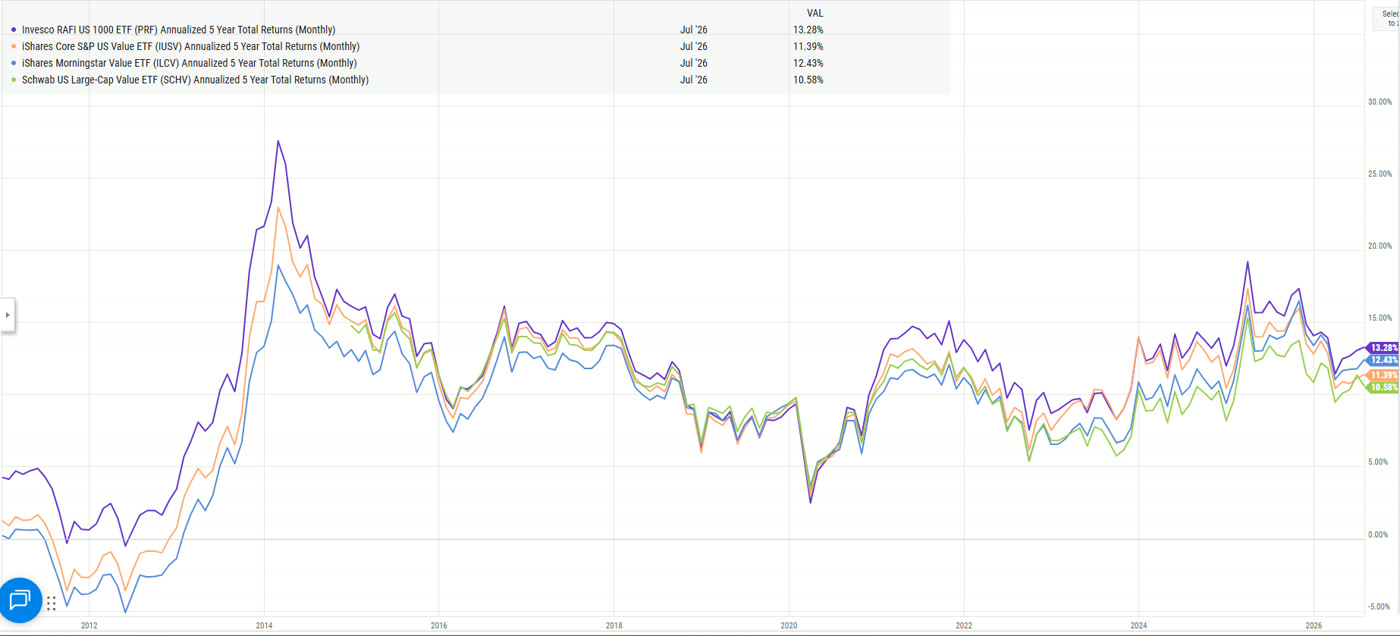
Rolling five-year returns since 2005: PRF (purple) versus three low-cost value index ETFs.
Over the full period, it’s produced a much higher return than the other three, roughly 1.5 to 2 times your initial investment more in total return since the end of 2005. The future is uncertain, but when I think about where my odds of success look highest among traditional value ETFs, I’d rather pay the extra few basis points for PRF.
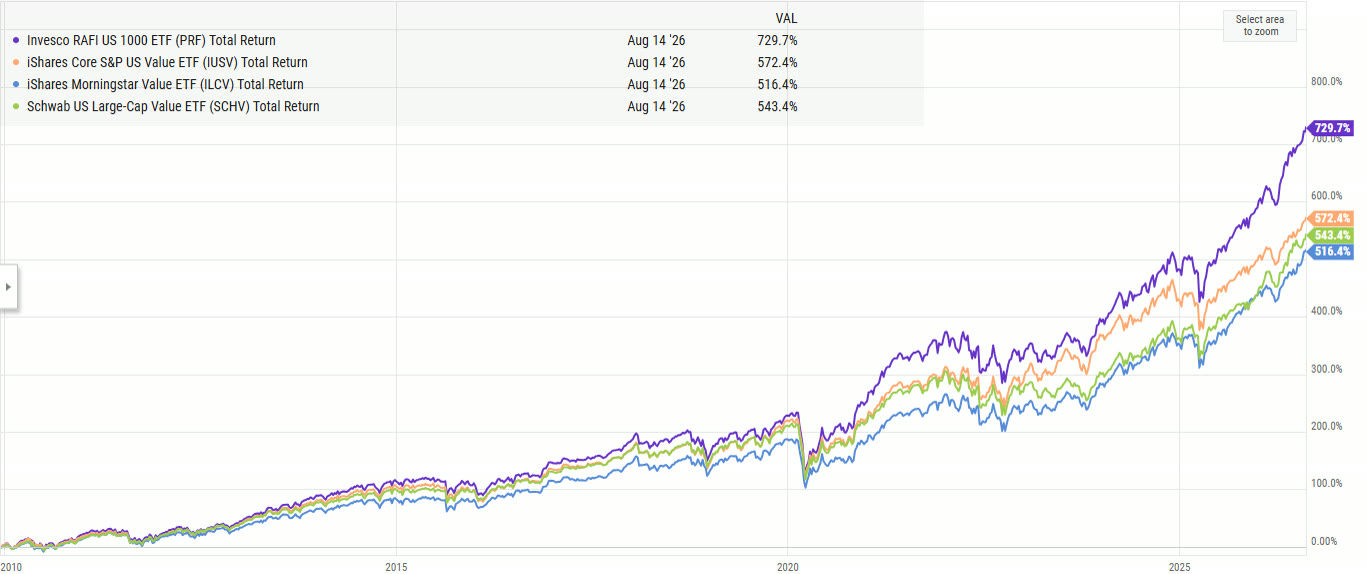
Cumulative returns since 2005: PRF (purple) well ahead.
Dividend Value ETFs
The second category is dividend value. We could do a whole separate video on dividend ETFs (and we’ve covered many already), but the idea here is that focusing on companies that pay high dividends tends to result in a portfolio that leans toward the value style.
Not all value companies pay dividends, and not all dividend payers lean value, but there’s a lot of overlap. Companies with lots of growth opportunities tend to reinvest most of their profits to grow more, so they’re less likely to pay dividends and more likely to be growing earnings fast — growth companies. Companies with fewer growth opportunities often have cash left over for dividends, and they’re often cheaper because they’re growing more slowly — value companies.
Dividend payers tend to be stable, steady-Eddie investments. They don’t have as much upside as high-growth companies, because they’re not growing as fast, or as deep-value companies, because their outlook isn’t as likely to change dramatically. But they tend to hold up better in downturns, because investors hate uncertainty. Of the three sources of return, earnings growth is uncertain in a downturn, and valuations usually fall under selling pressure. Dividends, though, tend to be steady, because companies hate cutting them: a cut signals they can’t afford it, and investors run. Growing a dividend signals confidence. When the market is up 20% in a year, a 3% dividend isn’t exciting. When the market is flat or down, that 3% starts to look pretty good.
SCHD vs CGDV
I know the one many of you want me to pick is SCHD, the Schwab U.S. Dividend Equity ETF and the internet’s baby. I’m not going to call this baby ugly: it costs only 0.06%, has a solid yield and has been consistently value-oriented. It’s everything a dividend value investor could want. I just don’t think it’s the best-looking baby. (OK, maybe this analogy has reached its limit.)
SCHD is solid, but I think there are better options, at least for my preferences. One we highlighted back in 2024 is CGDV, the Capital Group Dividend Value ETF, which captures this concept so well it’s in the name. It has absolutely crushed SCHD since that video. We weren’t making a two-year prediction, but I’d be remiss not to mention it.
CGDV isn’t as purely value-oriented as most traditional value funds or SCHD; it’s more expensive (0.33%) because it’s actively managed, and it has a lower yield. But it’s backed by the pedigree of Capital Group, the unofficial kings of dividend investing.
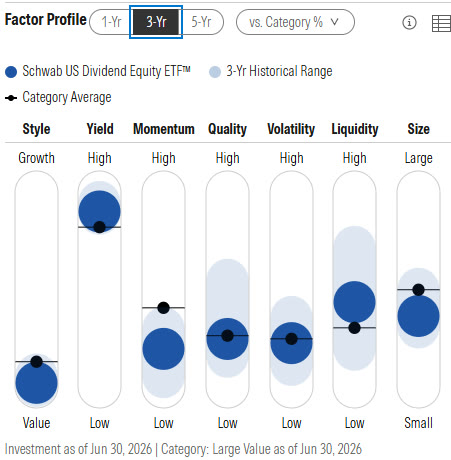
SCHD’s factor profile: strongly value-tilted with a high yield. Source: Morningstar.
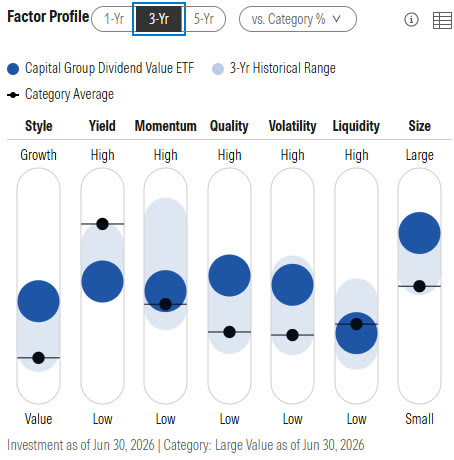
CGDV’s factor profile: less purely value-oriented, with a lower yield. Source: Morningstar.
Capital Group’s U.S. dividend-oriented mutual funds — Washington Mutual Investors Fund, The Investment Company of America and American Mutual Fund — all have histories of over 50 years beating the S&P 500 with lower volatility.
My Overall Winner: CGDG
On the U.S. side, CGDV would be my winner, but it’s not my overall winner. That’s CGDG, the Capital Group Dividend Growers ETF, which actually hasn’t done as well as CGDV since its 2023 launch. But if you want someone who just looks at past results and assumes whatever did best recently will always do best, you’ve come to the wrong place, because that’s not how professionals invest. (Well, sadly some of them kind of do, but that’s a story for another day.)
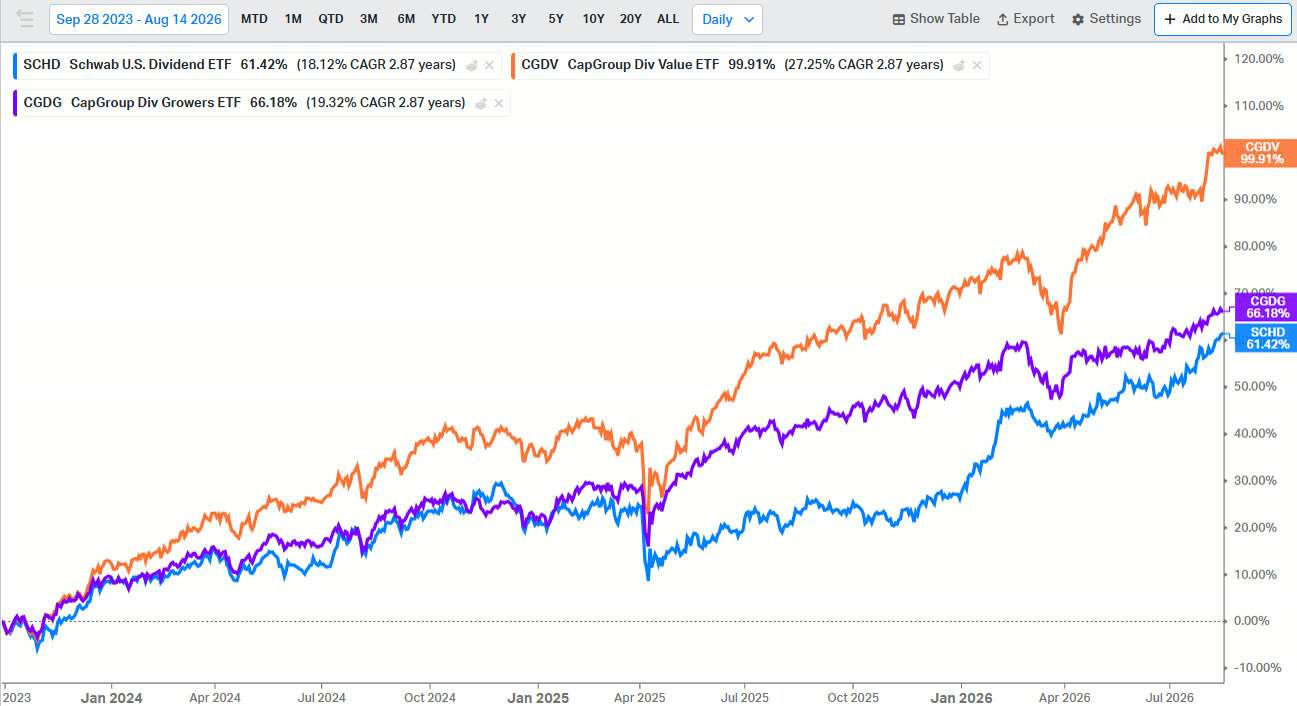
Since 2023: CGDV (orange), CGDG (purple) and SCHD (blue).
They’re not perfectly comparable, because CGDG is global, so it will sometimes have a big advantage or disadvantage against CGDV and SCHD simply depending on whether international markets are beating U.S. markets. But in the long run, I like it: if you’re going with an active manager focused on dividends, why not let them find the best ones anywhere in the world, especially since most high-dividend companies are outside the U.S.? It’s the same firm and the same investment process as CGDV, with a global reach and a specific focus on companies that consistently grow their dividends. It costs 0.47%.
If you want something cheaper, passive and higher-yielding, SCHD has an international sibling, SCHY. It hasn’t done quite as well as CGDG, but it’s been close, and it’s been at a disadvantage since it’s purely international while CGDG is global.
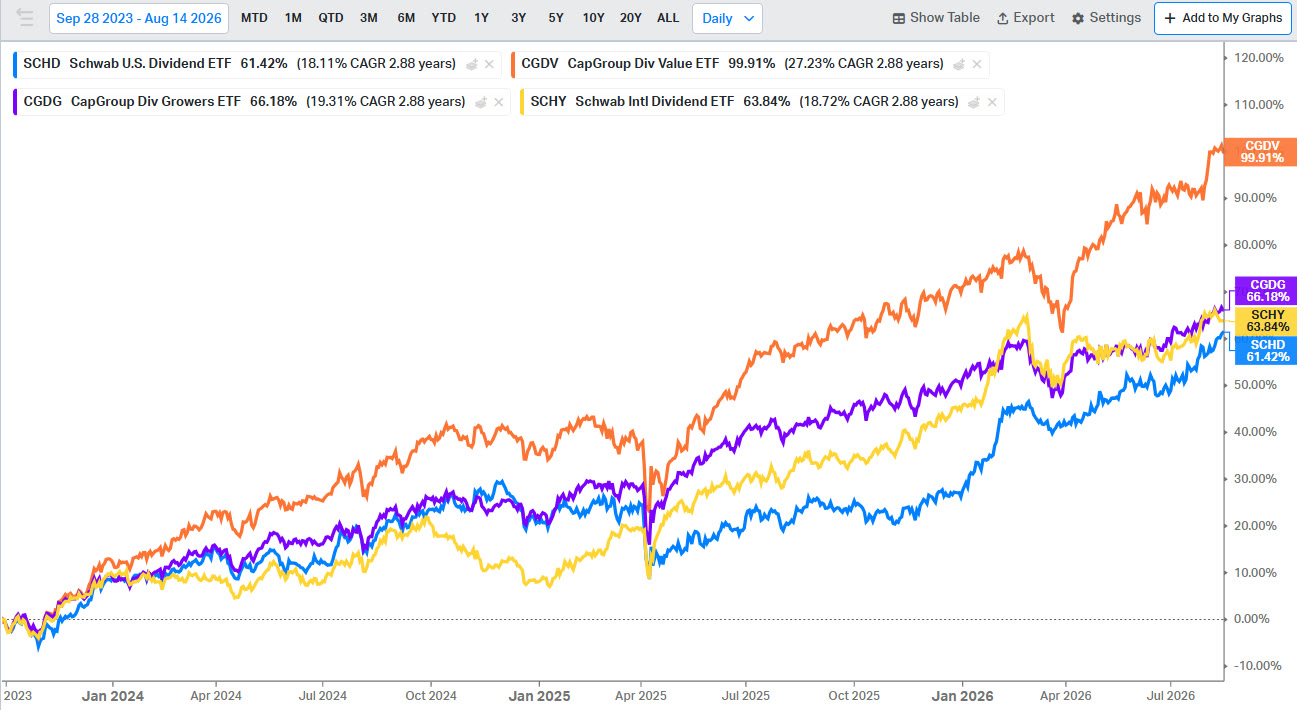
Adding SCHY (yellow), SCHD’s international version.
Intrinsic Value: The Truest Form of Value Investing
The third type is intrinsic value investing. Ask the market and it isn’t value investing at all; only stocks that are cheap on arbitrary, flawed metrics count. Ask me, and it’s the only true value investing. Intrinsic value is what you think a company should be worth after analyzing it. It factors in every source of return and projects them into the future, which lets you compare fast growers, slow growers, tech companies, oil companies, big dividend payers and non-payers on a level playing field, and focus on where the best value really is without boxing yourself into any one metric.
Who uses this method? Basically all of the most successful investors in history, including the one you all know: Warren Buffett. He’s widely considered a value investor, but he didn’t blindly buy the cheapest companies. He famously said it’s far better to buy a wonderful company at a fair price than a fair company at a wonderful price.
It’s hard to name a “best” intrinsic value ETF, since almost every fundamental, bottom-up active manager thinks about intrinsic value, and even excluding funds boxed into a style there are thousands of mutual funds and ETFs. There is no single best one, so here are a couple of my favorite funds in the industry.
International: American Funds EUPAC (and CGXU)
From a style perspective, American Funds EuroPacific Growth (EUPAC) has leaned a bit toward growth over the last five years, though it’s been drifting back toward the middle lately, and as far as I know it has no style constraints. Nobody would call it a traditional value fund. It’s run by 12 portfolio managers with different styles, so you get 12 different intrinsic value assessments in one fund. We covered it in an earlier video: it has a 99% success ratio against its benchmark across all rolling 10-year periods since its 1984 inception. Capital Group also has an ETF managed in a similar way by some of the same people, with the ticker CGXU.
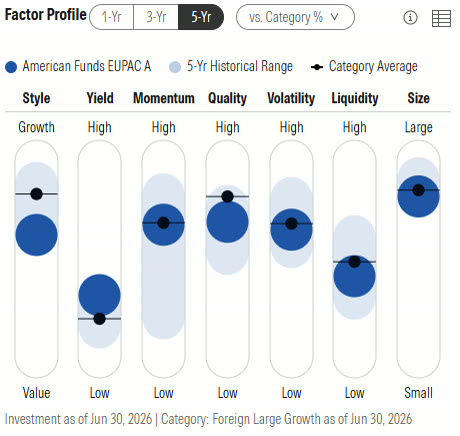
EUPAC’s factor profile. Source: Morningstar.
U.S.: Vanguard PRIMECAP
On the U.S. side, I love Vanguard PRIMECAP, which also focuses on intrinsic value rather than fitting neatly in a style box. It uses essentially the same multi-manager process as Capital Group’s American Funds, and these are among the only active managers that have consistently beaten their passive benchmarks in most or all of the funds they’ve ever launched. I don’t think that’s a coincidence.
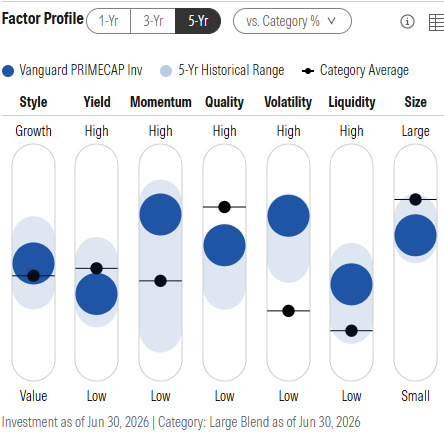
Vanguard PRIMECAP’s factor profile. Source: Morningstar.
There’s no ETF version yet, but it comes at a ridiculously cheap 0.35% expense ratio, or even less for those who can meet a $50,000 minimum. PRIMECAP has filed to launch its first ETF and ETF share classes of its mutual funds, so an ETF version of this or something like it could be coming soon. I’ll be watching.
How the Value Picks Compare
Traditional value: PRF, Invesco RAFI US 1000 (0.34%). Fits an investor who wants a rules-based value approach with a better yardstick than simple ratios. The cheapest index alternatives cost 0.04%.
Dividend value (U.S.): CGDV, Capital Group Dividend Value (0.33%), actively managed. SCHD (0.06%) is the low-cost passive alternative.
Dividend growth (global): CGDG, Capital Group Dividend Growers (0.47%), my overall winner. SCHY is the cheaper passive international alternative.
Intrinsic value: American Funds EUPAC or the ETF CGXU (international), and Vanguard PRIMECAP (U.S., 0.35%).
Next in the series: quality, and how to measure it.
Watch the Full Video
Want to Go Deeper? In the Fundamentals of Finance Academy, Ethan breaks down funds and current market events on a live call every other week, and members get the full archive of recorded calls. Learn more about the Academy →

This article is for educational purposes only and is not investment advice. Ethan is a CFA charterholder, but nothing here is a recommendation to buy or sell any security, and it does not take your personal situation into account. Past performance does not guarantee future results. Charts of index returns are for illustration only and don’t reflect the fees, expenses or taxes of any actual investment. Performance data and fund details are as of 08/19/2026 and will change; check each fund’s website for current figures.
