Momentum Investing Explained: Are SPMO and MTUM Headed for Breakout or Bust?
Momentum investing has been crushing the S&P 500 for decades, and it’s now easy to access through ETFs like SPMO and MTUM. But why does it work? Have recent market changes made it even more powerful? Or is its magical run about to come to an end? That’s what we’ll explore in the first part of our series on factor investing.
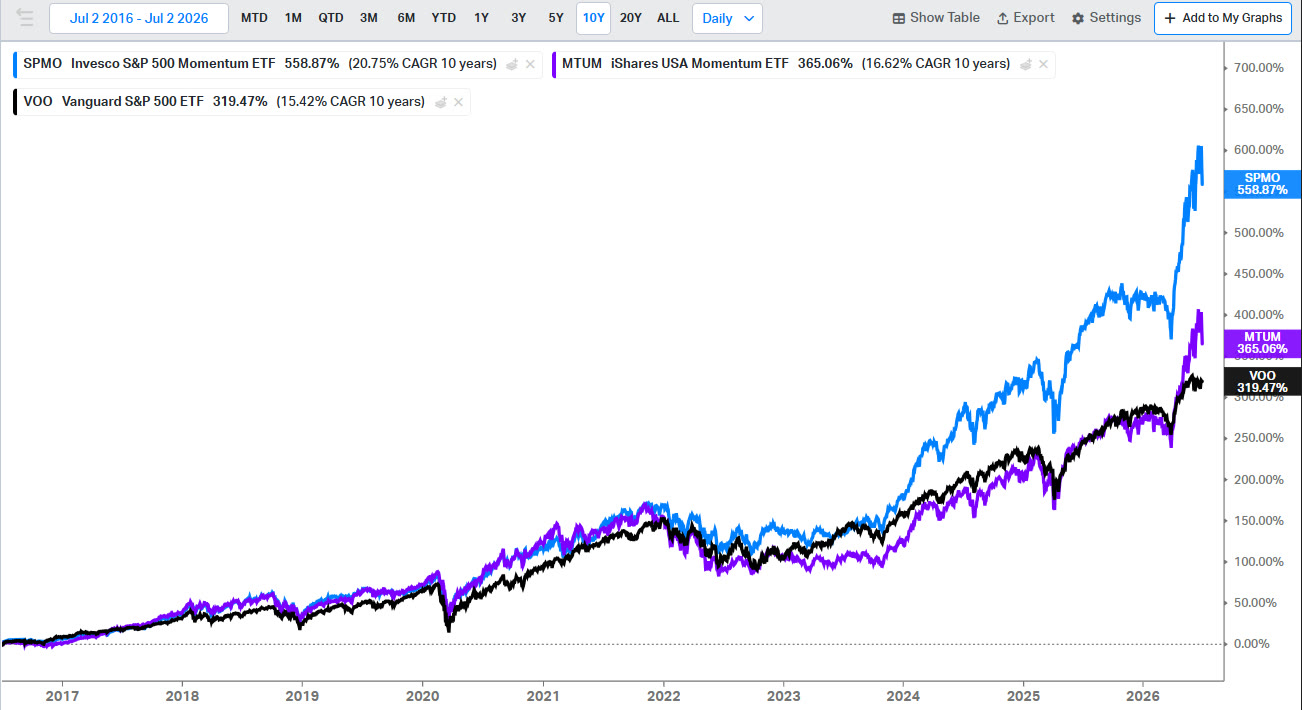
SPMO (blue) and MTUM (purple) versus VOO, the S&P 500 (black), over the last 10 years.
The short version
Momentum means buying what’s been going up recently. It’s literally chasing performance, done systematically.
It has beaten the broad market over most 3-year periods for 30 years, and right now it’s the only factor that’s been working.
It’s not a low volatility strategy: it usually rises more than the market in good times and falls more in bad times.
The rise of retail investors has probably made momentum more powerful, but today’s setup looks more like the late 1990s than any time since.
What is factor investing?
A 15-second primer: factors are characteristics of companies that have historically led to better risk-adjusted returns than investing in a broad market index like the S&P 500. They don’t all beat the market all the time, and they don’t beat it in the same way or in the same market environments. This series walks through each one so you can decide whether, and how, factor investing fits into your approach.
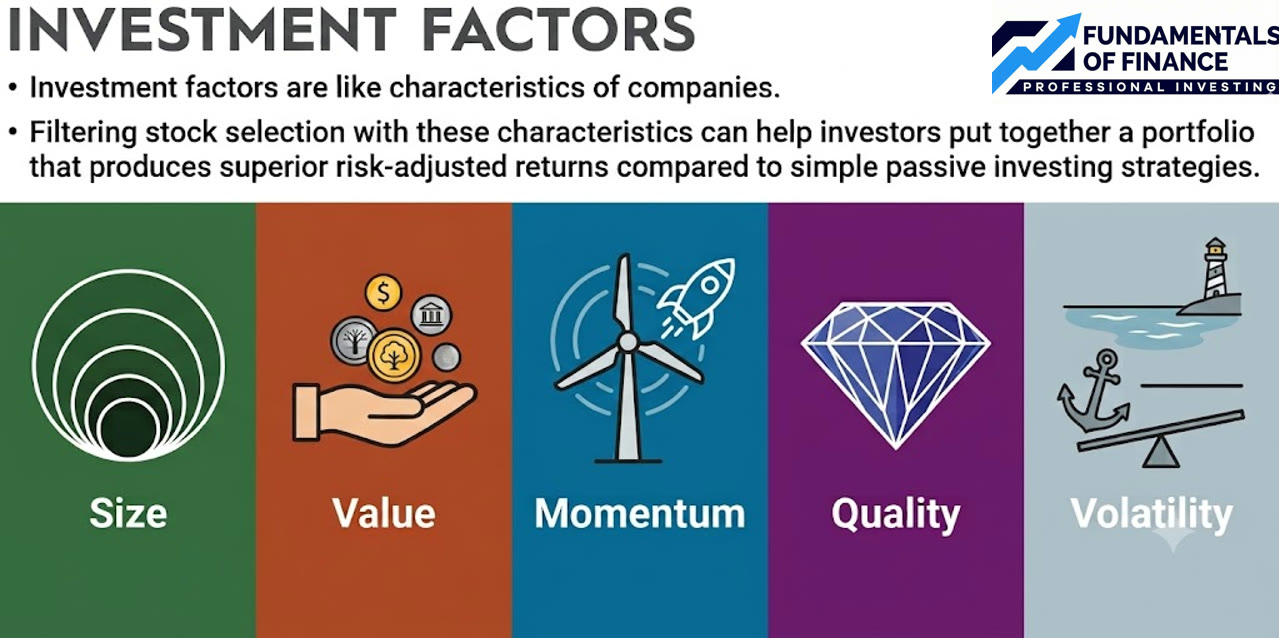
The five factors this series covers: size, value, momentum, quality and low volatility.
Here are the returns of six common factors over rolling 3-year periods. On its own this jumble doesn’t tell you much, except that every factor is still part of the market: they all do well in good markets and poorly in bad ones.
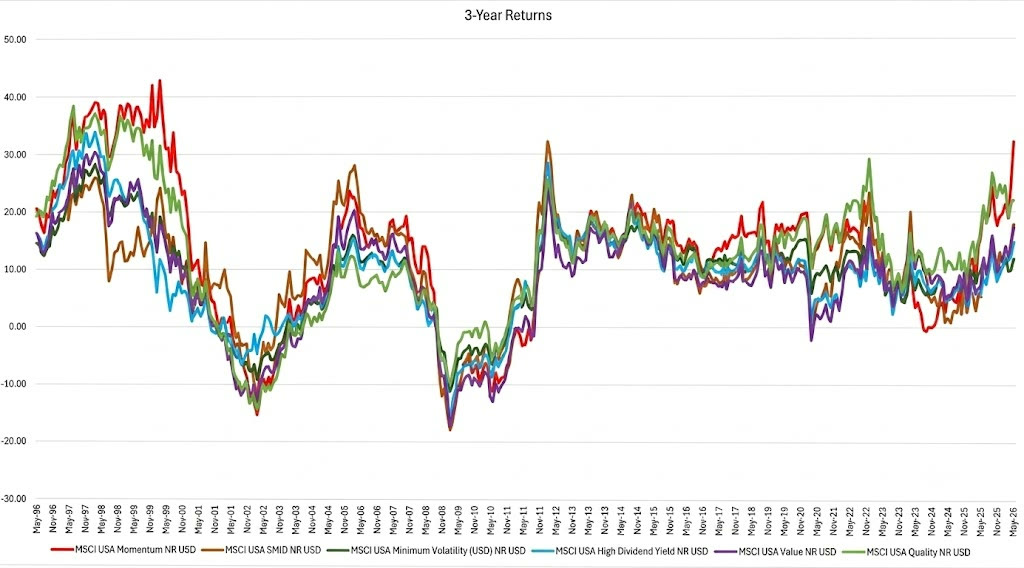
Rolling 3-year returns of six common factors. In absolute terms, they all move with the market.
A more useful view is each factor’s 3-year return relative to the MSCI USA index, which is very similar to the S&P 500. If a factor sits at 10 on this chart, it beat the broad index by 10% a year over the previous three years.
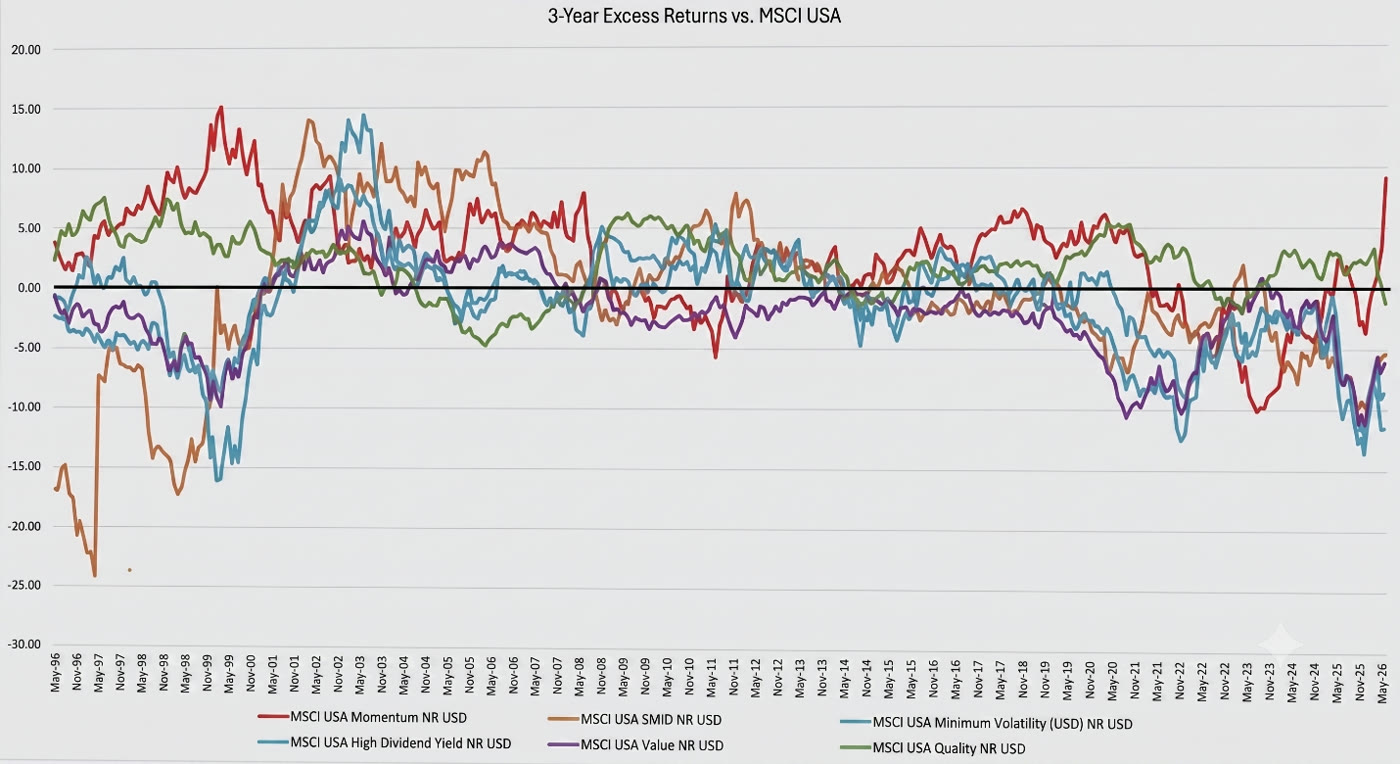
Rolling 3-year returns relative to the MSCI USA. Above zero means the factor beat the broad index.
You’ll notice most of these are above zero most of the time, meaning most factors beat the market most of the time. Some, like minimum volatility (light green), tend to win more on a risk-adjusted basis than an absolute one: similar returns with lower volatility. Others, like value (orange), have been out of favor for a long time. We’ll get to those in later parts.
We’re starting with momentum because it has been dominating the market lately. In fact, for the first time in at least 30 years, it’s the only factor that has been working over the last three years.
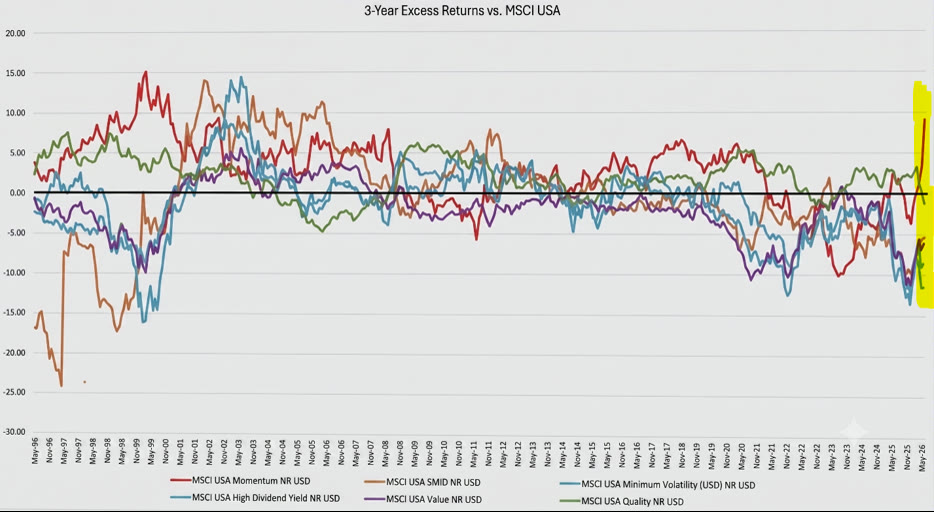
On the far right: momentum is the only factor ahead of the market over the last three years, a first in at least 30 years.
What is momentum investing?
The momentum factor is pretty much exactly what it sounds like. It’s based on the idea that stocks that have performed well recently will keep performing well. It’s literally chasing performance.
Each ETF defines momentum and invests in it slightly differently (S&P’s momentum indexes, for example, use a stock’s 12-month price change excluding the most recent month), and the next part of this series compares the top momentum ETFs in detail. What matters here is that they all invest in some subset of the highest-momentum companies, and “momentum” means what’s been doing well lately.
Momentum ETFs change what they hold
That means they adjust over time, at preset intervals like quarterly or annually, based on a formula. Look at a momentum ETF like SPMO today and it’s basically all AI-related semiconductor companies at the top.
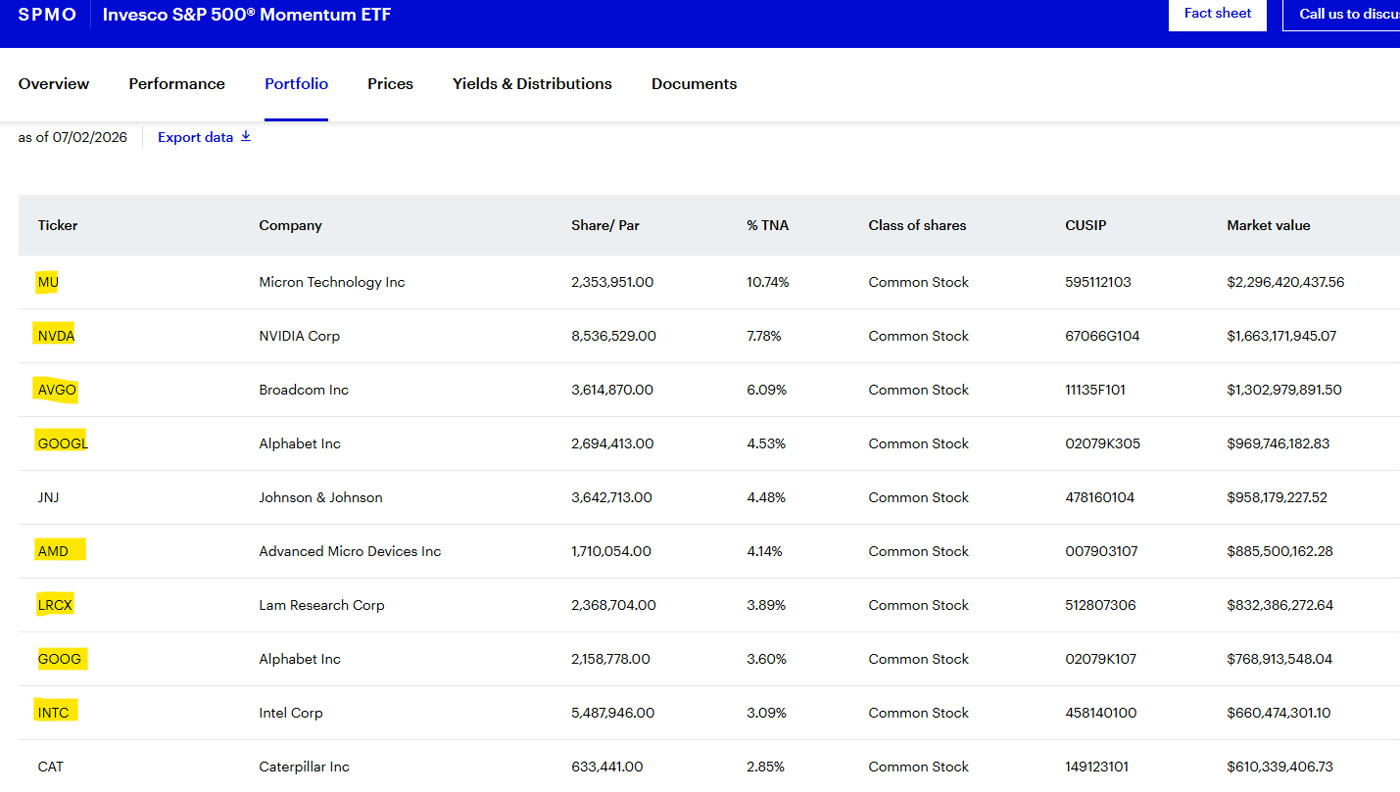
SPMO’s top holdings in mid-2026: AI-related semiconductor companies.
No surprise. But in September 2022 it looked completely different. After that reconstitution, SPMO’s top holdings were energy companies and conservative consumer staples: Exxon Mobil, Chevron, Eli Lilly, Johnson & Johnson, UnitedHealth, Merck, Pfizer, Coca-Cola, PepsiCo and ConocoPhillips. Energy stocks had been rising for the six months since Russia invaded Ukraine, and with the stock market selling off, energy and conservative stocks had naturally been doing best.
Momentum vs. growth and Nasdaq ETFs
This is the key difference between momentum and, say, a Nasdaq or growth ETF, which would all be invested pretty similarly today. Momentum won’t always lead to aggressive, growthy, tech-heavy holdings. It just does right now.
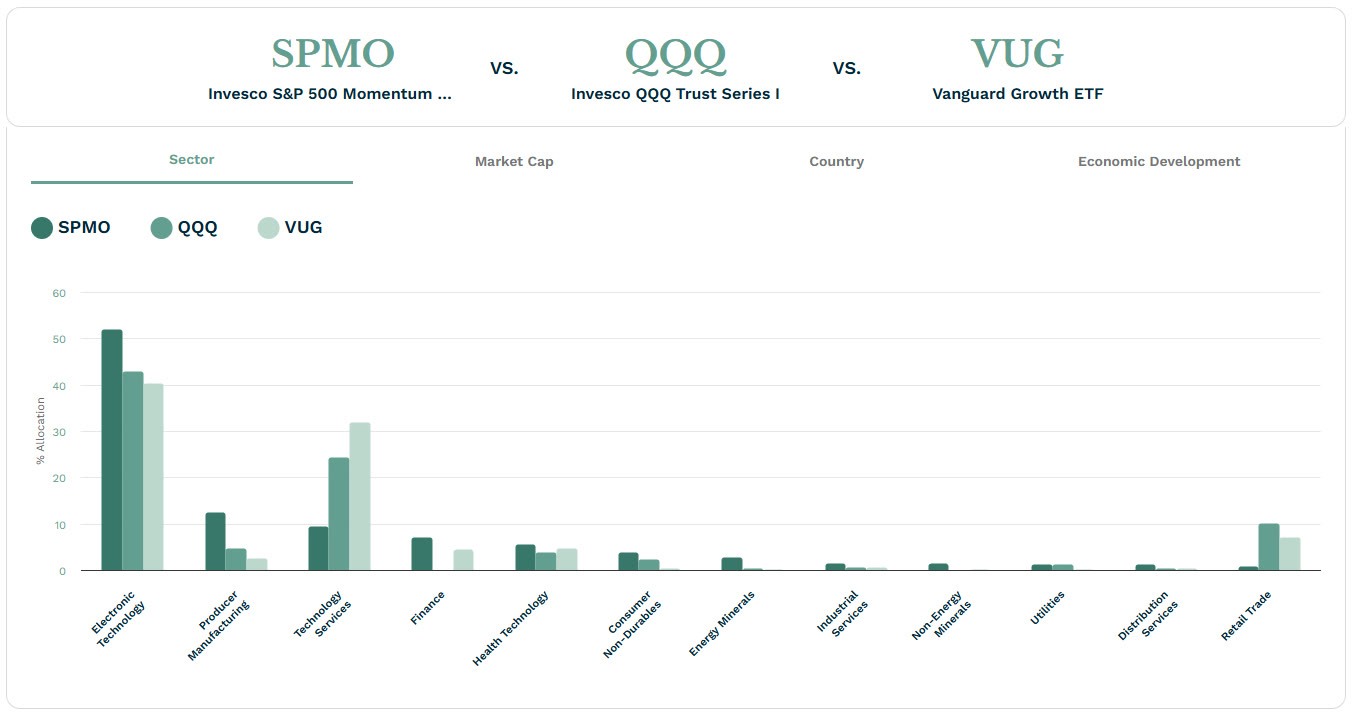
Today SPMO’s sector mix looks a lot like QQQ (Nasdaq-100) and VUG (growth). That won’t always be true.
If the goal is something that’s always high octane and always heavily exposed to the fastest-growing companies (not necessarily the fastest-rising stock prices), a Nasdaq or growth ETF will be more consistently invested in them over time. No matter how badly tech and growth stocks do, tech and growth ETFs will still hold them.
If the goal is something that adjusts its exposure to try to capture different market environments, momentum is a better fit. Momentum ETFs pivot. Whether those pivots will be successful is an open question: sometimes they will be and sometimes they won’t. So what matters is what you’re trying to achieve with your portfolio, and which investment style you want in the mix to help get you there.
Has momentum investing worked?
Historically, momentum — like all the factors, including value and low volatility — has improved risk-adjusted returns over time compared with the broad benchmark. You can see it clearly if we isolate momentum on the rolling 3-year chart. This is the index MTUM is based on, and it’s been ahead of the broad MSCI USA in most 3-year periods over the past 30 years.
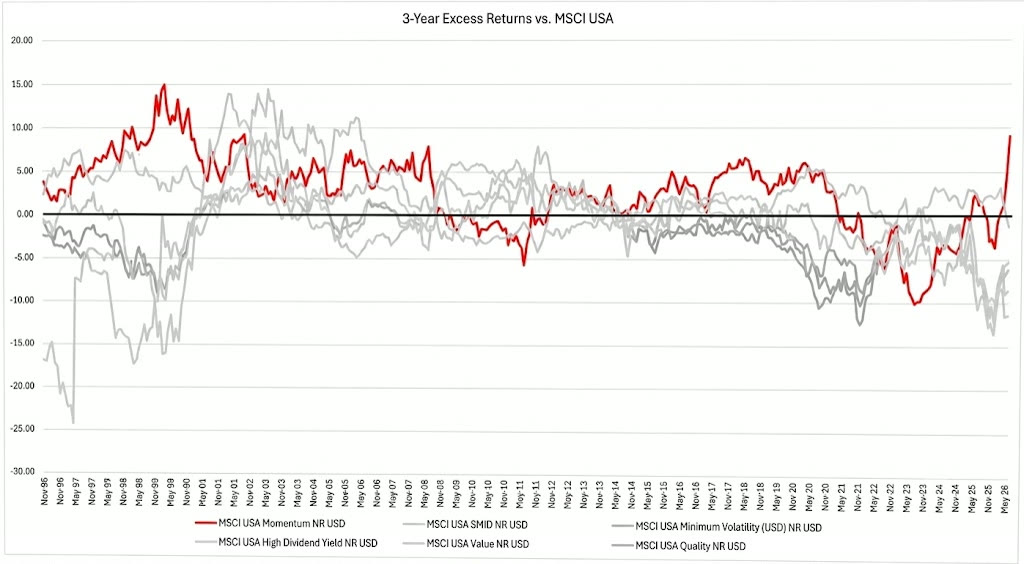
Momentum (red) relative to the MSCI USA: ahead in most 3-year periods over 30 years.
The catch: momentum is not low volatility
When considering any investment, how it gets there matters just as much. Momentum is not a low volatility strategy. If that’s what you’re looking for, might I suggest the factor called… low volatility?
Could momentum protect on the downside in a prolonged downturn, by adjusting toward conservative stocks while the market keeps falling? Sure, it’s possible. But then it would probably also miss the beginning of the recovery. And if it did protect on the downside, that would be the historical exception, not the norm.
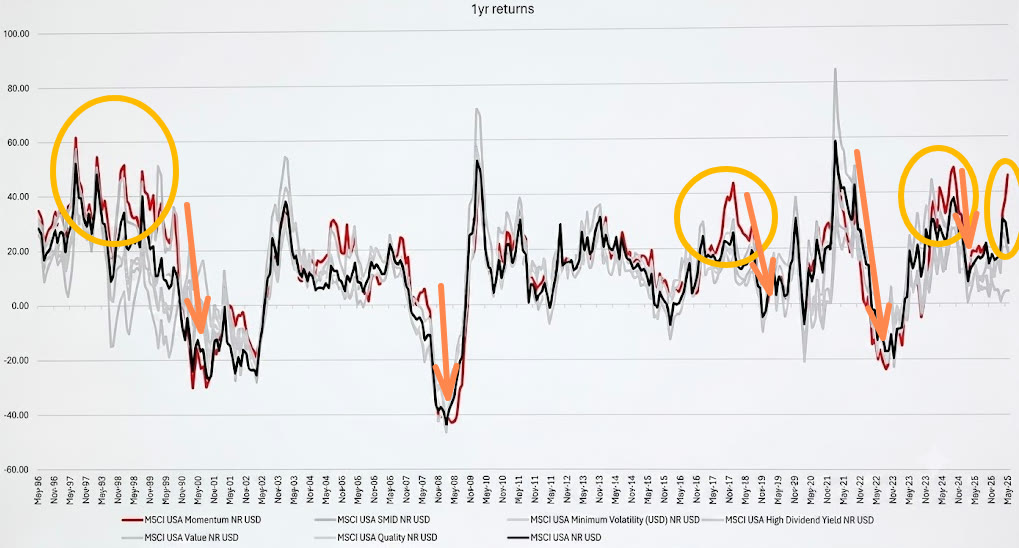
Rolling 1-year returns: momentum (red) versus the MSCI USA (black). Big spikes (circled) have usually been followed by sharp drops (arrows).
More often than not, momentum goes up more than the market in good times and down more than the market in tough times. That’s exactly what I’d expect from how it works. Momentum always gravitates toward the companies that have been doing best, which are often concentrated in one area. If that area leads the market into a downturn, momentum strategies get hit hard. You can see it play out clearly and consistently:
The late-1990s tech bubble: momentum did great against the broad index. When the bubble burst, it fell really hard, from way ahead of the benchmark to way behind, and from a 30%+ gain in a year to a 30%+ loss.
2008: a sharper fall than the market, but not by much, because everything went down. The crash wasn’t centered on one area that had been leading, so momentum wasn’t heavily invested in the worst-hit part of the market.
2017–18, 2021–22 and 2024–25: the same pattern each time. A big spike, momentum does far better, then the downturn hits it particularly hard.
And now we’re in another significant momentum spike, except this time, for the first time, momentum has gone vertical while the broader market’s returns have actually been weakening.
Has momentum investing gotten more powerful?
That brings us to the big question: has something changed to make momentum even more powerful, or are we being set up for another epic reversal? The theory goes like this.
In 2020, two key things happened. First, we had a 30% decline and the fastest recovery of all time. Second, a lot of people had extra money in their pockets and were stuck at home with nothing to do. Together, that brought a whole new crop of retail investors into the market. Then, with the launch of ChatGPT and the AI hype that followed from late 2022, that growth continued: from 2023 to early 2025, retail investing flows rose by about 50%, according to JPMorgan.
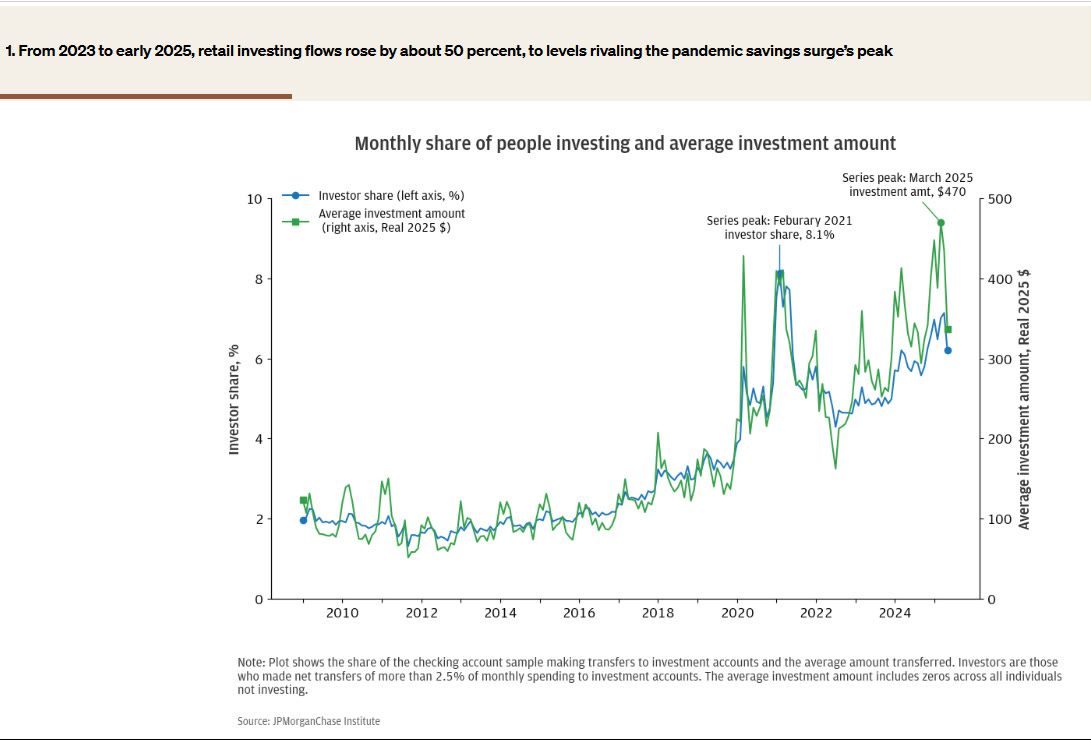
Retail investing flows rose about 50% from 2023 to early 2025. Source: JPMorgan.
Why does that matter? Retail investors aren’t building complicated financial models or assessing how a new CEO’s leadership style might translate into cost savings. They’re mostly buying what’s hot: what’s been going up most and what’s being hyped on social media. In other words, a lot of investors are momentum investors; they just don’t know the term for it.
In the end, the market is driven by everyone’s collective buying and selling. If everyone buys the same companies, those companies keep leading. If everyone moves to a different group, those start to lead. Momentum strategies are systematically built to follow trends like that.
So has the rise of the retail investor made momentum more powerful than before? I say yes, it probably has. But does that mean outsized returns like the recent ones will continue, and that momentum won’t crash hard in the next downturn? No, I would certainly not feel confident in that.
Breakout or bust?
There are reasons to believe momentum investing could keep working over time, maybe even better than it has historically. But we also have a setup right now that’s closer to the late 1990s than at any point since, and that was followed by a pretty rough period for momentum investing. Both can be true.
Remember, retail investors aren’t the only thing that drives the market, and they can switch allegiances much faster than momentum strategies can reconstitute, since those only rebalance on a regular schedule. As concentrated as momentum strategies are in tech, AI and especially semiconductor companies right now, they’re highly vulnerable to anything that changes that story.
Nothing leads the market forever. The question for momentum is whether memory stocks and the AI trade gradually level off, giving momentum strategies time to diversify before the next downturn, or whether they suddenly crash when everyone realizes AI expectations got way ahead of themselves. The short answer is I don’t know. But history says it’s usually the latter, and given today’s level of hype, concentration and leverage, plus a much larger crop of short-term-oriented retail investors, that would be my expectation this time too.
That doesn’t mean momentum strategies should be avoided. It means knowing the risk being taken, especially after a period like this one. Momentum has had many short spurts of much better and much worse performance than the index, and I’d expect that to continue.
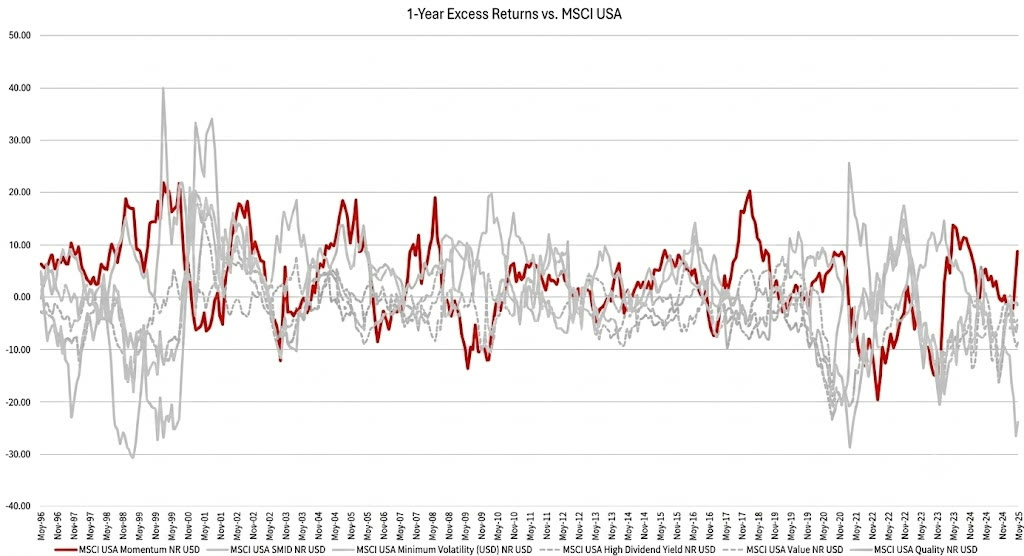
Rolling 1-year returns relative to the MSCI USA: momentum (red) swings well above and below the index.
In the next part, we compare the top momentum ETFs, SPMO and MTUM, which have had significantly different results over time, especially in the last few years. Then we continue with the other factors and the ETFs that track them.
Watch the full video
Want to go deeper? In the Fundamentals of Finance Academy, Ethan breaks down funds and current market events on a live call every other week, and members get the full archive of recorded calls. Learn more about the Academy →

This article is for educational purposes only and is not investment advice. Ethan is a CFA charterholder, but nothing here is a recommendation to buy or sell any security, and it does not take your personal situation into account. Past performance does not guarantee future results. Performance data and fund details are as of July 2026 and will change; check each fund’s website for current figures.
