Top International Quality ETFs Reviewed by a CFA Charterholder: IDHQ vs CGIE
About this article: This article is based on Ethan’s video, originally published on September 6, 2026. Because the written version was published later, returns, yields and fund details reflect data available at the time of the video and have likely changed since. Please check each fund’s website for current figures.
Factor Investing Series: you’re reading Part 8 of 11
Part 1: Momentum Investing Explained
Part 2: SPMO vs MTUM
Part 3: Small-Cap Investing Explained
Part 4: Top Small-Cap ETFs
Part 5: Value vs Growth Stocks
Part 6: Best Value ETFs
Part 7: Quality Factor Investing Explained
Part 8: Top International Quality ETFs (you’re here)
Part 9: Top U.S. Quality ETFs
Part 10: Minimum Volatility Investing Explained
Part 11: Best Low Volatility ETFs
I couldn’t think of a clever intro this time, but I did find some extraordinary high-quality funds to introduce you to, so let’s dive right in.
If you’re new here, I’m Ethan, a chartered financial analyst with more than a decade of experience evaluating funds for a living. So far our factor investing series has covered momentum, small caps, value and quality, plus the top ETFs for the first three. This part covers the top international quality funds, active and passive. I was going to cover U.S. and international together, but it was getting far too long, so this is the international half; U.S. quality ETFs are in the next part.
The Short Version
I narrowed 500+ international funds down to the few that were both consistently high quality and consistently strong performers.
Passive winner: IDHQ, the Invesco S&P International Developed Quality ETF (0.29%). It has walloped the broad market since becoming a quality fund in 2012.
Active winner: CGIE, the Capital Group International Equity ETF (0.54%). It aims to lose less in downturns, and quality is a by-product.
Expect CGIE to do better in most downturns and IDHQ in most big up markets.
How I Narrowed 500+ Funds Down to the Best
For a little peek behind the scenes, here’s the three-step process I used:
Consistently high quality. I kept only the international mutual funds and ETFs that have never fallen out of the top third for Morningstar’s quality factor exposure at any point in the past 10 years, using 10 years of the actual numbers behind the quality bar I showed in the last part.
Consistently strong results. I looked at who’s using quality effectively: rolling 5- and 10-year excess returns against the MSCI ACWI ex USA and MSCI EAFE, the main international indexes. A fund launched three months ago can pass a quality screen and get lucky, but we have no idea whether that’s repeatable, so I favored longer, consistently successful track records. It’s easy to Google an ETF that screens for quality. What I wanted was funds that lean toward quality and do it well — in the end, we make money from returns, not factor exposures.
Repeatability. I researched each finalist to understand how it uses quality and whether its results are likely to be repeatable, and I picked funds that do it in different ways, since you may prefer one investing style over another.
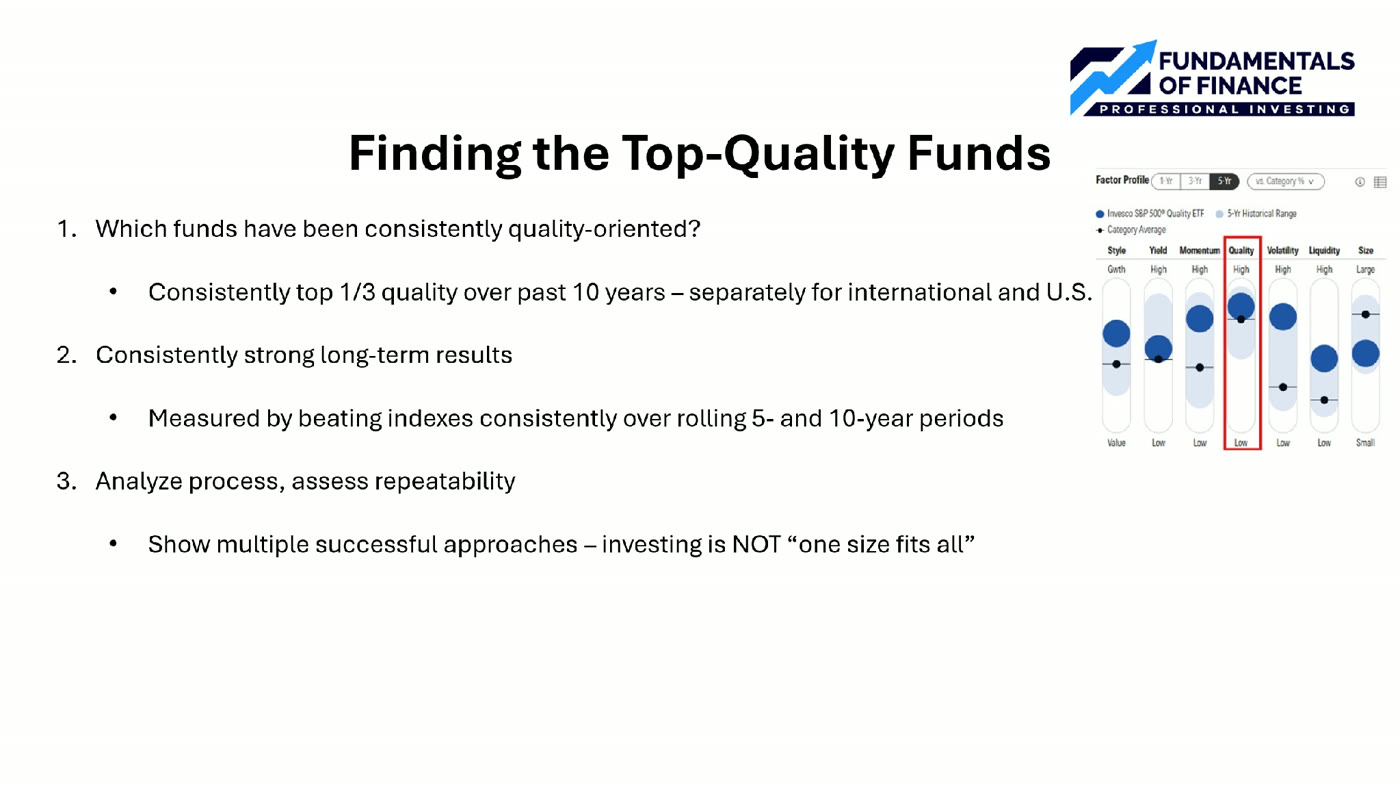
The three-step screen: consistently quality-oriented, consistently strong results, repeatable process.
That took us from over 500 international funds to just five, and from there I dug deep to pick the best of the best: one active winner, one passive winner and one bonus.
The bonus is the international fund I teased at the end of the last part: WCM Focused International Growth. Is it extraordinary? Yes. Is it closed to new investors? Also yes. If you already own it or it’s in your 401(k), you can add to it, but otherwise you can’t buy it, and I apologize for not checking that more closely. There are actually tons of extraordinary active funds I never talk about because they’re closed. What I can do is help find the ones that aren’t closed — yet.
Passive Winner: IDHQ
The Invesco S&P International Developed Quality ETF (IDHQ) is honestly super impressive for a passive international ETF. I’ve said I don’t think simply screening for quality is generally the best way to invest in it, and I don’t think passive is generally as effective internationally, where most active funds actually beat their benchmarks in the long run. But you could make a strong argument that IDHQ is the most impressive of all the funds here, which I honestly didn’t expect when I started this research.
It costs 0.29%, cheaper than the active option and roughly in line with other international passive ETFs. VEA and SPDW are cheaper at 0.03%, but they generally haven’t done as well, even though quality just went through its worst five-year stretch on record in international stocks:
Since their common inception, about 19½ years ago: IDHQ is ahead.
Over 10 years: IDHQ is ahead.
Over 5 years: somehow only slightly behind.
Over 3 years: ahead.
Over 1 year: way ahead, as quality has started to make a comeback in the last couple of months.
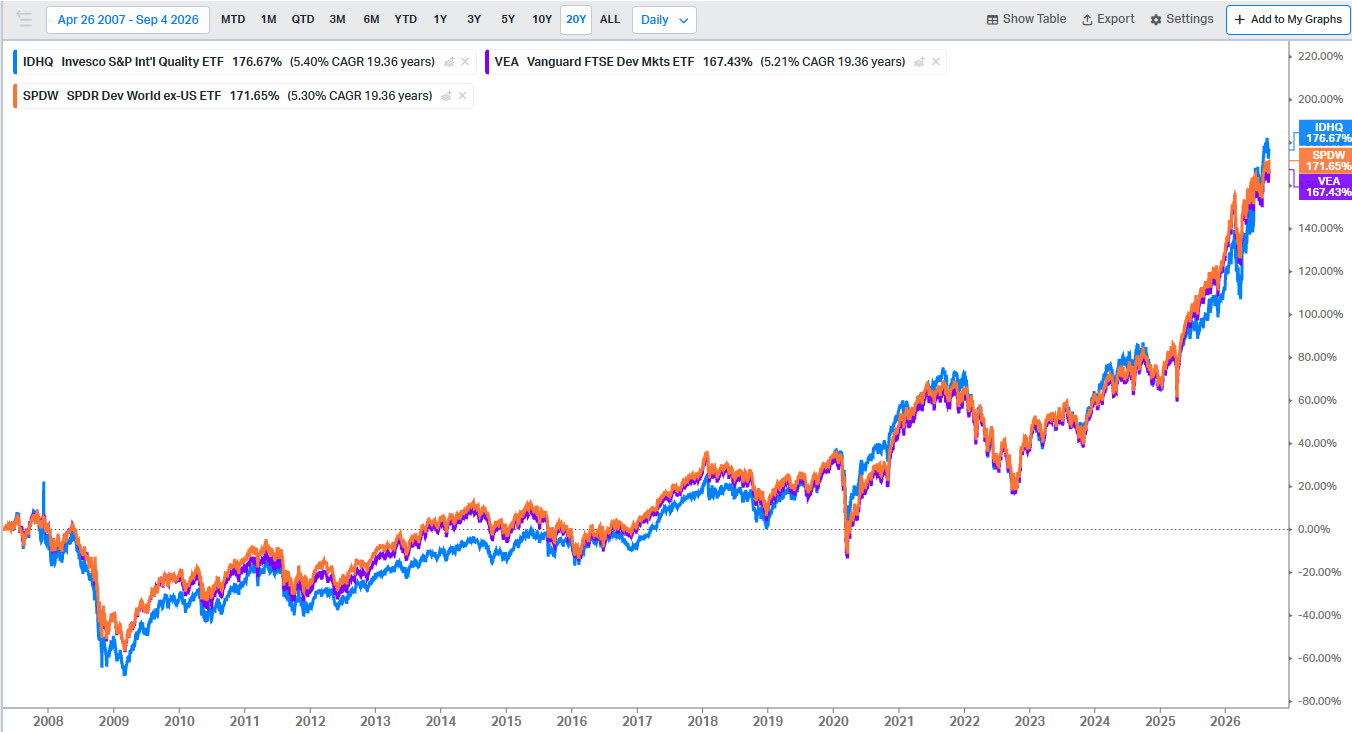
IDHQ versus VEA and SPDW since their common inception, about 19½ years ago.
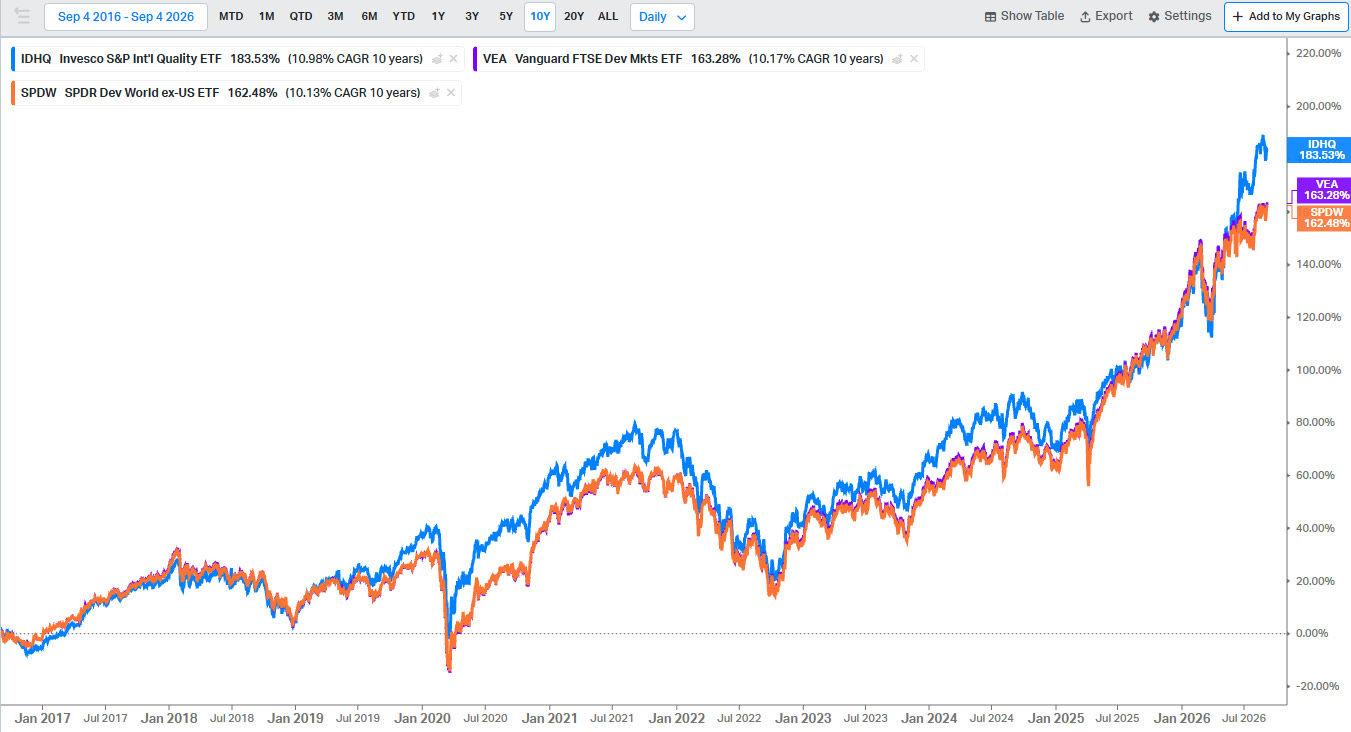
Over 10 years: IDHQ ahead.
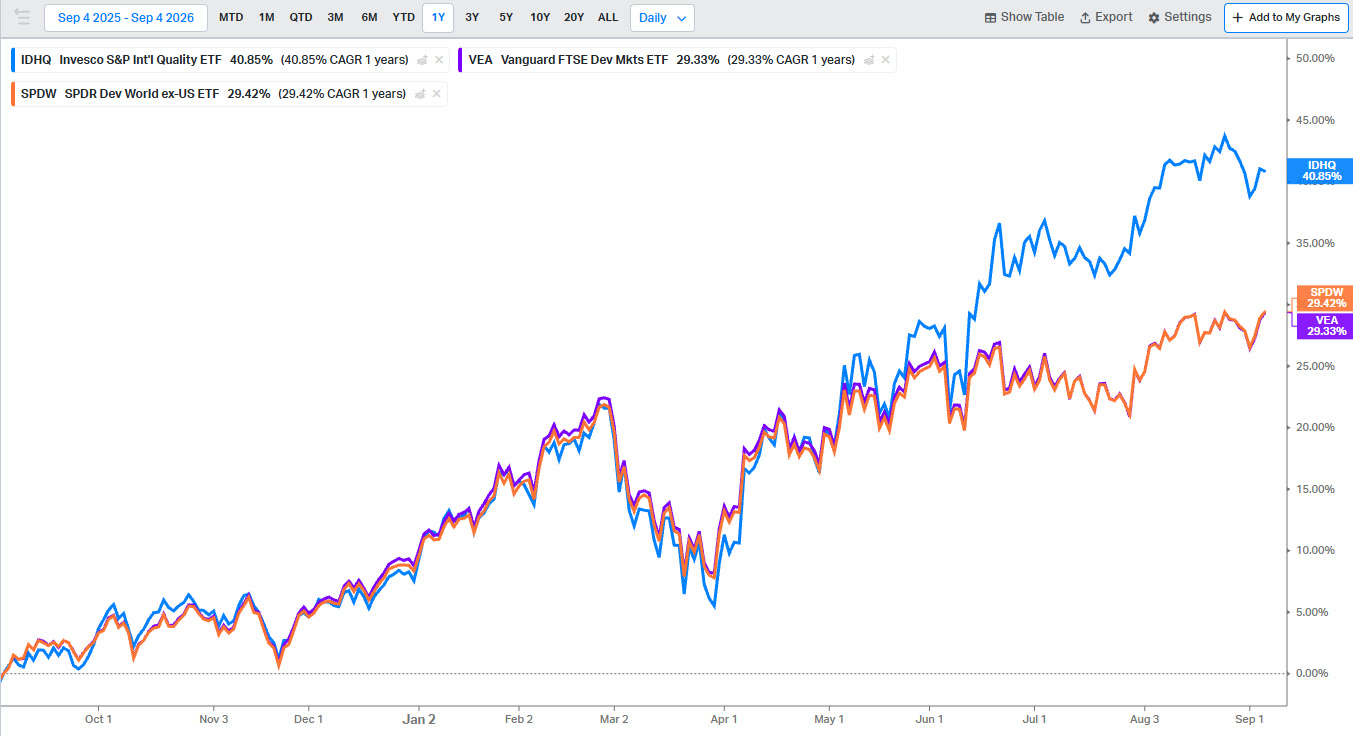
Over one year: IDHQ (blue) well ahead as quality comes back.
How IDHQ Does It
Besides screening for quality, which any passive quality ETF does, IDHQ doesn’t try to look too similar to the broad index. Many quality ETFs keep their sector weights close to the index, and then you don’t get much of the factor you’re looking for. IDHQ just multiplies each company’s quality score by its size, with only a few limits: 5% per stock and 40% per sector or country. In my opinion, that’s a slightly better mousetrap. There’s no guarantee it will do better, but it should be more true to the quality exposure you want, with more of the steady-Eddie profile: generally holding up well in downturns while possibly giving up some upside in recoveries from crises.
The result is a higher quality profile, of course, but also a bit of a tilt toward large caps and growth.
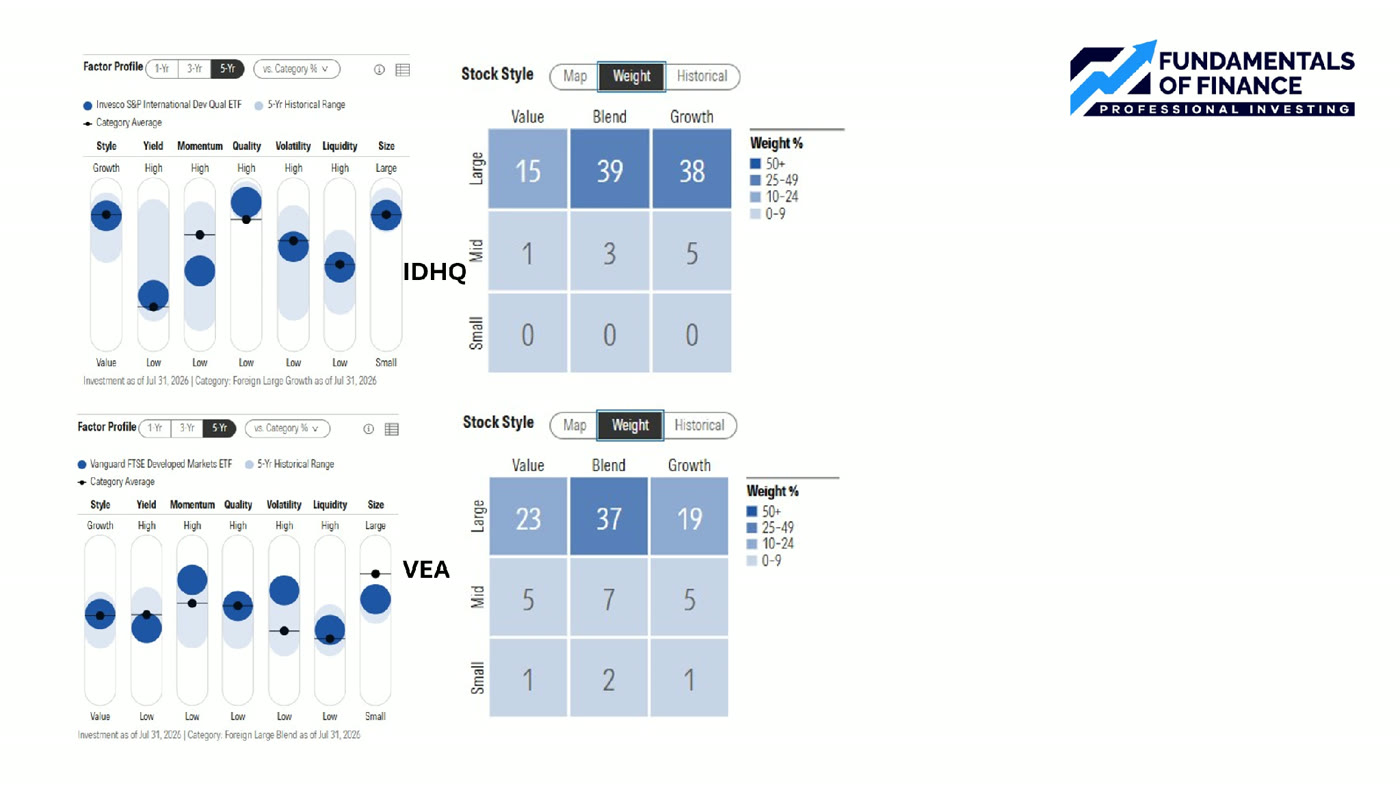
IDHQ (top) versus VEA: higher quality, with a tilt toward large caps and growth.
Quality vs. Growth vs. Value
A quick sidebar: quality tends to be closely related to growth. “Growth” generally means companies growing fast, by earnings or revenue, while “quality” generally means companies growing consistently, so naturally there’s overlap. The key difference is that quality often screens out unprofitable companies, while growth may include companies growing revenue quickly but not yet profitable. That tends to give quality a lower volatility profile than growth. Value, on the other hand, tends to include lots of cyclicals, which are more boom-and-bust and less consistently profitable — almost the opposite of quality. So most quality funds lean toward growth but are less volatile than pure growth funds.
Wait — It Fell 70% in 2008?
To show that, I added an international growth ETF (EFG) and the broad VEA alongside IDHQ. Hmm… did IDHQ really fall over 70% in 2008? And did it also do the worst in the 2011 European debt crisis? Ethan, didn’t you say it was supposed to hold up better in downturns?
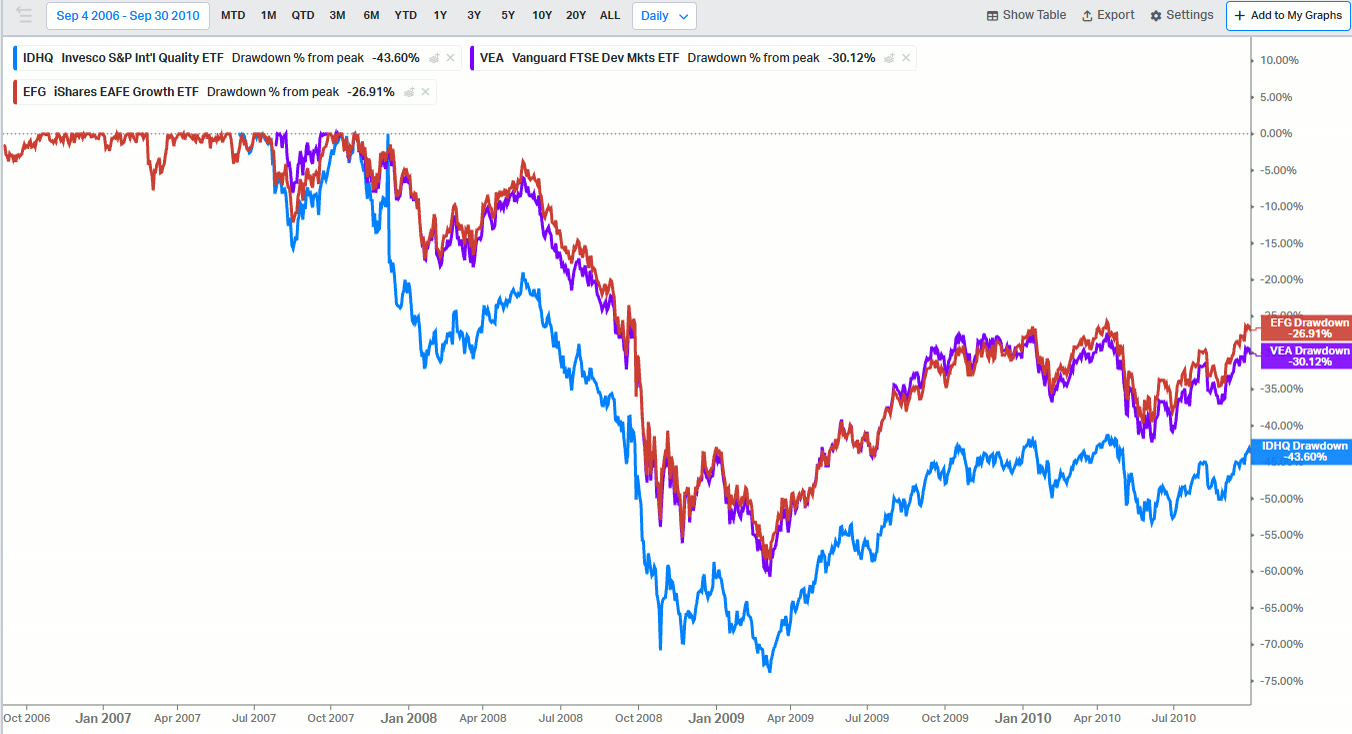
2008: IDHQ (blue) fell the most — but it wasn’t a quality fund yet.
Don’t worry. One annoying thing about funds is that when they aren’t successful, they sometimes rebrand and go in a totally different direction, and it’s up to investors to notice. IDHQ has had three benchmarks in its history, and until March 2012 it wasn’t a quality-oriented ETF at all. Heading into 2008, financials were more than a third of its assets, and it held almost no health care or consumer staples, two of the areas that held up best in the crash. No wonder it did horribly.
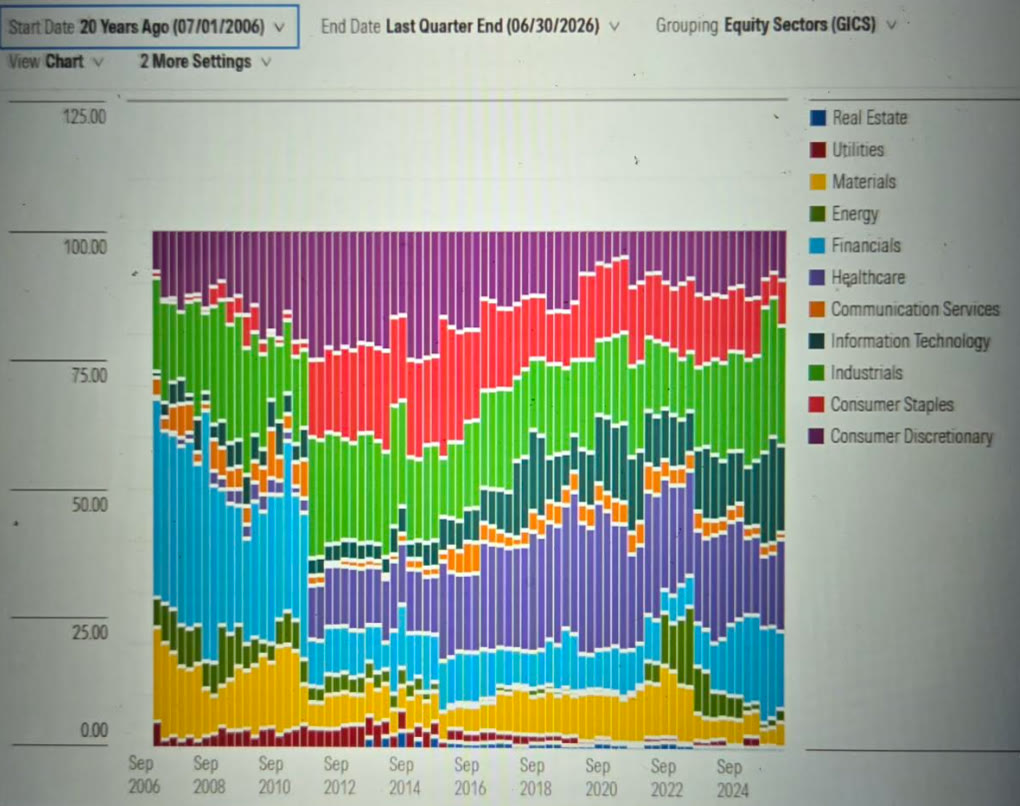
IDHQ’s quarterly sector weights before it became a quality fund: heavy in financials.
IDHQ Since It Became a Quality Fund
Since then, it’s done much better:
2016: held up well when everyone was worried about China’s economy crashing. IDHQ doesn’t invest in China or emerging markets, but global stocks sold off because China was a key source of projected growth for many multinationals.
2018: quality held up the best.
2020: beat the market but slightly trailed growth. That downturn was unusual, though: many high-growth businesses were up around 100% while many steady ones were forced to shut down.
2022: held up better than growth but sold off more than the broad market, since it leans toward growth and holds few cyclicals like energy, which was pretty much the only thing doing well in that energy crisis.
2025: held up the best on Liberation Day, but did the worst when the U.S. attacked Iran, another energy shock, which isn’t an environment where I’d expect quality to shine.
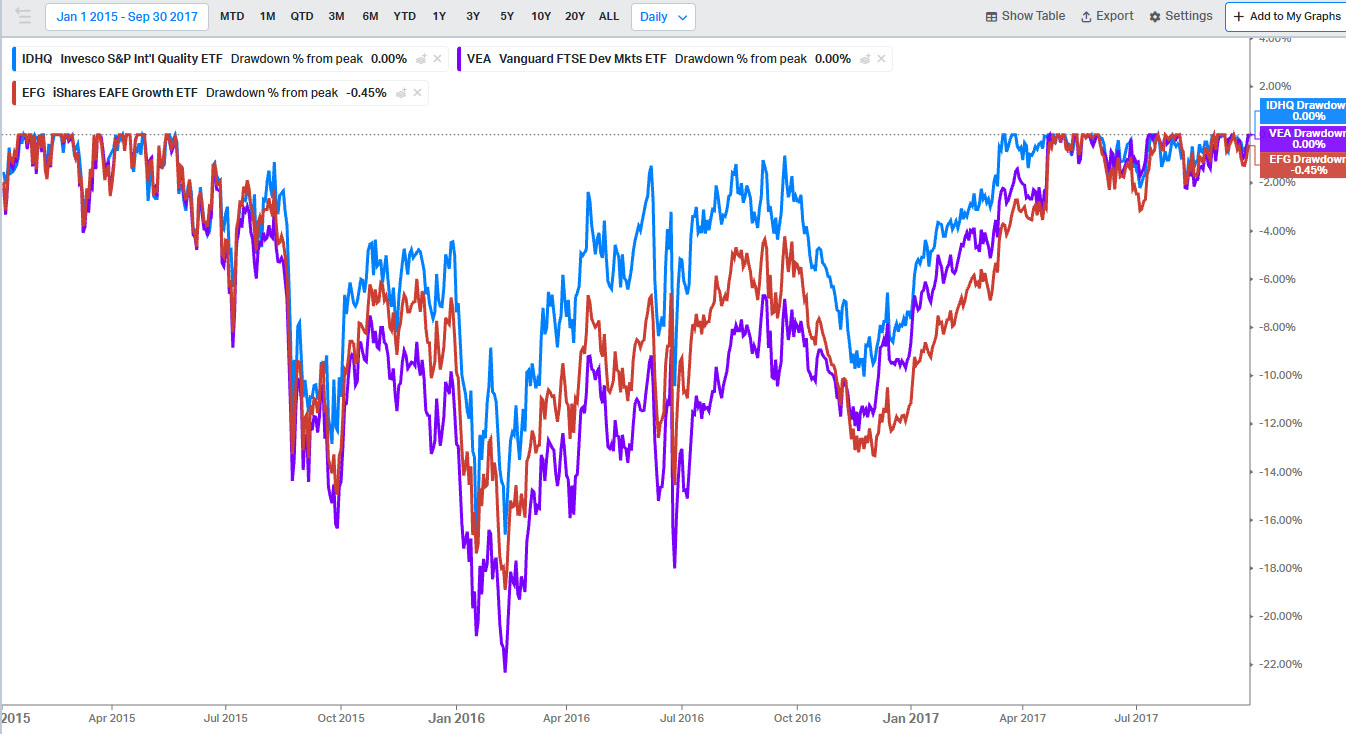
2016: the China scare.
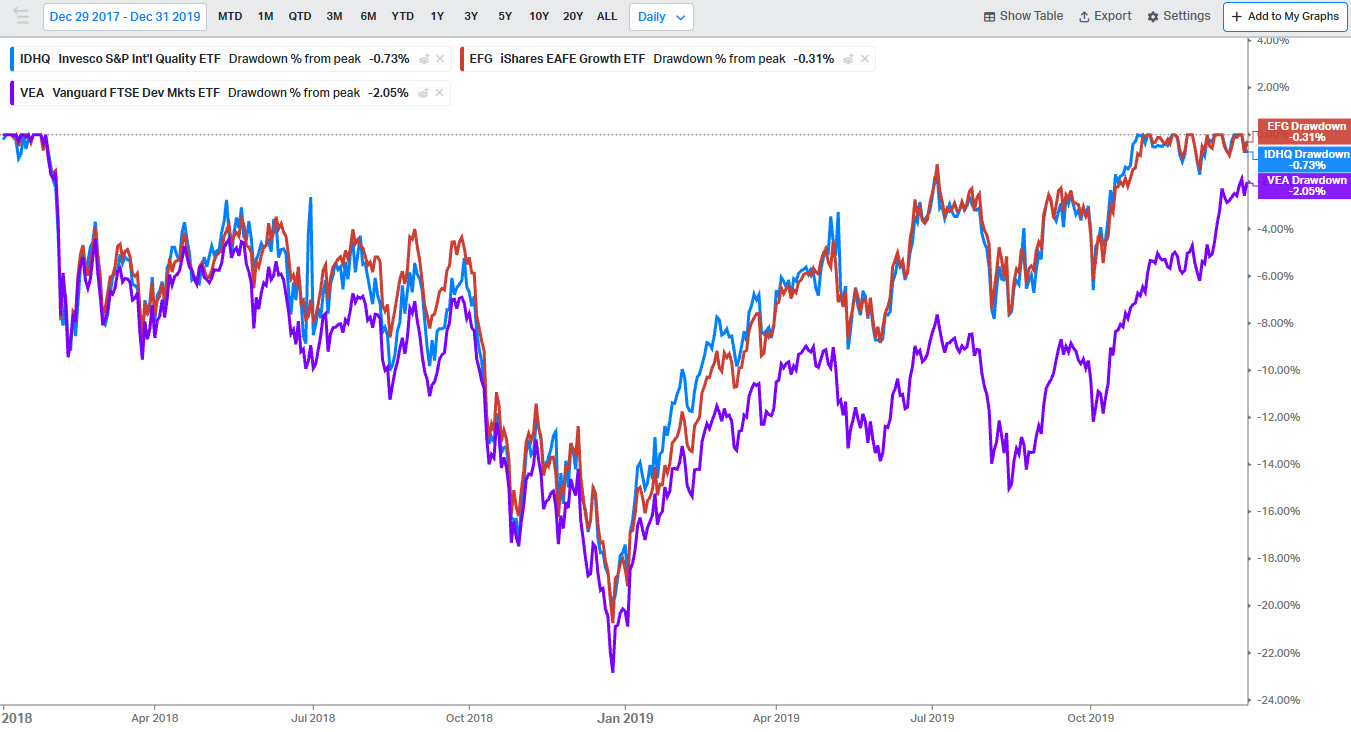
2018: quality held up the best.
It’s not foolproof, but in most downturns I’d expect it to hold up better than the broader market, and crucially, a quality tilt doesn’t necessarily mean giving up long-term return. Will it protect on the downside as much as cash, bonds or low volatility ETFs (which we’ll cover next)? I highly doubt it. But it can protect some, and still offer compelling long-term upside. Since it became a quality ETF on March 1, 2012, it’s absolutely walloped the broad market ETFs, even though they’re cheaper.
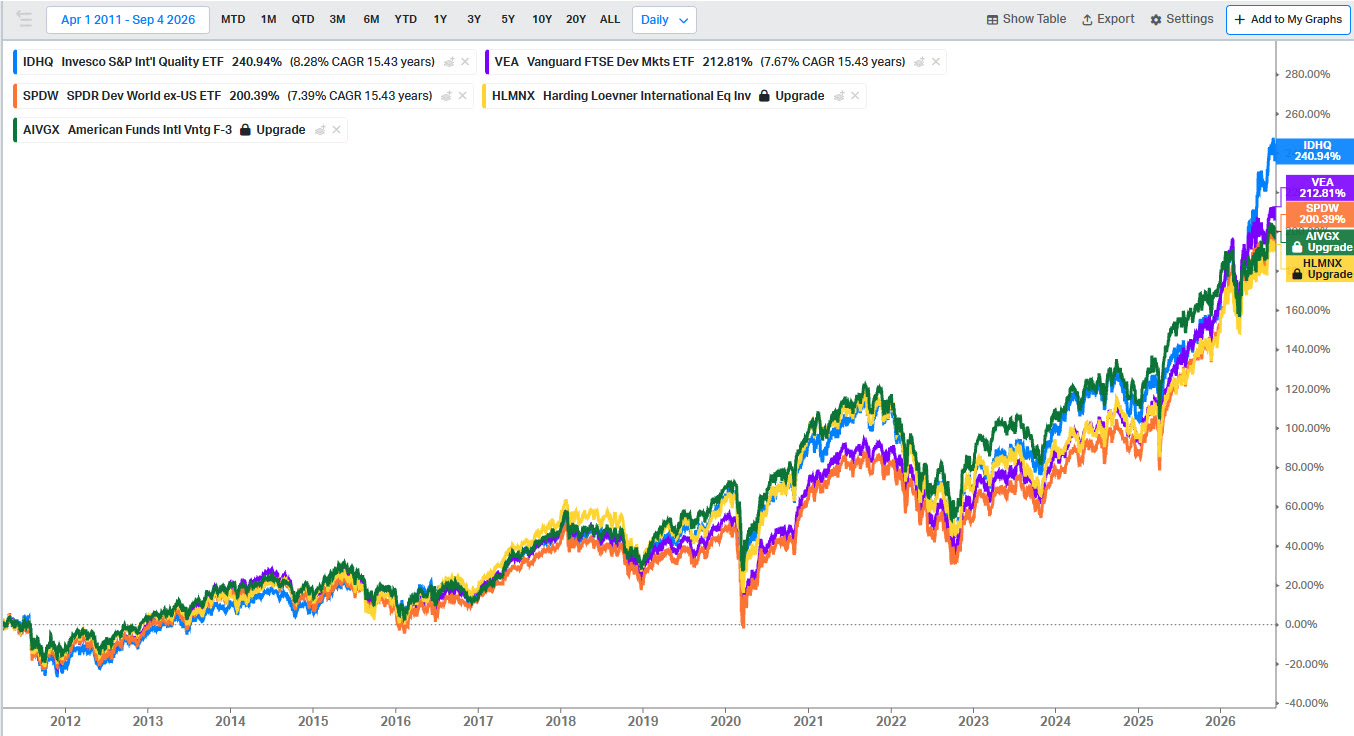
Since becoming a quality ETF in March 2012, IDHQ has walloped the broad market ETFs.
Active Winner: CGIE
My active winner is CGIE, the Capital Group International Equity ETF. The first thing you might notice is that “quality” isn’t in its name. That’s because it doesn’t target an exposure, like a passive ETF; it targets an outcome, and investing in mostly high-quality companies is how it gets there. CGIE is managed toward dual objectives of prudent growth of capital and conservation of principal, which you rarely see in stock funds, and it specifically aims for a smoother ride and smaller losses than the market in downturns.
So IDHQ aims to be high quality, and a by-product is that it tends to lose less in downturns. CGIE aims to lose less in downturns, and a by-product is that it tends to be high quality. To show that, here’s the factor profile of its parent mutual fund, American Funds International Vantage Fund, which has been around since 2011. (There’s also a separate account version going back to 1987 with unbelievable results, but I’m pretty sure I’m not allowed to show that here.)
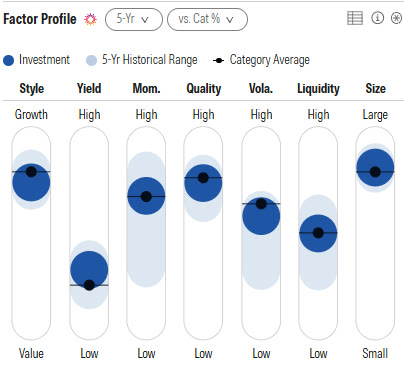
American Funds International Vantage, CGIE’s parent mutual fund: a high quality profile. Source: Morningstar.
How CGIE’s Strategy Held Up in Downturns
2011: the mutual fund held up much better than everything else. (IDHQ wasn’t a quality fund yet, and the main comparison is VEA, the broad international market.)
2015–16: held up better than the market, but only slightly, and did worse than growth and IDHQ.
2018: held up the best.
2020: held up the best.
2022: an environment where I really wouldn’t expect it to beat the market, and it barely trailed, holding up quite a bit better than IDHQ and the growth ETF.
2025: held up better than growth and about even with the others on Liberation Day, and once again better than everything else when the U.S. attacked Iran, which I honestly wouldn’t have expected in another energy shock.
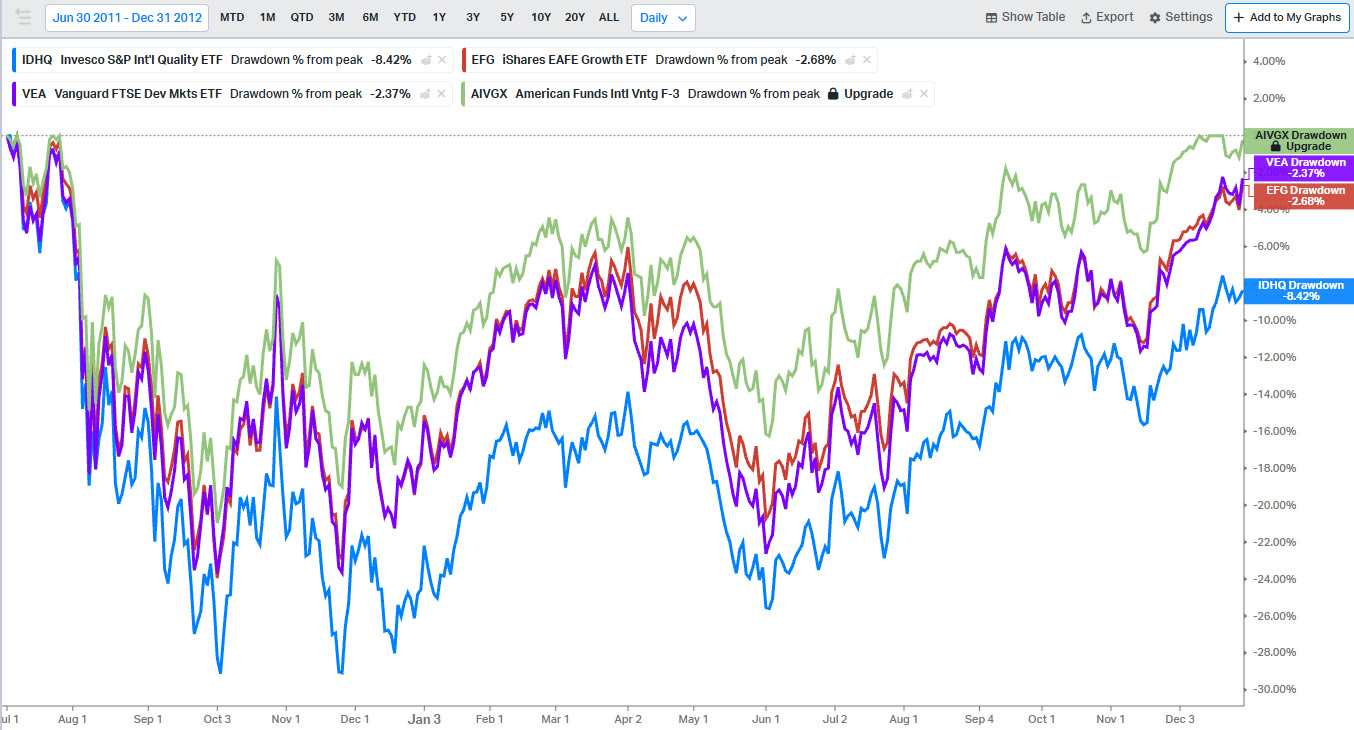
2011: the CGIE strategy (green) held up much better than everything else.
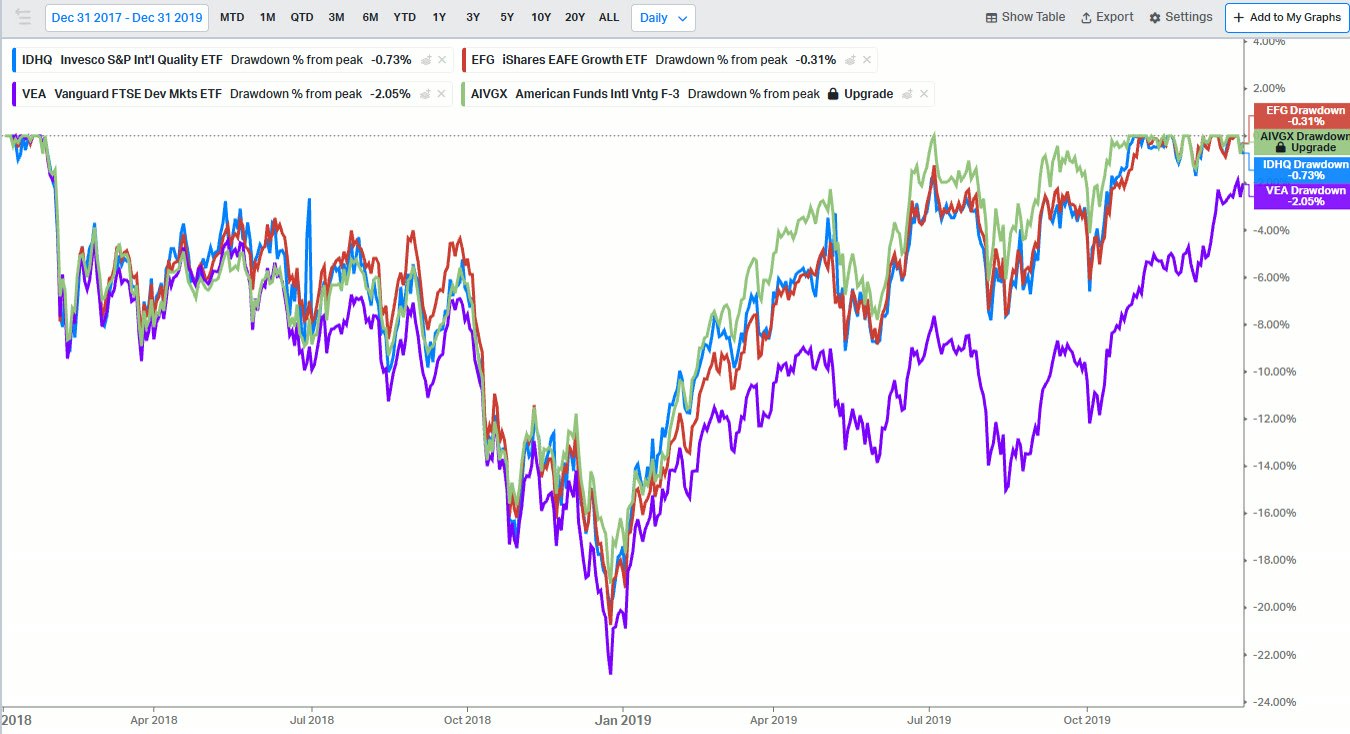
2018: held up the best.
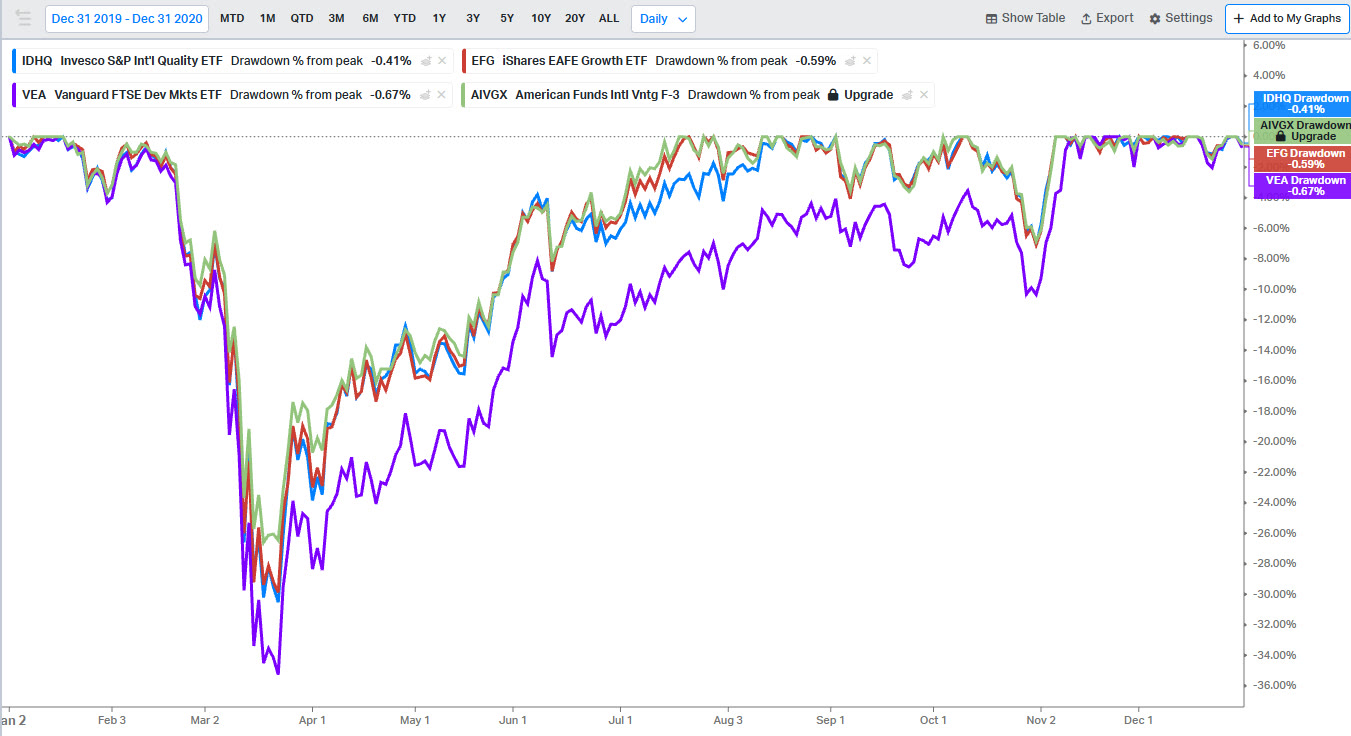
2020: held up the best.
CGIE’s Long-Term Returns
So the downside protection is real. What about long-term return potential? Since the mutual fund’s inception, it’s trounced growth and finished between the two cheapest broad-market ETFs, but lagged IDHQ. Interestingly, it was ahead of everything for most of that time — even with lower volatility — but it’s really fallen behind in the past year or so.
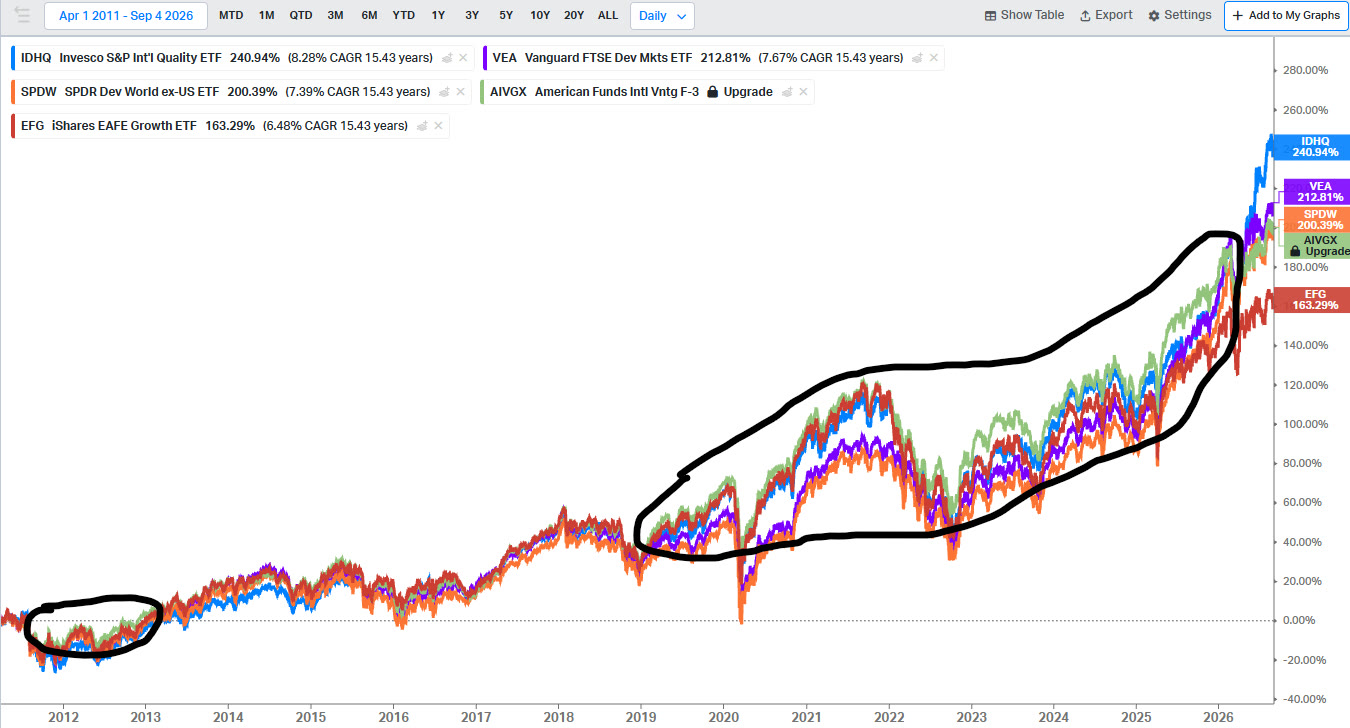
Since 2011: the CGIE strategy led for most of the period (circled), until the last year.
Why? Because the broad market is up over 29% and CGIE is focused on downside protection. (The actual ETF, CGIE, launched in 2023 and has tracked the mutual fund closely.) I would not expect any fund aiming for downside protection and conservation of principal to beat a market that’s up 30% in a year; it’s not designed to.
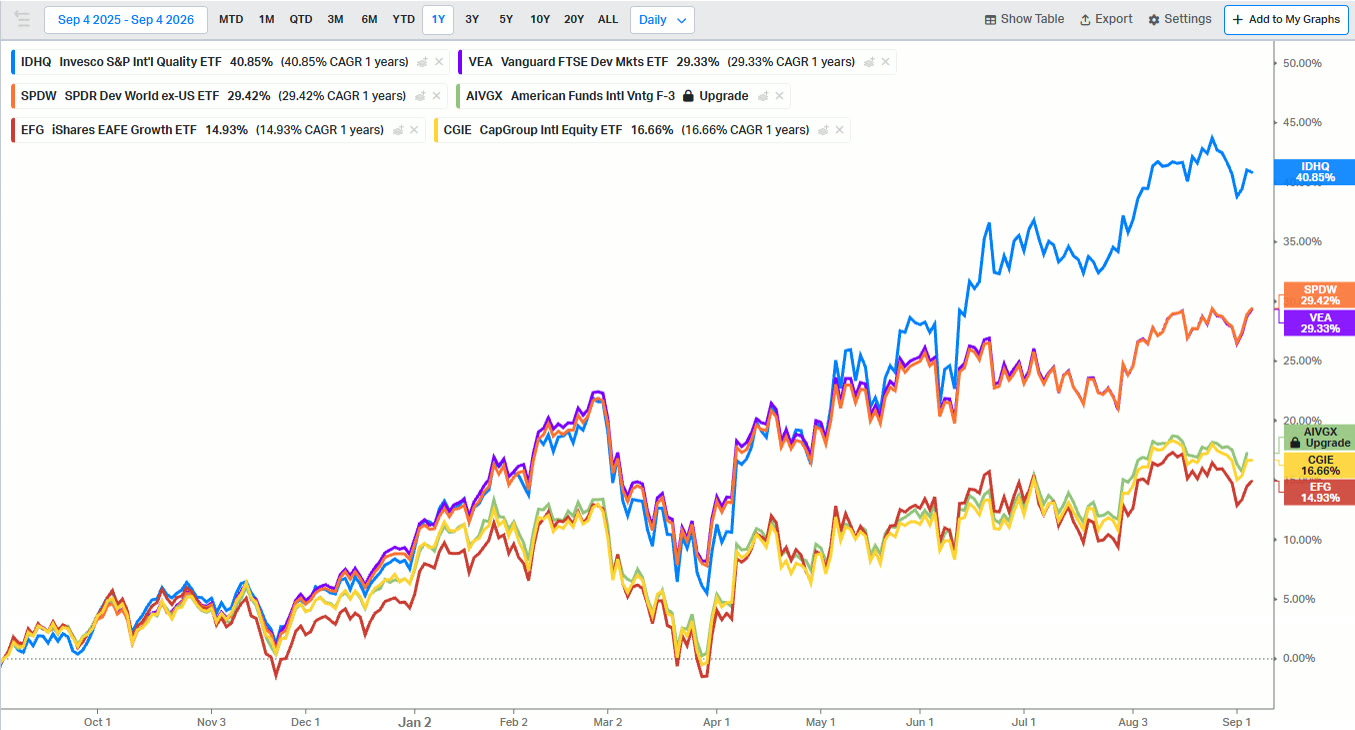
The past year: a strong market, with IDHQ (blue) well ahead and CGIE (yellow) behind.
You might notice CGIE is still ahead of the growth ETF, which shouldn’t happen in a strong up market… unless the rally was driven by something else. It was: cyclical companies like miners (up over 60% in a year), energy (up over 46%) and financials (up over 34%). Those are cyclicals CGIE typically avoids because they’re volatile, but they aren’t usually classified as growth either, so EFG didn’t hold many of them.
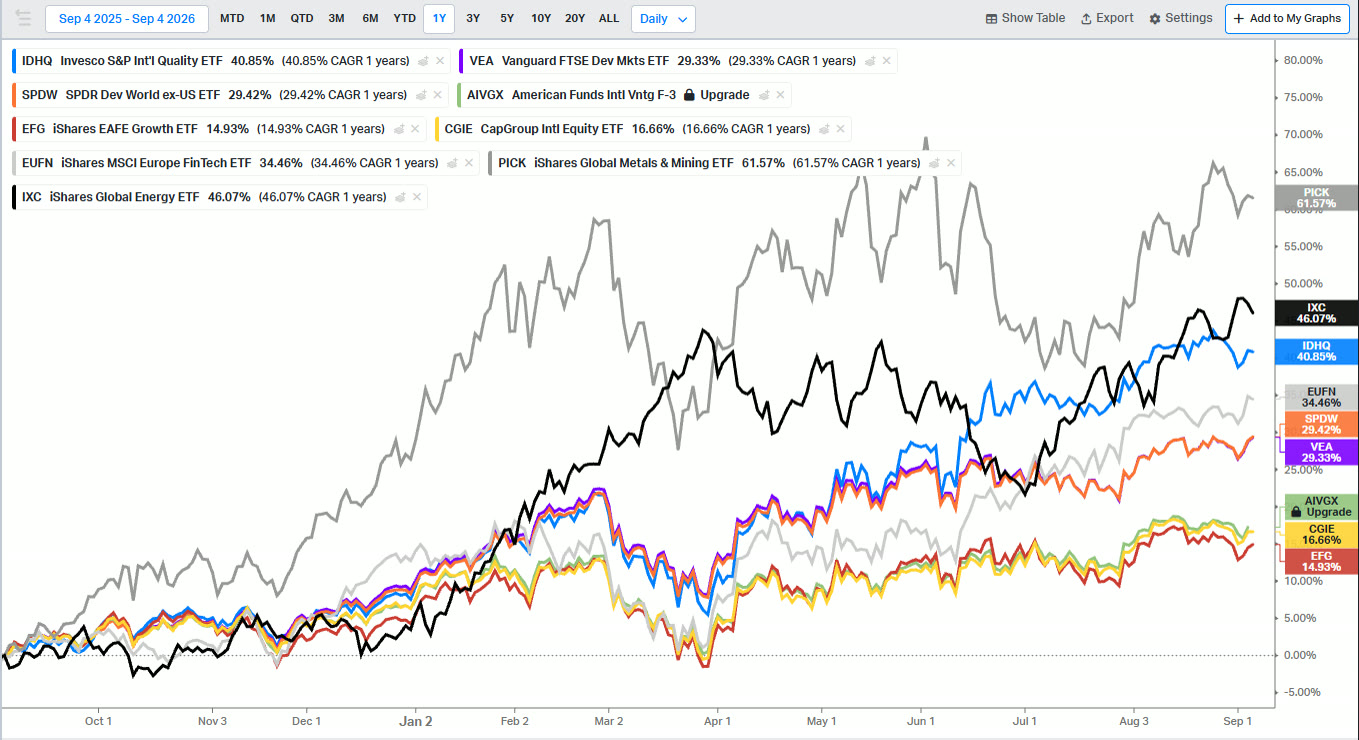
The past year’s leaders: miners, energy and financials, the cyclicals quality funds tend to avoid.
IDHQ vs CGIE: How They Compare
I wouldn’t expect IDHQ to beat the market by 10%+ in a year very often, especially when the market is up so much. But this highlights the key difference between the two. Both invest mainly in high-quality companies, but in different ways:
IDHQ (passive, 0.29%): focused on the quality factor, with downside protection as a by-product. In a major up market, I’d expect IDHQ to do better most of the time.
CGIE (active, 0.54%, very cheap for an active fund): focused on downside protection, with quality as a by-product. In a downturn, I’d expect CGIE to do better most of the time.
It won’t happen that way every time, but over 10 downturns and 10 upswings, I think it will more often than not. Both have provided consistently attractive return profiles compared with the broad international market, and in my opinion both are solid quality-oriented international options; which fits better depends on preferences.
In the next part: U.S. quality funds, including one whose parent mutual fund has crushed U.S. growth stocks over the past 26 years — and is open to new investors.
Watch the Full Video
Want to Go Deeper? In the Fundamentals of Finance Academy, Ethan breaks down funds and current market events on a live call every other week, and members get the full archive of recorded calls. Learn more about the Academy →
This article is for educational purposes only and is not investment advice. Ethan is a CFA charterholder, but nothing here is a recommendation to buy or sell any security, and it does not take your personal situation into account. Past performance does not guarantee future results. Charts of index returns are for illustration only and don’t reflect the fees, expenses or taxes of any actual investment. Performance data and fund details are as of 09/06/2026 and will change; check each fund’s website for current figures.
