The Ultimate Retirement Income Guide: Dividends, REITs, Covered Call ETFs, High-Yield Bonds, & More
About this article: This article is based on Ethan’s video, originally published on September 19, 2024. Because the written version was published later, returns, yields and fund details reflect data available at the time of the video and have likely changed since. Please check each fund’s website for current figures.
Covered call ETFs, high-yield bonds, business development companies, REITs, dividend funds: there are plenty of ways to generate retirement income, and each comes with trade-offs. In this guide I’ll walk through the pros, cons and role of every major retirement income strategy, and what I think matters most when you put them together.
The Short Version
Higher income usually means more risk, less long-term growth, or both. Both is the worst combination.
The most important feature of a retirement income strategy is that it can grow, so your income keeps up with inflation.
Most covered call ETFs and many high-yield products struggle on that test. Dividend funds, REITs and municipal bonds do better.
The yield itself doesn’t matter. Total return and volatility do. Reinvesting everything and taking systematic withdrawals is often the steadiest approach.
Think of It as a Spectrum
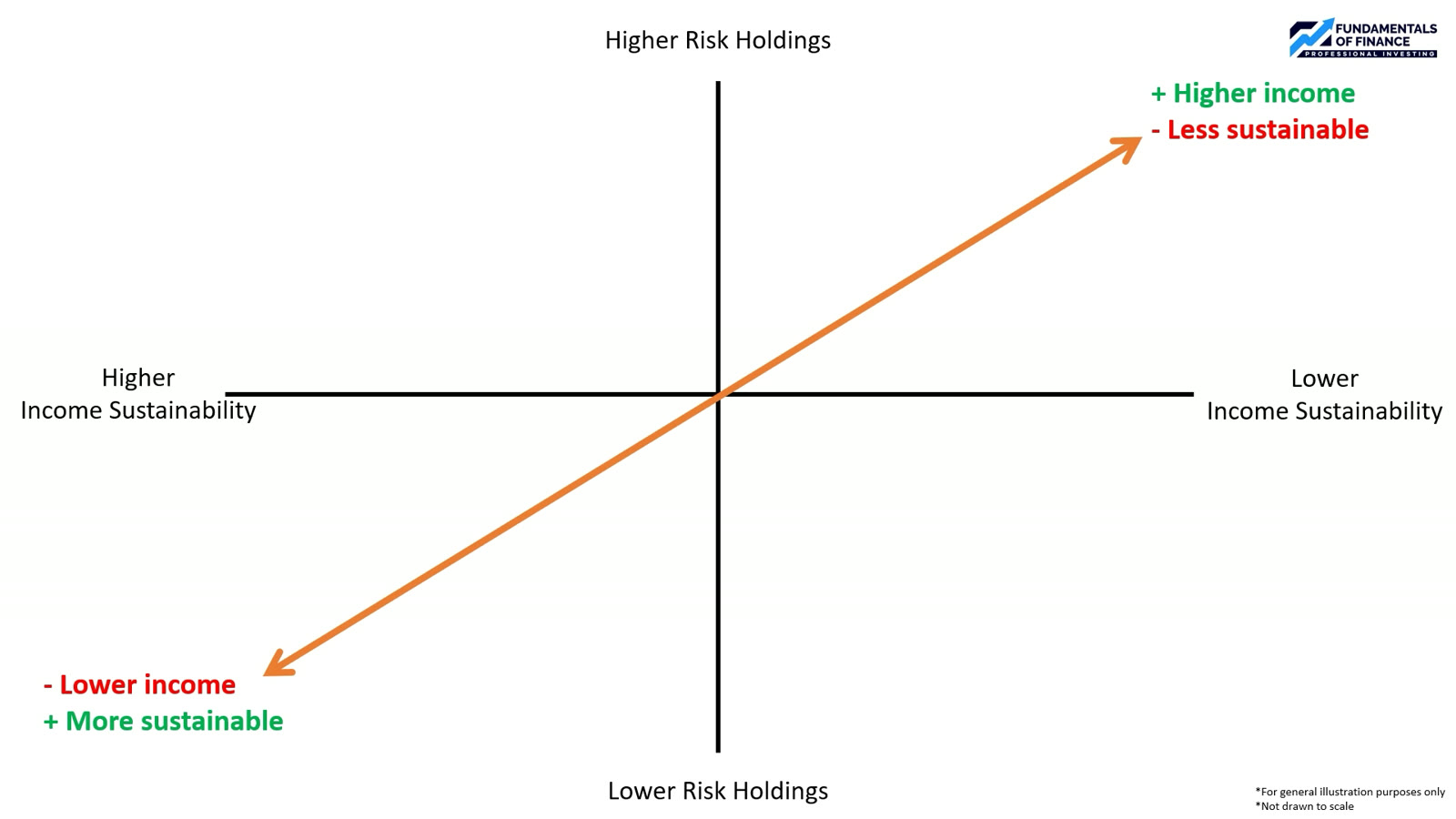
Everyone wants the highest possible income, but like anything in life, there are trade-offs. To get more income you usually have to take on more risk, give up long-term growth potential, or both, and both is the worst outcome.
The single most important thing in an income strategy is long-term sustainability. The prices of what you buy will rise over time, so unless retirement lasts only a few years, a sustainable strategy needs a growing income stream. Without one, a retiree eventually can’t maintain their lifestyle. Throughout this guide, I assume you’re taking the income rather than reinvesting it.
1. Covered Call ETFs
A covered call ETF buys stocks, then sells call options on them. A call option gives the buyer the right to buy a stock at a set price (the strike price), which they’ll only do if the stock rises above it. So by selling calls, the fund keeps a little of the upside and gives up everything beyond the strike price. In exchange, you get a juicy yield, which is the main reason people buy them.
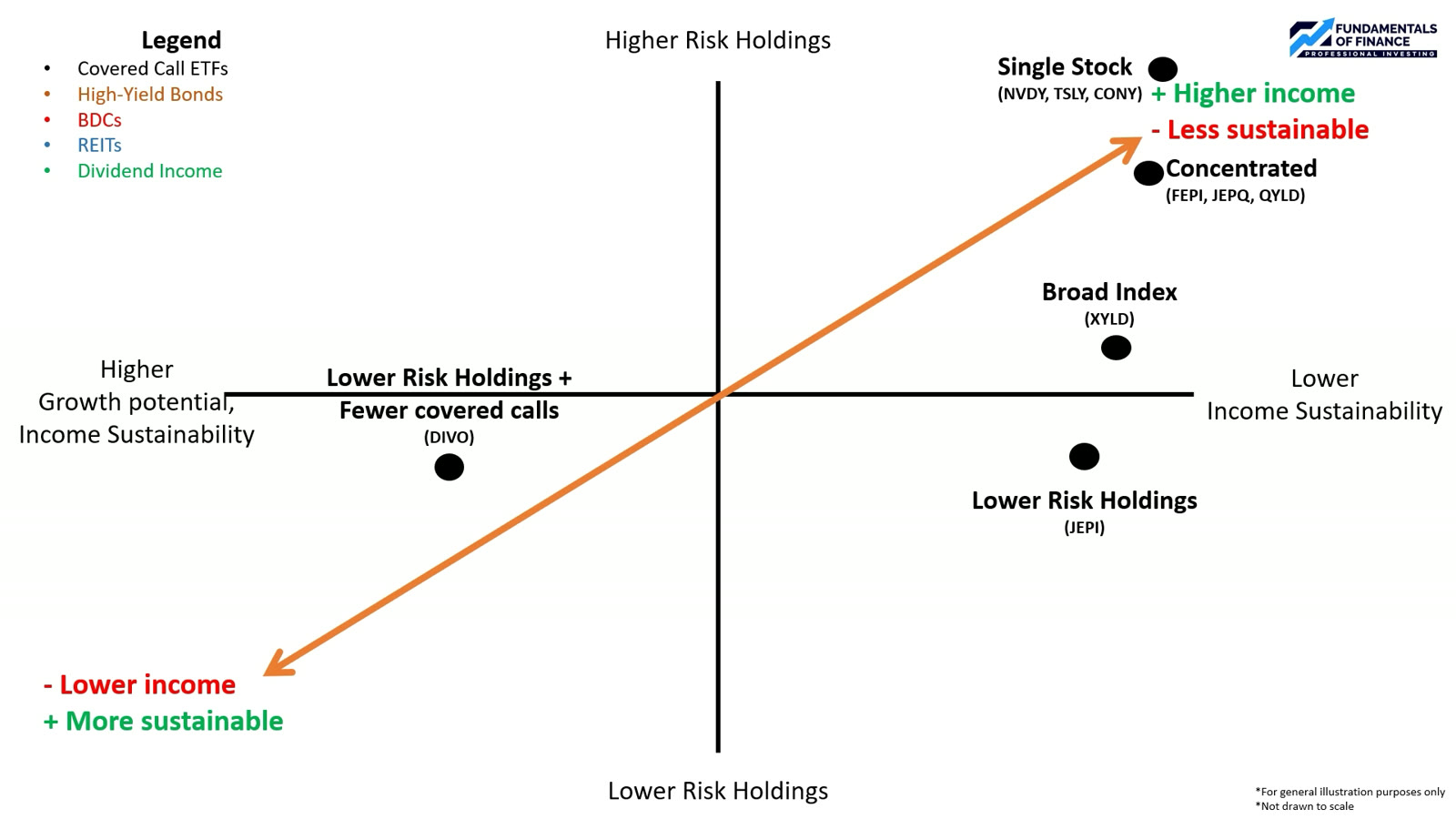
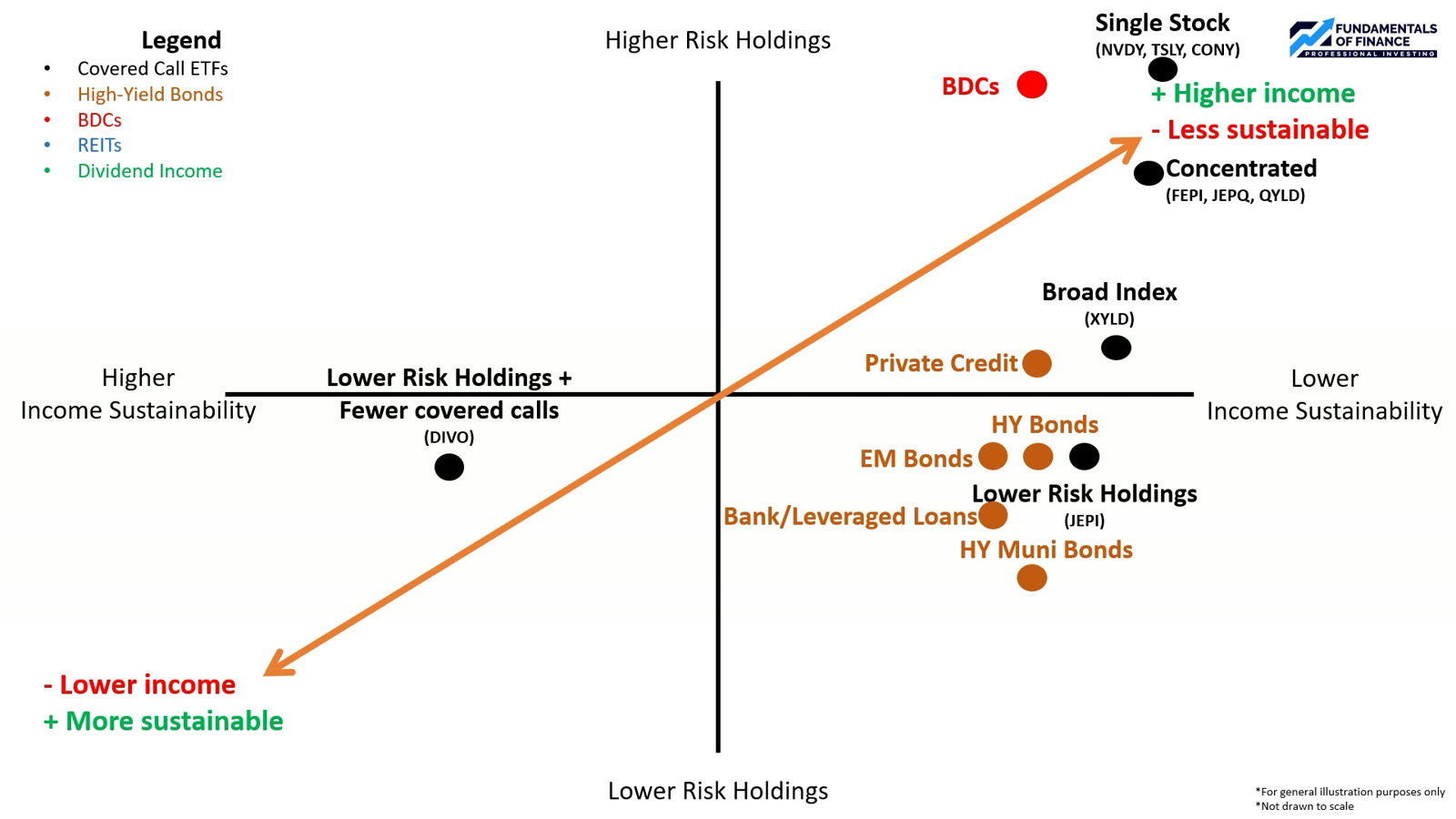
On the spectrum, most of these are among the worst options here. The more concentrated and risky the stocks, and the more of the portfolio they write calls on, the higher the yield and the less sustainable it is. At the extreme are single-stock covered call funds, then concentrated tech ones, then broad-market ones, then lower-volatility ones. Each step down means less risk, less income and a slightly more sustainable stream, but covered call strategies in general aren’t built for long-term sustainability.
The only ones I think can create a sustainable income are those that take a lower-volatility approach and write calls on only a small part of the portfolio. DIVO is an example. The vast majority, in my opinion, are likely to get crushed in the next downturn and struggle to recover, so the income may look great now but has a good chance of shrinking over time. That’s the opposite of what a long-term income strategy needs.
For deeper dives, see JEPQ vs GPIQ vs QQQI and How to Use JEPI in a Portfolio.
2. High-Yield Bonds, in All Their Flavors
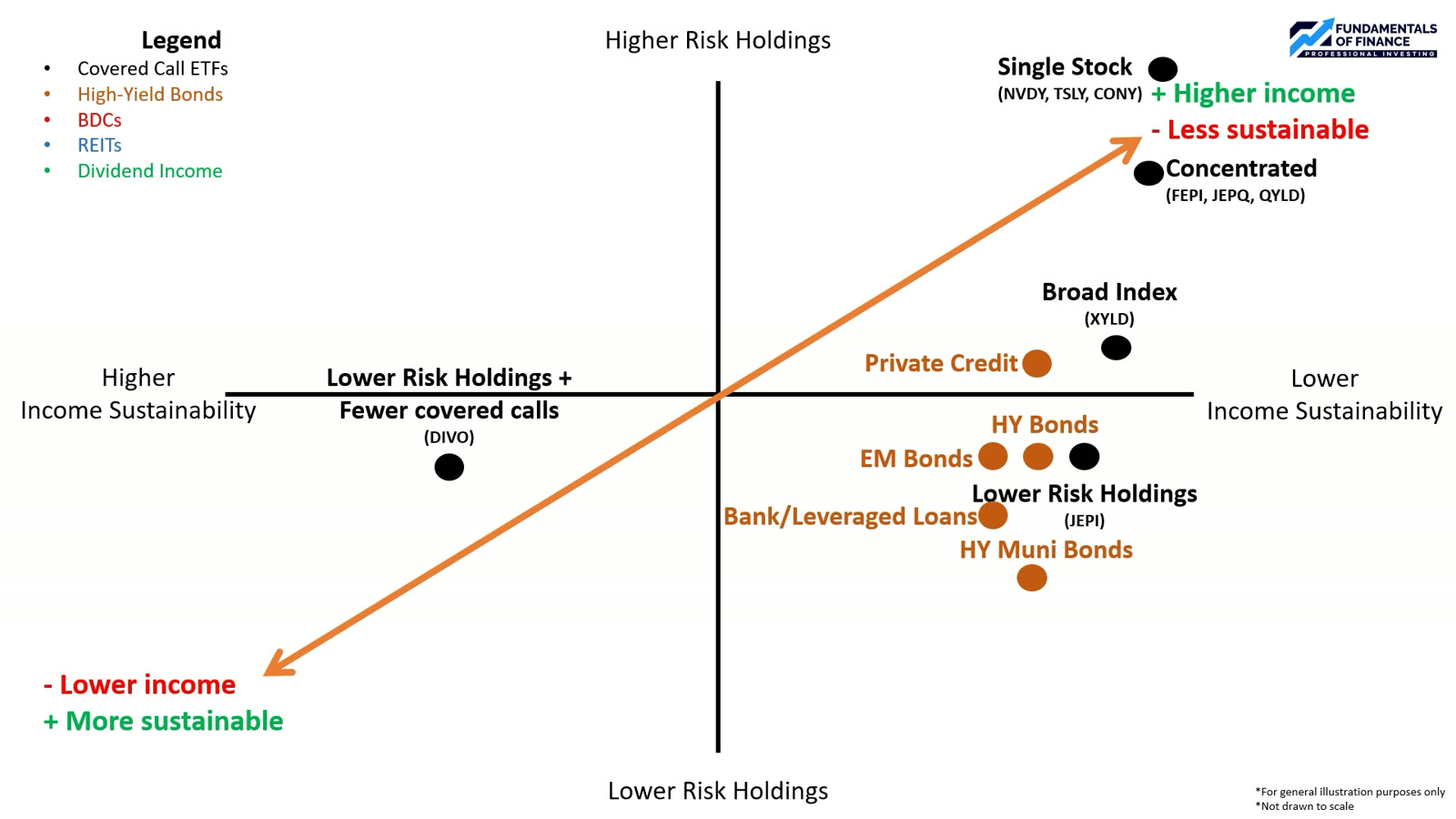
All of these lend money to higher-risk companies or governments. When you lend money you want it back, and the less likely you are to get it back, the higher the yield you demand. So between two high-yield bond funds, the one with the higher yield is usually taking more risk. Some of these also have a lot of downside and behave more like stock funds.
Traditional High-Yield (“Junk”) Bonds
These mostly lend to risky companies. I think of them as generally less risky than the stock market but exposed to many of the same risks. When the economy is strong and profits rise, stocks usually rise, and it’s easier for companies to pay their debts, so high-yield bonds do well too. When profits fall, both suffer. They’re usually a bit less risky than stocks because bondholders are ahead of stockholders in a bankruptcy: often the stock goes to zero while bondholders recover something like 40% (with a wide range of outcomes). Still a huge loss, but usually smaller.
The spread, the extra yield over Treasuries, tells you how attractive they are. A wide spread means more perceived risk and more yield, and that has usually been the best time to buy for a five-plus-year horizon, even though it feels worst, with scary headlines everywhere. As of September 2024, spreads were around 3–3.5%, low by historical standards, and with Treasuries near 5%, many funds yielded around 8% after expenses. Low spreads mean the market is complacent and you aren’t paid much for the risk, so I didn’t find them especially attractive then. In general, though, they can be a solid component of an income strategy.
High-Yield Municipal Bonds
These lend to riskier state and local governments instead of companies. The key takeaways:
The yield looks lower, at least on the surface, for two reasons:
They’re less risky. Local governments can go bankrupt, but it’s much rarer than with companies.
They’re often tax-exempt federally and sometimes at the state level. For example, in a 40% tax bracket, a 5% muni yield equals an 8.33% taxable yield.
They’re much less correlated with stocks than other high-yield options, because a stock market drop doesn’t hit government finances as directly as company finances. That makes them a better complement to stocks.
For high earners investing in a taxable account, I think these can be an excellent part of a retirement income portfolio.
Emerging Market Bonds
These lend to riskier countries. Their risk is broadly similar to U.S. high-yield bonds, though both vary widely by borrower. I think of them as adding international diversification to a high-yield allocation: sometimes they do better or worse, sometimes they yield more or less, and both can serve as the higher-risk, higher-yield part of an income strategy.
Bank Loans (Leveraged Loans)
Usually risky floating-rate loans. Some consider them slightly safer than high-yield bonds because they’re repaid first in a bankruptcy, but they still lend to risky companies and have had some nasty blow-ups. I would by no means call them safe.
Because the rate floats over a benchmark, borrowers pay more when rates rise. Over most of the past 15 years they’ve offered lower returns with similar risk to high-yield bonds, but they can help if you expect rising rates. In September 2024 they actually yielded a bit more than high-yield bonds, often 9–10%, thanks to higher rates. That’s poised to fall if rates come down, and these funds were seeing record outflows on recession and rate-cut fears.
Private Credit
The details of these strategies are so opaque I honestly don’t know where to place them. Usually it’s private lending to small, risky companies that pay high yields because they can’t easily borrow elsewhere. The market has grown so fast that yields and lending standards have been falling. It reminds me of the mid-2000s subprime mortgage market. It’s not a perfect comparison, but an opaque, new, fast-growing industry lending to risky companies with loosening standards makes me nervous. That isn’t a reason to avoid it entirely, but any private credit product deserves thorough due diligence.
Why I Prefer Active Management in High Yield
Stock indexes put the most money in the largest companies. Bond indexes put the most money in the most indebted ones. If you were lending to friends, would you pick the one who already owes the most? That’s insane, so why buy an index that does it? In general, active managers have a much higher success rate in bonds than in U.S. stocks.
3. Business Development Companies (BDCs)
BDCs are essentially closed-end funds that invest in small, risky, often private companies, either early-stage or financially distressed. Unlike typical fund managers, they take a hands-on role, more like venture capital or private equity. Most of their investments are loans or preferred stock, so they generate a lot of income, and they must distribute 90% of profits, so they’re popular for high yields.
They can offer high returns, high yields and some growth. But they combine leverage with a dangerous mismatch: investors can sell their shares on an exchange at any time, while the underlying private companies can’t be sold on a whim. If lots of investors head for the exit at once, leverage and illiquidity can turn against you quickly. To me that’s not an attractive risk/reward profile for a retirement income investor, though with careful due diligence some BDCs can play a small role.
4. REITs (Real Estate Investment Trusts)
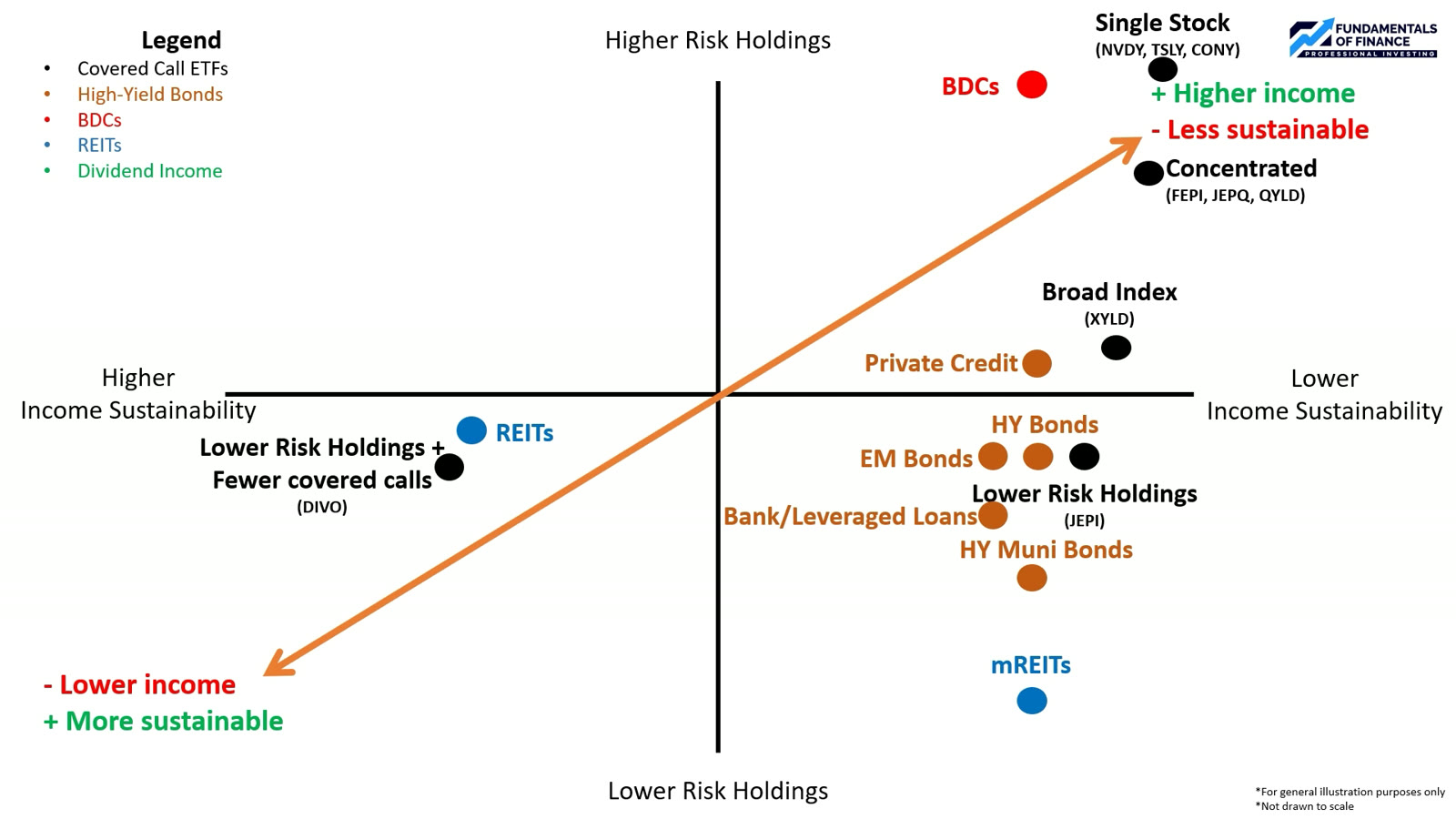
REITs own, and usually manage, income-producing real estate. Like BDCs, most trade on exchanges and must distribute 90% of profits.
Mortgage REITs (mREITs) invest in mortgages and mortgage-backed securities, so they’re essentially bond funds. They usually yield less than equity REITs, are often lower risk, and have limited ability to grow income, but they’re less likely to deteriorate quickly than the riskiest options above.
Equity REITs are more common and come in many categories that perform very differently. Commercial real estate has been in a rough spot, but that’s a big oversimplification: the weakness has mostly been in offices, as remote work leaves buildings half empty. REITs owning data centers, apartments with rising rents, or self-storage have generally fared better. It’s a lot like stock market sectors, where different sectors tend to do better at different times.
Broadly, REITs offer stock-like returns that historically haven’t moved in lockstep with the stock market, which makes them a nice complement to stocks and bonds. Because they hold mostly income-producing assets, they pay more income, so if you take all of it, growth potential is limited, but not zero. Property values and rents tend to rise over time, especially with inflation, which can help protect your income. To me, REITs are another high-quality option as part of a retirement income portfolio.
A word to the wise: some non-traded REITs have historically carried very high fees and broker commissions, around 8%. When a REIT is recommended, it’s worth understanding why. A big commission for the broker isn’t a good reason.
5. Dividend Income Funds (My Personal Favorite)
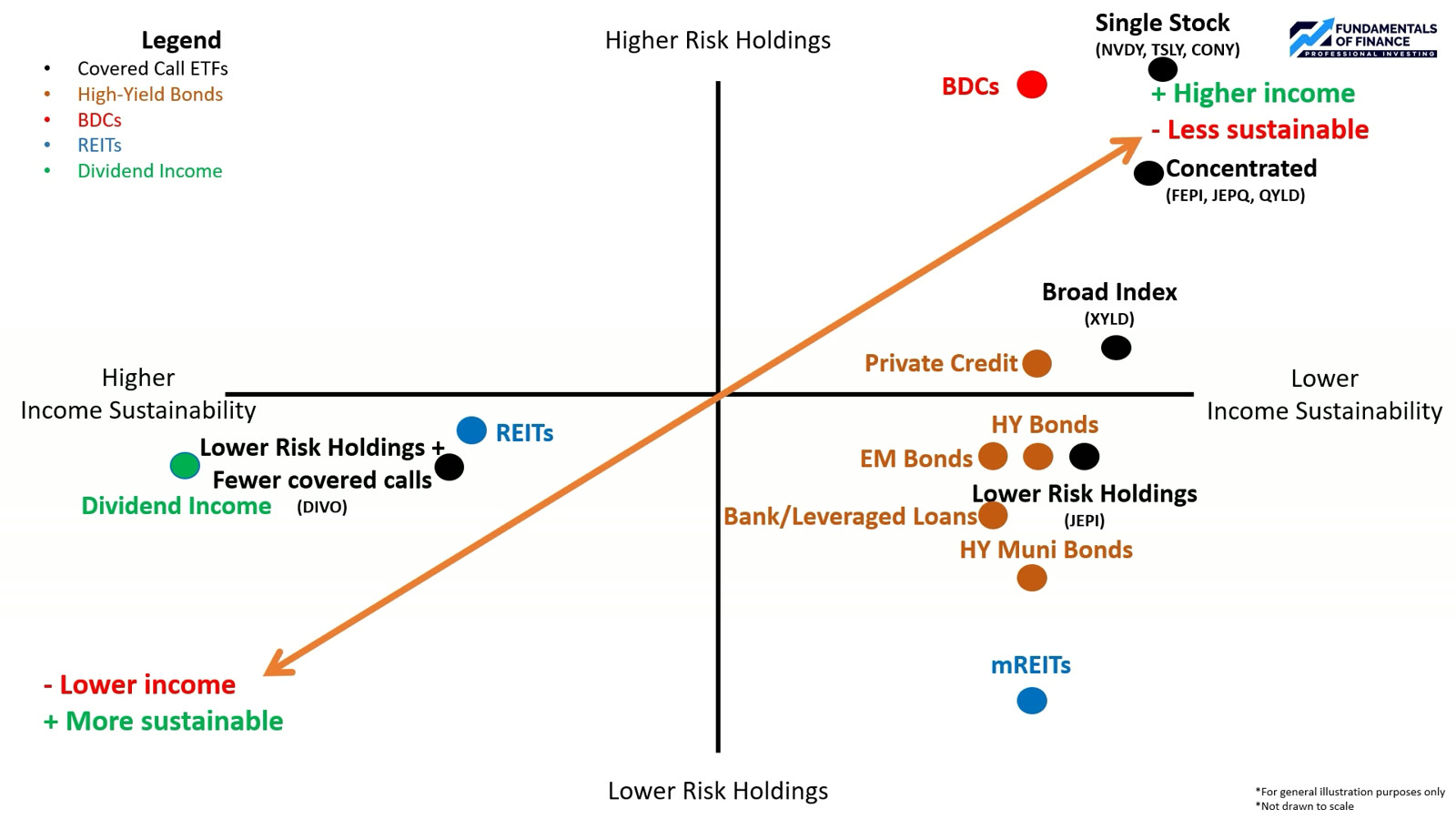
These hold diversified portfolios of stocks that pay out part of their earnings as dividends. They generally yield less than everything else here, except perhaps conservative mREITs, but they’re also more tax-efficient than everything else here except municipal bonds (assuming it was in a taxable account).
Most other options are taxed as ordinary income. Qualified stock dividends are taxed at lower rates (a 20% maximum and 15% for most people, as of September 2024), and much of a stock’s return comes as capital gains, also taxed at lower rates if held over a year. And compared with the broader market, dividend payers, especially companies that consistently grow their dividends, tend to hold up better in downturns.
Of all these options, I’d argue dividend funds give you the best chance at a long-term, sustainable income that keeps pace with inflation. It won’t be 10%, but in my opinion nothing really delivers that sustainably. Everyone is different, but if I were building a retirement income strategy for myself, I’d combine dividend-paying stocks, REITs and municipal bonds.
The Two Big Lessons
1. Your Income Has to Be Able to Grow
If it can’t keep up with inflation, your lifestyle will have to shrink over time.
2. The Yield Doesn’t Matter (Except Sometimes for Tax Reasons)
Many ultra-high-income products are asset-gathering gimmicks. What really matters is volatility and total return.
Volatility matters because the more you lose, the harder it is to recover, and taking income makes it worse. If your investments return −10% and you withdraw 5%, your portfolio falls 15%. The next year, if they return 15% and you withdraw 5%, you only gain 10%. Every bit you lose takes disproportionately more return to make up.
Total return matters because a dollar in your account can become a dollar of income, and a dollar that isn’t there can’t. If your account value falls, your dividend payments in dollars fall too, even if the percentage yield stays the same. You can’t buy groceries with percentages. If you put money in something very risky, like a single-stock covered call ETF, and take all the income, within a couple of years your balance may be far lower. You might still get a 70% yield, but on a much smaller base. And if your portfolio hits zero, a 10% or 1,000% yield is still zero.
A More Sustainable Approach
The most sustainable approach is a diversified, tax-efficient portfolio that earns enough return with low enough risk to meet its goals. Income products create variable, unpredictable payouts. In my view, it’s often better to reinvest all dividends and take systematic withdrawals of whatever is needed, which creates a consistent paycheck based on actual spending needs.
As a general rule, a 4–5% annual withdrawal rate is considered sustainable over the long run, though it depends on what you own. If you’re comfortable with your money running out over 30 or 40 years, you may be able to take a little more. Many people benefit from working with an advisor on a specific plan, but I hope this gives you a clear map of the options and how they compare.
Next, read How to Transition Your Investments as You Near Retirement, or start from the beginning with Asset Allocation: The Ultimate Guide.
Watch the Full Video
Want to Go Deeper? In the Fundamentals of Finance Academy, Ethan breaks down funds and current market events on a live call every other week, and members get the full archive of recorded calls. Learn more about the Academy →
This article is for educational purposes only and is not investment advice. Ethan is a CFA charterholder, but nothing here is a recommendation to buy or sell any security, and it does not take your personal situation into account. Past performance does not guarantee future results. Charts of index returns are for illustration only and don’t reflect the fees, expenses or taxes of any actual investment. Performance data and fund details are as of 09/19/2024 and will change; check each fund’s website for current figures.
