How to Use JEPI in a Portfolio (And Why It's Not a Bond Replacement)
About this article: This article is based on Ethan’s video, originally published on April 1, 2024. Because the written version was published later, returns, yields and fund details reflect data available at the time of the video and have likely changed since. Please check each fund’s website for current figures.
JEPI, the JPMorgan Equity Premium Income ETF, is one of the most popular income funds around. In this article I’ll show you how to think about it the way my partner Kyle and I used to show financial advisors: what it is and how it’s managed, how it tends to behave in different markets, and where it can (and can’t) fit in a portfolio.
The Short Version
JEPI is a U.S. stock fund that sells covered calls for income, built as a lower-risk version of the S&P 500.
In most downturns it should lose less than the S&P 500 but more than bonds. In the 2020 crash it barely protected at all.
JEPI is not a replacement for bonds. 2022 was a rare exception that set unrealistic expectations.
Capping gains at about 2% a month is a costly trade over time. JEPI trailed the S&P 500 by about 25% since 2020, even with its income.
What JEPI Is
At its most basic level, JEPI is a U.S. equity covered call ETF. It buys stocks, then writes, or sells, call options on them.
A call option gives the buyer the right to buy a stock at a set price, called the strike price. They’d only want to do that if the stock rises above that price. So when JEPI sells those options, someone else gets the upside if the stocks go up a lot. You keep a little of the upside and give up anything beyond the strike price. In exchange, you get a juicy yield, which is the main reason people buy JEPI. When this was written, its 12-month yield was almost 8%.
How JEPI Is Managed Differently
JEPI differs from a typical covered call ETF in a few important ways. First, it’s actively managed. It starts with the stocks in the S&P 500, but instead of copying the index, the managers try to build a lower-risk version of it. That matters: if you’re giving up upside, you want some protection on the downside too.
For example, it limits how much can sit in any one sector or company. The more exposed you are to one thing, the more you’re at risk if it goes wrong. If interest rates rise, a new wave of tech regulation hits, or a trade war disrupts key materials for tech companies, that would likely hurt the S&P 500 more than JEPI, because the S&P is more concentrated in tech.
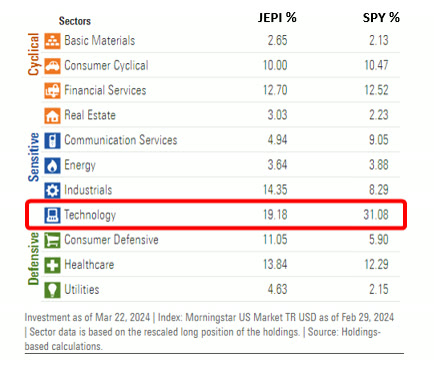
JEPI held about 19% in technology versus about 31% for the S&P 500 (SPY).
Even when a downturn isn’t tech-led, JEPI should usually lose less than the S&P 500, for two reasons: the option income offsets some of the losses, and it owns a lot more defensive stocks.
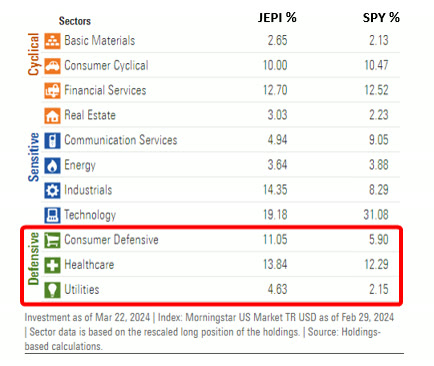
JEPI leans much more on defensive sectors: consumer defensive, healthcare and utilities.
JEPI Is Not a Bond Fund Alternative
That downside protection is compared with the S&P 500. I’ve heard JEPI described as a possible alternative to a fixed income fund, and let me be clear: it is in no way an alternative to bonds.
Yes, both pay income, but they’re vastly different. Bonds usually have low or even negative correlation with stocks, which means that when the stock market falls, bonds often rise (2022 was an anomaly). JEPI may hold less volatile stocks than the S&P 500, but it still holds stocks. If the market is down, JEPI will most likely be down too.
For a retiree with stocks for growth and bonds for stability, swapping the bonds for JEPI would be very dangerous. That mix works because the bonds usually rise while the stocks fall. If the part of your portfolio meant to protect you is falling too, it won’t protect you very well.
The Evidence From Past Downturns
To get a longer track record, I’ll use JEPIX, the mutual fund version of JEPI. As you can see, it performs essentially the same.
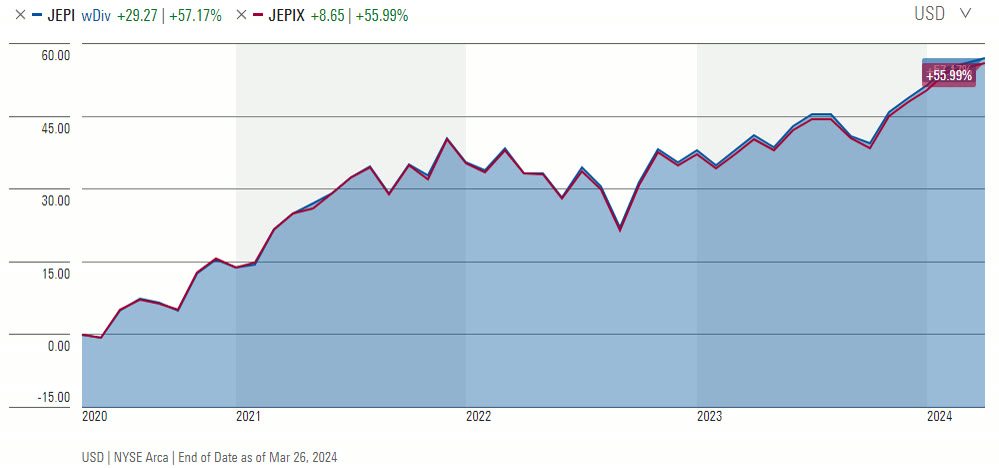
JEPI and JEPIX, its mutual fund twin, track almost exactly.
In the fourth quarter of 2018, the S&P 500 (SPY, red) fell almost 14%. JEPIX fell less, a little over 8%, but it definitely still fell. The Vanguard Total Bond Market fund (BND, green) rose almost 2%.
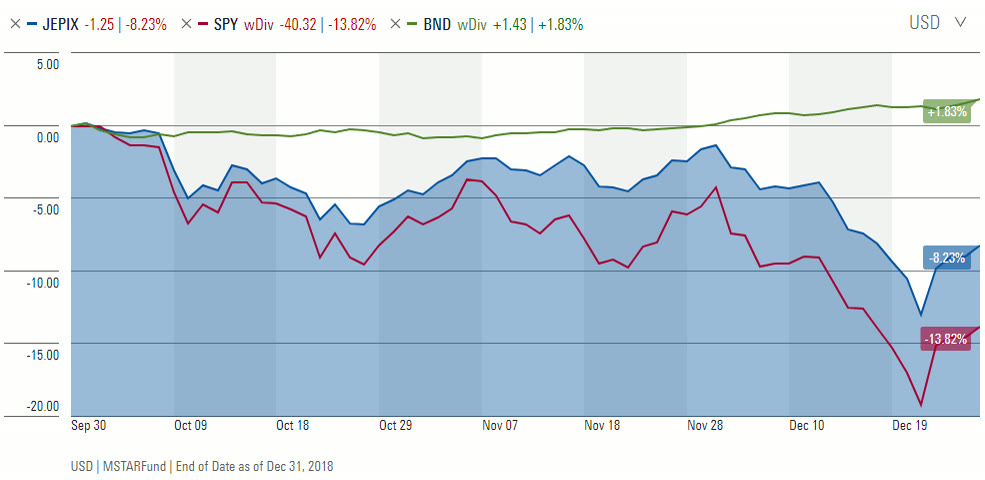
Q4 2018: SPY −13.8%, JEPIX −8.2%, BND +1.8%.
It was a similar pattern in the dips of May 2019, July–August 2019 and September–October 2019.
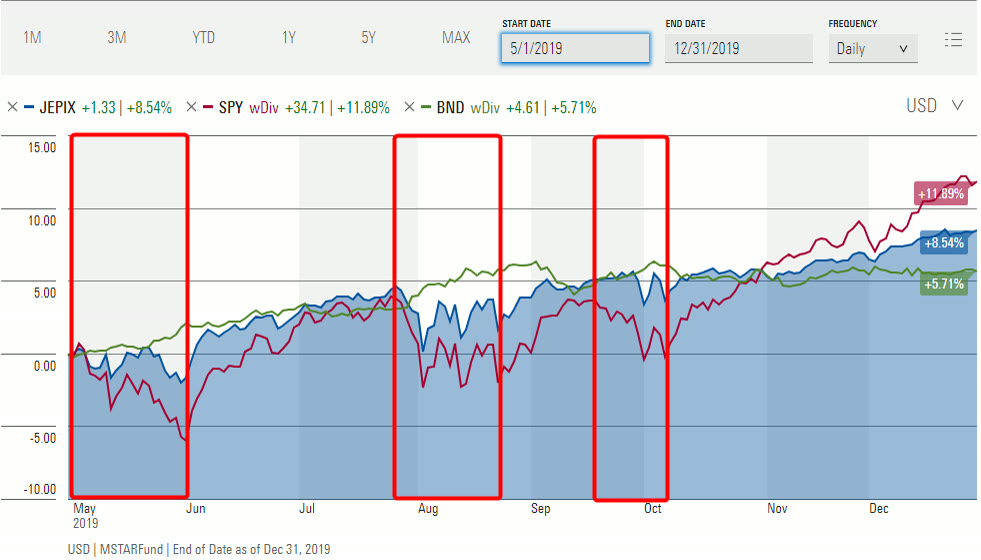
Three dips in 2019, with the same pattern each time.
The most important period is early 2020. When the S&P 500 fell broadly and rapidly, JEPIX provided hardly any downside protection, and BND beat it by over 30%.
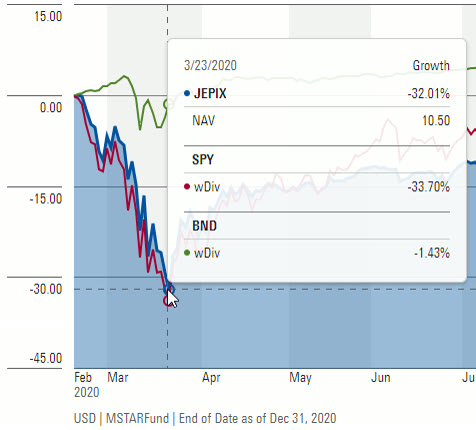
The 2020 crash: JEPIX −32.0%, SPY −33.7%, BND −1.4%.
What to Expect in Different Kinds of Downturns
Every downturn is different, but these periods are a good blueprint:
A narrow downturn led by one sector, especially tech: JEPI should hold up better than the market, because it’s less concentrated in tech.
A gradual downturn: JEPI should also hold up better, because the option income builds a cushion. But that takes time. An 8% yearly yield is about 0.67% a month. If the market falls 12% over a year, an 8% cushion is nice. If it falls 12% in a month, a 0.67% cushion won’t make you feel much better.
Any downturn not driven by rising rates: most bonds should hold up significantly better than both JEPI and the S&P 500. When people get scared they rush to safe assets like Treasury bonds, pushing bond prices up exactly when stocks are being sold. If a recession leads the Fed to cut rates, that boosts bonds further.
Why 2022 Was Misleading
2022 was the rare downturn when JEPI protected better than bonds. It was a perfect storm: the decline was gradual; it was narrow and driven by tech; and it was partly caused by rising interest rates, so bonds didn’t hold up. It was one of the worst years on record for bonds.
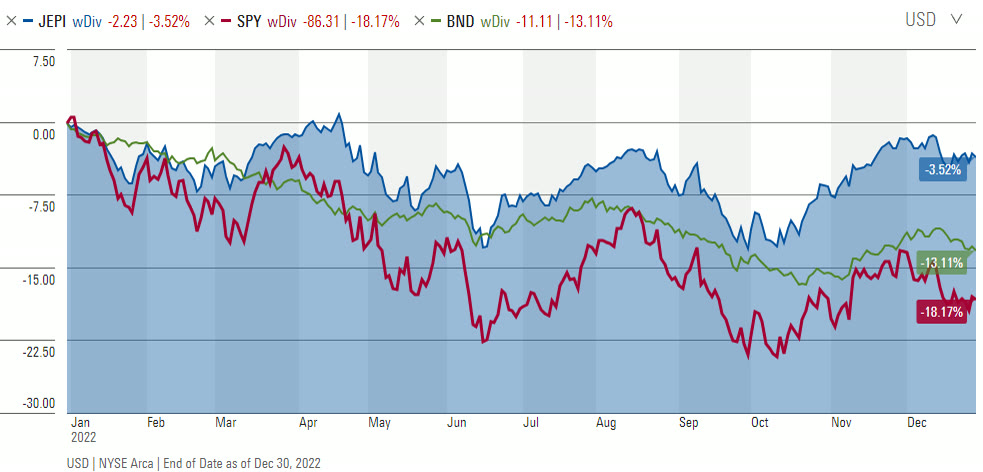
2022: JEPI −3.5%, BND −13.1%, SPY −18.2%.
Since that’s the only major downturn JEPI itself has lived through, I fear a lot of newer investors are forming unrealistic expectations. It could happen again, but it’s very unlikely, and I’d strongly caution anyone against treating JEPI as a bond alternative.
To recap: in most down markets, I’d expect JEPI to lose less than the S&P 500 but more than bonds. In up markets, it should beat bonds but trail the S&P 500.
The Long-Run Cost of Capping Your Upside
Over the long run, I think JEPI is very likely to trail the S&P 500. Here are all the U.S. covered call ETFs and mutual funds with a 10-year track record I could find. Every single one got smashed by the S&P 500, and that should surprise no one.
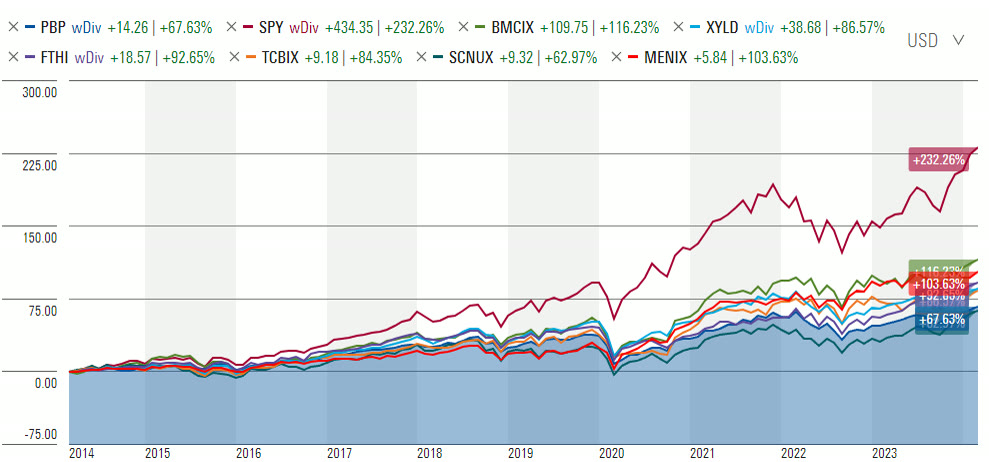
Every U.S. covered call fund with a 10-year record trailed the S&P 500 (red).
Selling covered calls limits upside. JEPI usually sets its calls to cap appreciation at about 2% a month. How often does the S&P 500 rise more than 2% in a month? More than you’d think: about five months a year, on average, over the past decade.
Here’s the real kicker. As of the end of February 2024, the S&P 500’s 10-year return was 12.7% a year. If you’d missed every monthly gain above 2%, it would have been −2.2% a year. You actually would have lost money.
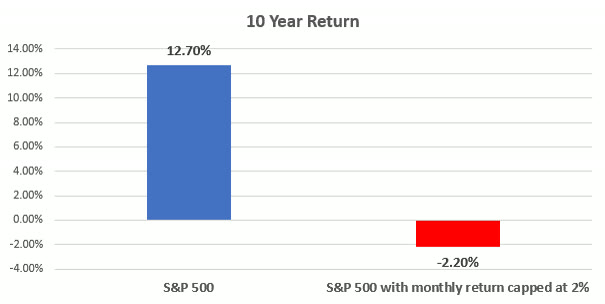
10-year S&P 500 return: 12.7% a year, versus −2.2% with monthly gains capped at 2%.
That’s the paradox of covered call ETFs. Income is higher when volatility is higher, and everyone wants that income. But higher volatility also means more extreme months, both up and down, so more of the long-term return comes from short rallies that covered call funds miss, while the losses are bigger in bad times. You capture most of the downside and miss most of the upside.
The only environment where I’d expect a fund like JEPI to beat the market is a flat one, and over long periods that almost never happens. JEPI does a better job than most covered call funds at building a lower-volatility portfolio, but it can’t avoid those extremes entirely, and its income isn’t enough to make up for the return it gives up. Since launching in 2020, JEPI has trailed SPY by about 25%, even after all the income it paid.
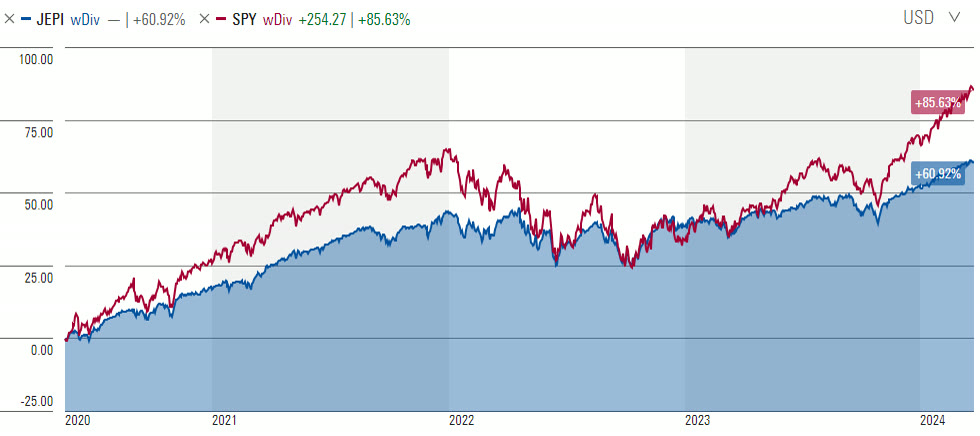
Since 2020, with dividends: JEPI (blue) versus SPY (red).
Where JEPI Fits, and Where It Doesn’t
So where does JEPI belong in a portfolio? In my opinion, in very few.
Young investors: someone once asked me, “Don’t you want at least one covered call ETF for constant monthly income, even if you’re young?” In my opinion, no. With a long time horizon, long-term growth matters most, and funds like JEPI sacrifice a lot of growth for income that most young investors probably don’t need.
Holding it in an IRA: a common suggestion, since JEPI’s equity-linked notes make its income less tax-efficient. That’s true, but it doesn’t change the bigger question. If retirement is far off, it’s still unlikely to beat a pure stock fund without covered calls, in an IRA or not.
Retirees taking income: this is where it starts to make a little more sense. But volatility matters a lot in retirement, and JEPI is still a stock fund. It’ll usually be less volatile than the market, but it isn’t a bond fund, and in a short, sharp downturn like 2020 it may not protect you much at all.
Where I think JEPI can make sense is for an investor who needs a high income, doesn’t need much long-term growth, and uses it as the lower-risk part of their stock allocation. Being blinded by the income and forgetting the downside risk is a recipe for disaster.
A Different Way to Create Retirement Income
Personally, I’m not a fan of most covered call ETFs. Giving up most of your upside while keeping most of your downside isn’t a good long-run deal. Even for retirees who want income, I think there’s a better approach.
Instead of worrying about how much your investments pay out, you can reinvest all the dividends and capital gains, then set up a systematic withdrawal plan. Any brokerage account can do it, and it gives you a steady monthly payment that feels much more like the paycheck you had while working, without having to pick funds by their yield.
Think of it this way: a dollar in your account can become a dollar of income. It doesn’t have to arrive as a dividend or interest payment. In fact, it’s often more tax-efficient to skip funds like JEPI and get more of your return from qualified dividends and long-term capital gains. Bonds can lower your portfolio’s volatility, which helps you sustain those withdrawals. And as you get into retirement, with a shorter time horizon and no salary, volatility matters more and more.
It’s simple math. If your portfolio falls 10%, you need 11.1% to get back to even. If it falls 50%, you need 100%. Each extra percent of loss takes more to recover, and when you’re withdrawing income, a bad year is even harder to make up.
So the approach I prefer for retirement income has three parts:
Enough growth to sustain your income.
Low enough volatility to avoid huge losses.
A systematic withdrawal plan to smooth out your monthly income.
In my opinion, covered call ETFs like JEPI take too much of your long-term return and leave you with too much short-term risk. Their main advantage is the income stream, and you can build a steadier one, with fewer trade-offs and better tax efficiency, using the approach above.
For a look at JPMorgan’s Nasdaq version, read JEPQ ETF Explained, or see how the two compare in JEPQ vs JEPI.
Watch the Full Video
Want to Go Deeper? In the Fundamentals of Finance Academy, Ethan breaks down funds and current market events on a live call every other week, and members get the full archive of recorded calls. Learn more about the Academy →
This article is for educational purposes only and is not investment advice. Ethan is a CFA charterholder, but nothing here is a recommendation to buy or sell any security, and it does not take your personal situation into account. Past performance does not guarantee future results. Charts of index returns are for illustration only and don’t reflect the fees, expenses or taxes of any actual investment. Performance data and fund details are as of 02/29/2024 and will change; check each fund’s website for current figures.
