Momentum Is Getting Crushed: What Happened to SPMO and MTUM, and What's Next
About this article: This article is based on Ethan’s November 2026 video on momentum ETFs. Prices, returns and fund holdings are as of November 13, 2026, and are moving quickly, so they have likely changed since. Please check each fund’s website for current figures.
Momentum investing is getting crushed. A few months ago, the popular momentum ETFs SPMO and MTUM were about 20% ahead of the S&P 500. They’ve quickly given all of that back and are now behind the S&P 500 over the past year. So what happened, and what can you expect from here?
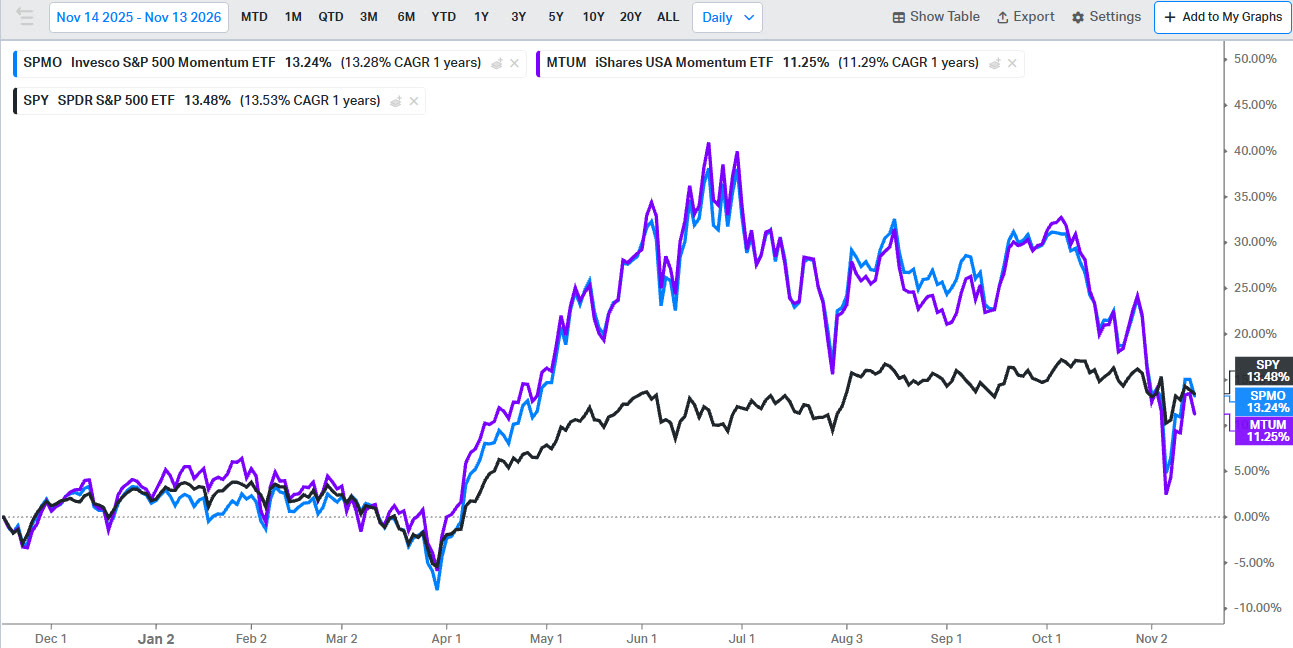
SPMO (+13.24%) and MTUM (+11.25%) versus the S&P 500 (SPY, +13.48%), 11/14/2025 to 11/13/2026.
The Short Version
What happened: worries about AI piled up, tech sold off hard, and momentum ETFs that are roughly half tech went down with it.
How bad: since the selloff began in early October, the S&P 500 fell about 3%, while SPMO, MTUM and tech fell 13–16%.
What’s next: SPMO won’t rebalance again until March, so it stays tied to AI sentiment. MTUM rebalances at the end of November and could look quite different.
The big picture: momentum can beat the market in the long run, but expecting it to win every year, or to hold up in most downturns, is unrealistic.
What Happened
To explain it, let’s go back to what I said in our July 5 video on momentum investing:
“While there are reasons to believe momentum investing could continue to be successful over time, and maybe even more successful than it has been historically, we also have a setup right now that’s closer to what we saw in the late ’90s than we’ve had at any point since, and that was followed by a pretty rough period for momentum investing.”
“As concentrated as momentum strategies are in tech, AI, and especially semiconductor companies right now, they’re highly vulnerable to anything that changes that thesis.”
And that is essentially what happened. Investors have started to worry about all manner of things related to AI:
Where will companies get all the money to build all these data centers?
Will the midterm elections lead to new regulations that slow down data center construction?
Will the trillions of dollars invested in AI infrastructure actually pay off in time?
And what does former Nvidia CEO Jensen Huang’s recent resignation mean for the AI movement that he had so successfully championed and funded?
As I’ve mentioned in prior videos, both of these ETFs are heavily concentrated in tech: around 45–50%, even after the recent selloff.
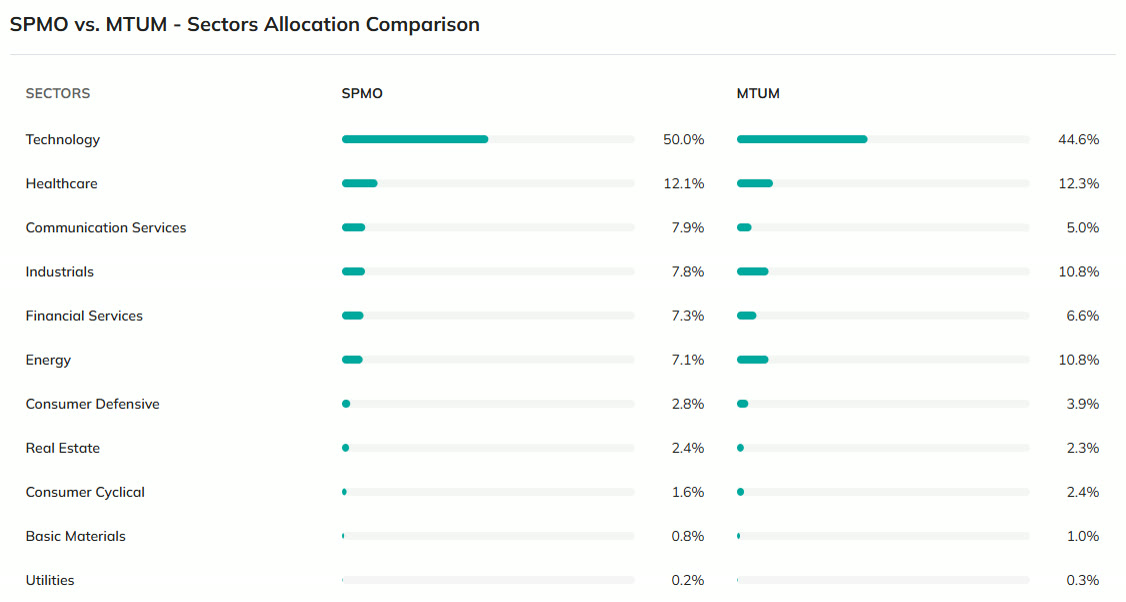
Sector weights: technology is 50.0% of SPMO and 44.6% of MTUM. As of November 2026.
Once those concerns popped up, tech (orange below) sold off massively. The momentum ETFs actually peaked in June, but the real damage came with the broad market selloff that started in October.
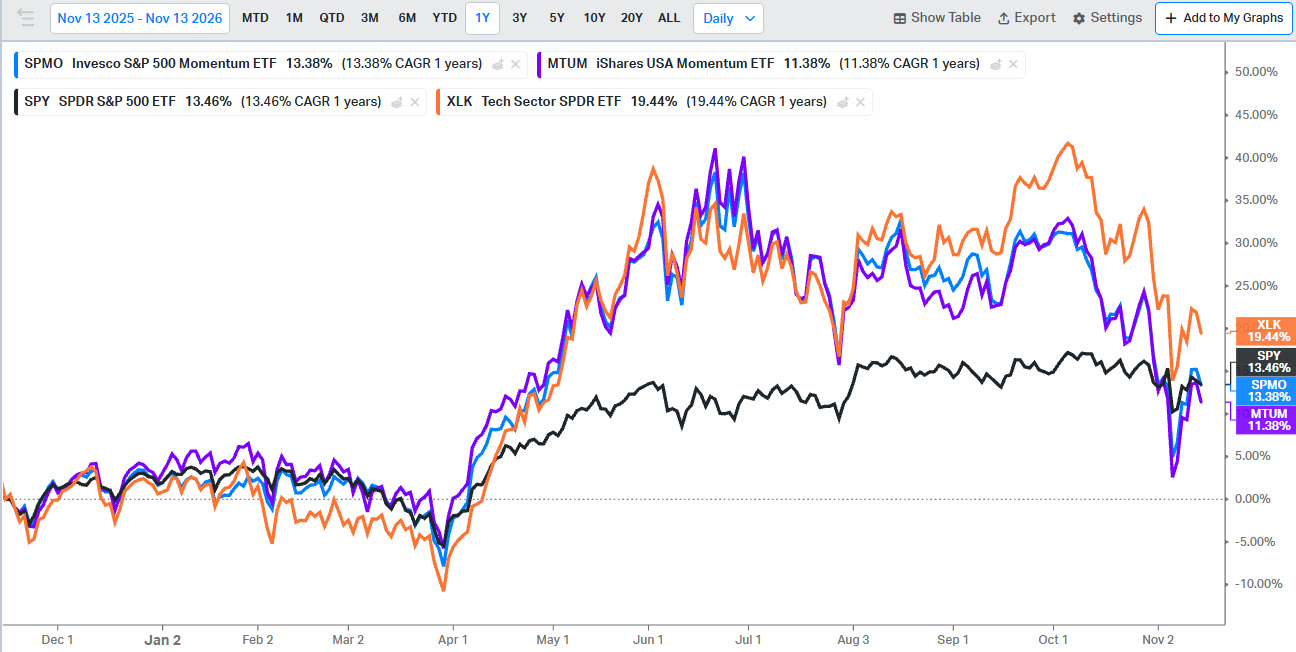
SPMO, MTUM, the S&P 500 (SPY) and tech (XLK), 11/13/2025 to 11/13/2026.
Since then, the S&P 500 has fallen about 3%, while tech and both momentum ETFs have fallen at least 10 percentage points more than that. No one should be surprised.
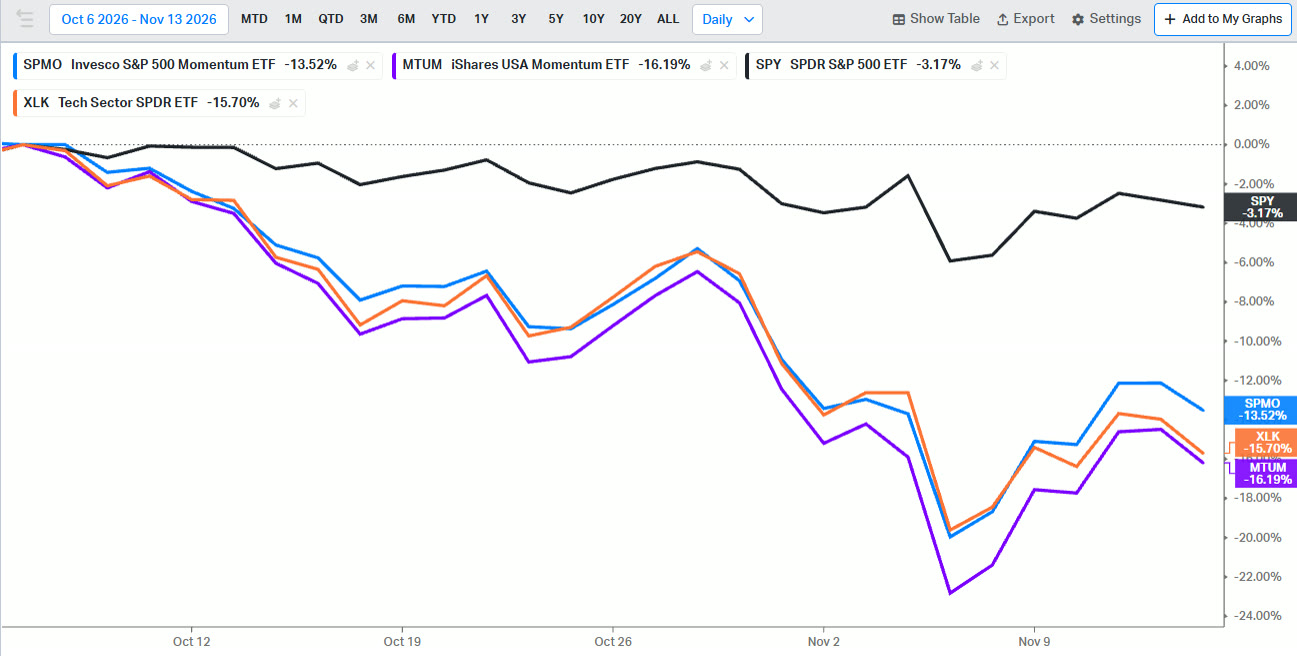
Since the selloff began: SPY −3.17%, SPMO −13.52%, XLK −15.70%, MTUM −16.19%, 10/06/2026 to 11/13/2026.
Why I Point Out Risks
What’s much less certain is what comes next. But first, two reminders. Nobody can perfectly predict the market, but let’s look at what the data is actually telling us. And the point of this channel, which I do for free, is to help you become a better investor.
One of the most important ways I can do that is by helping you see risks and opportunities you might not see yourself. If I point out a risk in something you own, it’s not a personal attack. I’m trying to help you understand what you own so you can make more informed decisions.
Some people understand the risks and are comfortable with them, and that’s fine. I’m the last person who will say no one should ever take investment risk. But many people simply don’t realize how risky their investments are. If I tell you something you don’t want to hear, you’re more than welcome to disagree, but listening to different opinions is how you make your own better informed.
We’ve gotten some… let’s call it constructive criticism for our warnings about momentum investing. Four months ago, one commenter wrote: “As we speak it’s up over 31% YTD while the S&P 500 is up a pathetic 8.4%.” (Halfway through the year, 8.4% is actually a pretty strong return historically, but that’s neither here nor there.) He also said I’m a clown with no idea what I’m talking about. Two months ago, another said nothing I say makes any sense and that SPMO has lower drawdowns than the S&P 500.
I can’t predict short-term market moves, and I wasn’t trying to. But I do know how momentum investing works, and I warned that this would eventually happen, so this downturn shouldn’t surprise anyone. To be clear, I have never said momentum ETFs like SPMO and MTUM are bad or that you shouldn’t invest in them. I’ve just been trying to help investors understand risks they might not see.
What Happens Next
SPMO just reconstituted in September and won’t do it again until March. It dropped Nvidia and Broadcom, but it more or less kept its tech weight by adding to other names like Apple and some of the chip stocks. So it’s still closely tied to sentiment on AI, at least until March.
MTUM, on the other hand, might look different in a couple of weeks. Its index recently switched from rebalancing twice a year to rebalancing quarterly, to keep companies from getting too concentrated after the huge run-ups we’ve had lately, and the next rebalance is at the end of November. MTUM also uses a combination of 6- and 12-month momentum, while SPMO uses just 12 months. So it remains to be seen what MTUM will look like afterward, and there’s a chance it ends up quite different from SPMO, especially if the tech selloff continues for another week or so.
With that caveat, SPMO, and possibly MTUM too, are likely to stay heavily reliant on AI for the foreseeable future. If sentiment recovers in the near term, they’ll probably recover quite nicely, as they have over the past few days. However, the downturn of the last few weeks is only the tip of the iceberg compared with what could happen in a more severe AI downturn, which is a risk scenario investors need to be prepared for.
And as a momentum investor, you just have to be OK with that.
No Factor Works All the Time
Since late June, the momentum ETFs are behind the S&P 500 by about 20%, and that’s been in an up market.
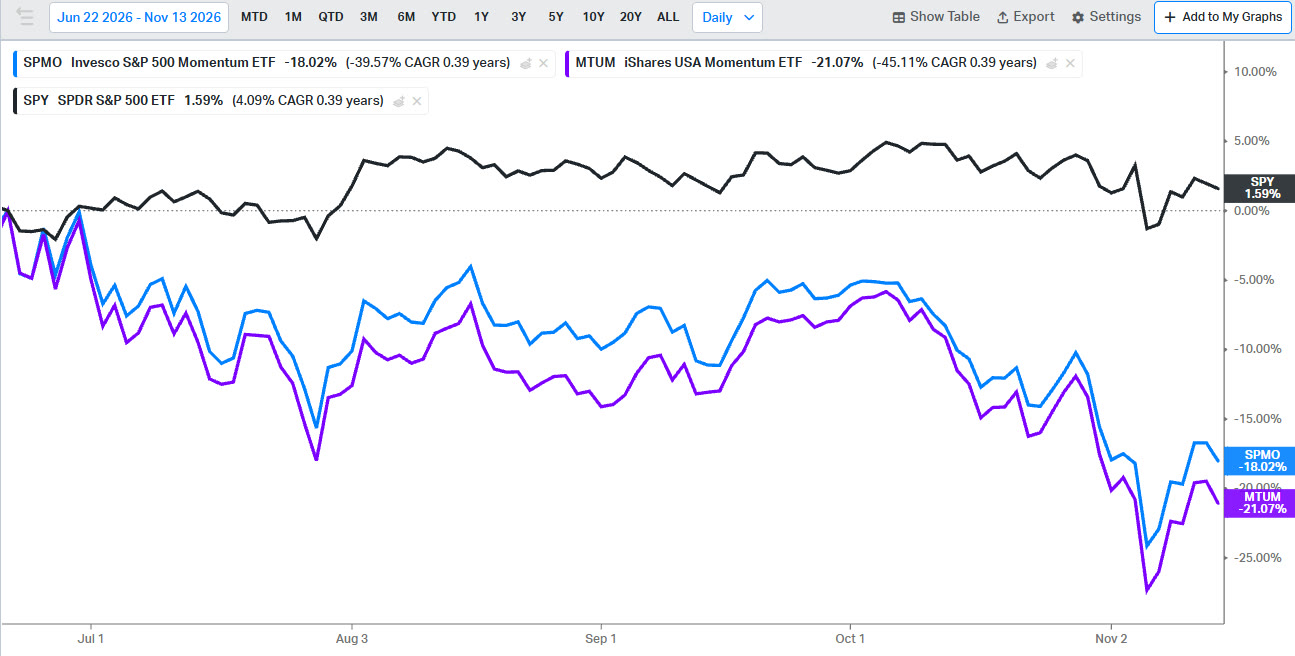
Since late June: SPY +1.59%, SPMO −18.02%, MTUM −21.07%, 06/22/2026 to 11/13/2026.
No factor works all the time. Momentum is one I believe can beat the broad market in the long run, but the idea that it’ll beat the market every year, or that you can expect it to do well in most downturns, is honestly ridiculous.
MTUM even shows this chart on its own website. Over the past five years, it’s been the second most volatile fund in its entire Morningstar category. The most volatile? SPMO.
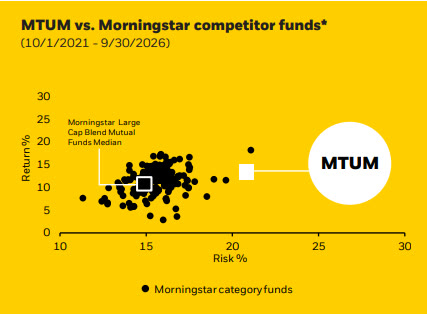
MTUM’s risk and return versus Morningstar Large Blend competitors, 10/01/2021 to 09/30/2026. Source: iShares.
For more background, see our earlier posts: SPMO vs MTUM and SPMO Revisited.
Watch the Full Video
Want to Go Deeper? In the Fundamentals of Finance Academy, Ethan breaks down funds and current market events on a live call every other week, and members get the full archive of recorded calls. Learn more about the Academy →

This article is for educational purposes only and is not investment advice. Ethan is a CFA charterholder, but nothing here is a recommendation to buy or sell any security, and it does not take your personal situation into account. Past performance does not guarantee future results. Fund returns shown are price returns from daily data as of 11/13/2026 and will change. MTUM’s risk and return chart is from iShares and covers 10/1/2021–9/30/2026.
