OMAH ETF Monthly Dividend ETF Pays 15%...But It Could Wreck Your Retirement Plan
About this article: This article is based on Ethan’s video, originally published on May 27, 2025. Because the written version was published later, returns, yields and fund details reflect data available at the time of the video and have likely changed since. Please check each fund’s website for current figures.
The OMAH ETF, named after the “Oracle of Omaha,” promises Warren Buffett’s wisdom with a 15% yield. Berkshire Hathaway has produced incredible returns for decades, but Buffett has been adamant about never paying a dividend. So is OMAH the way to get both? Sort of. In this review I’ll evaluate it the way a professional would: what Berkshire actually is, how OMAH works, and how I’d expect it to do on income, total return and taxes.
The Short Version
OMAH holds Berkshire stock plus the 20 largest stocks in Berkshire’s portfolio, then sells options targeting 15% income a year (1.25% a month).
Over 90% of its stock exposure is Berkshire’s public stock portfolio, only about a quarter of what Berkshire is actually worth.
Its active, call-spread options approach is smarter than most covered call ETFs, for a 0.95% fee.
But you can’t sustainably take 15% a year from investments that earn around 10%. The fund’s value, and your income in dollars, are likely to shrink.
What Is Berkshire Hathaway, Really?
Few people actually know. Is it a company? A mutual fund? Just Buffett’s personal portfolio?
In the 1960s, Buffett bought Berkshire Hathaway, then a boring textile company, and used the cash it generated to buy other businesses. Today Berkshire owns or controls 189 businesses. Those privately held, controlled businesses are worth far more than its stakes in publicly traded companies, yet the public stocks are what most individual investors focus on.
Using rough, simple math on a company worth about $1 trillion:
A bit under half comes from the businesses it fully or mostly owns, generally boring, stable industries: insurance (its biggest is GEICO), railroads, utilities, energy and more.
About a third is essentially cash and Treasury bonds.
Roughly a quarter is its stakes in publicly traded companies, the part most investors focus on.
Keep that last point in mind.
How OMAH Works
OMAH has two parts: core stock exposure and high monthly income from actively written covered calls, targeting 15% a year paid monthly, or about 1.25% a month.
The Stock Portfolio
I’d call it value stock exposure, since most of what Berkshire owns is value-oriented. OMAH buys Berkshire Hathaway stock and the 20 largest public stocks in Berkshire’s portfolio, in the same proportions Berkshire holds them, according to VistaShares’ CEO.
As of May 27, 2025, Berkshire itself was only about a 10% position. Of that 10%, roughly a quarter is Berkshire’s own stock portfolio. So over 90% of OMAH’s exposure is to Berkshire’s public stock portfolio, which is only about a quarter of Berkshire’s value. You’re getting some Berkshire Hathaway exposure, but not the direct investment in the company you probably thought.
The Income Engine
The fund’s stated primary objective is income, with capital appreciation secondary. I’m skeptical it will deliver any capital appreciation for investors taking the income, and more likely the opposite, but more on that below.
One thing I like: they’re willing to use call spreads. Selling a covered call caps your upside, because the option buyer gets every gain above the strike price. A call spread also buys a cheaper call further out, so the fund can participate again if a stock soars.
Here’s a simple example. A stock is at $10. A covered call sells an option for $1 with a $12 strike: you collect $1 of income, keep gains up to $12, and miss everything above it.
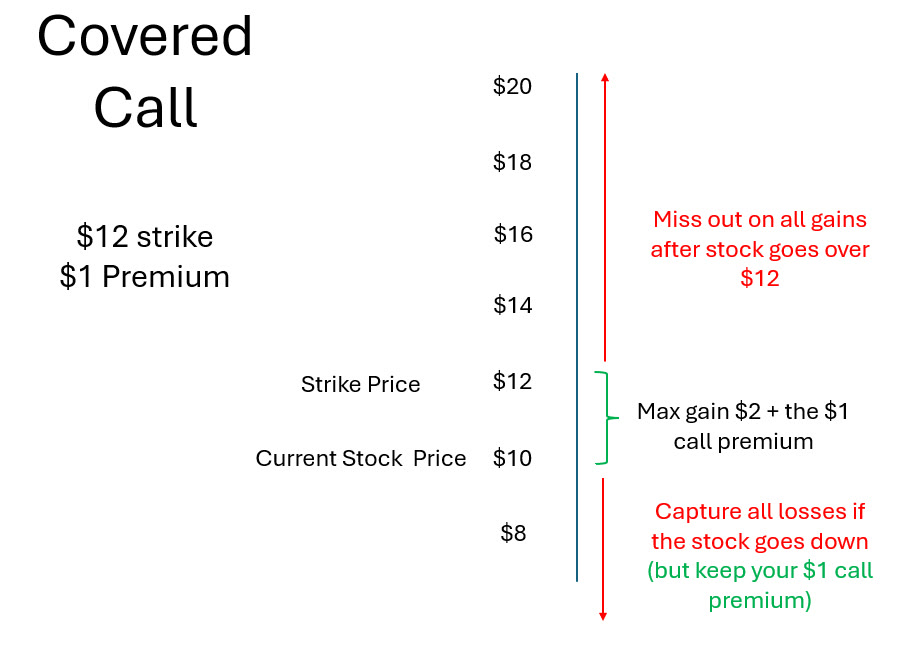
A covered call: collect $1, keep gains up to $12, and miss everything above it.
A call spread also buys a call for $0.25 with a $15 strike. Your income drops to $0.75, but you only give up the gains between $12 and $15. If the stock goes to $20, you capture the gains above $15 again.
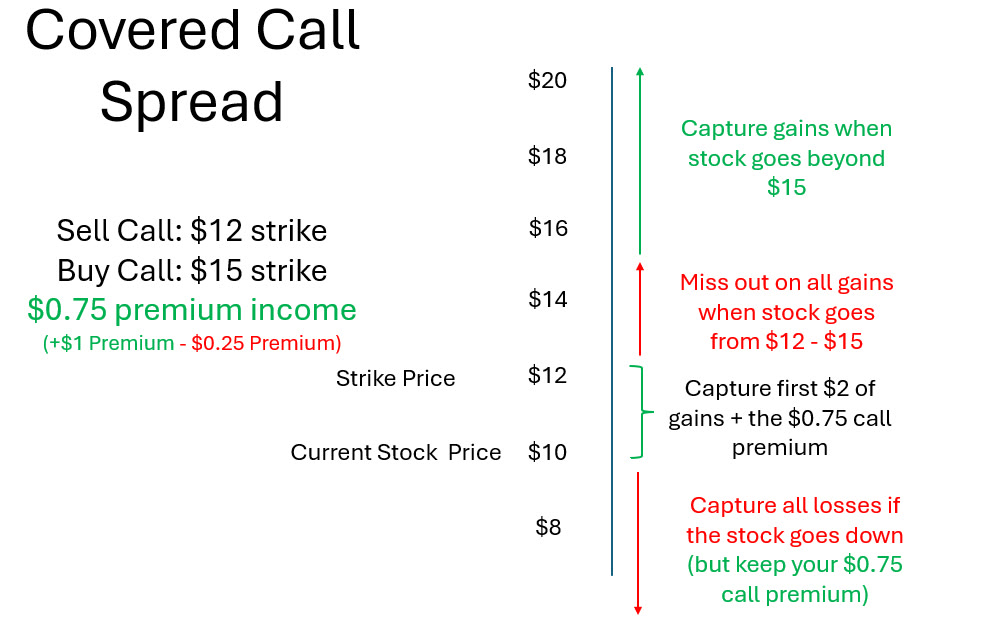
A call spread: $0.75 of income, and only the $12–$15 range given up.
The other nuance: management is active, and they “only” target 1.25% a month. I like this a lot, as long as they make the right calls. It can soften what may be the biggest weakness of covered call ETFs, capped upside. Much of the market’s upside comes in short bursts, and option premiums rise when volatility is high. So in volatile times the fund can hit its monthly target quickly, then reposition to capture more upside. According to the VistaShares CEO, that’s what happened in April 2025: they hit the monthly target in the first week and then focused on upside. I think this approach is better than most covered call ETFs I see. It costs 0.95% a year, which could be worth it if they navigate those periods well.
Five Reasons I’d Think Twice
OMAH has some redeeming qualities: a potentially smarter options approach and a lower-volatility stock portfolio than many covered call ETFs. But I’d think twice for five reasons.
1. Berkshire May Not Generate the Returns It Once Did
Buffett has retired as CEO and handed the reins to Greg Abel. The process is supposed to stay the same, but Buffett wasn’t only running the company; he also managed about 90% of the stock portfolio. Those are huge shoes to fill. In mutual funds, when a great manager retires, the successor rarely repeats their success. That alone would temper my expectations.
2. You’re Not Really Getting Berkshire Hathaway
Over 90% of OMAH’s stock exposure is Berkshire’s top public holdings, about a quarter of Berkshire’s value.
3. Copying Berkshire’s Stocks May Not Capture Its Returns
We only learn what Berkshire bought when it files its quarterly report, more than a month after the quarter ends. Berkshire might buy a stock cheaply in a downturn three or four months before this ETF can. Own Berkshire directly and you get its decisions in real time, plus all its other businesses.
4. It’s Tax-Inefficient
Short-term covered calls on individual stocks will likely be taxed mostly at your ordinary income rate.
5. The Math Doesn’t Work
You can’t take a 15% income stream from investments that earn around 10% a year. Much of what’s called “income” will ultimately be return of your own capital. And if you withdraw money from an account every month, what happens to the account? It goes down.
That’s very likely what will happen to OMAH’s NAV over time. A company that’s a third cash and two-thirds steady, lower-return businesses seems unlikely to earn 15%-plus a year for decades. And if the answer is “because Warren Buffett is amazing,” well, he’s retired.
The yield percentage may stay near 15%, but it’s 15% of the NAV. If the holdings don’t earn enough to cover the payouts, the NAV falls, and so does your income in dollars. At about $19 a share, it starts as 15% of $19, then becomes 15% of $17, 15% of $15, 15% of $10, and so on. Thanks to the call spreads and steadier holdings, I don’t expect the erosion to be as severe as in more high-octane covered call ETFs, but over 10 years I think it’s likely to be significant. In my opinion, a falling income and a falling NAV aren’t a good building block for a long-term retirement plan.
It’s a pass for me. For more on why the yield isn’t what matters most, read The Ultimate Retirement Income Guide.
Watch the Full Video
Want to Go Deeper? In the Fundamentals of Finance Academy, Ethan breaks down funds and current market events on a live call every other week, and members get the full archive of recorded calls. Learn more about the Academy →
This article is for educational purposes only and is not investment advice. Ethan is a CFA charterholder, but nothing here is a recommendation to buy or sell any security, and it does not take your personal situation into account. Past performance does not guarantee future results. Charts of index returns are for illustration only and don’t reflect the fees, expenses or taxes of any actual investment. Performance data and fund details are as of 05/27/2025 and will change; check each fund’s website for current figures.
