Bond ETFs to Complement VOO
About this article: This article is based on Ethan’s video, originally published on May 4, 2024. Because the written version was published later, returns, yields and fund details reflect data available at the time of the video and have likely changed since. Please check each fund’s website for current figures.
In this article I’ll cover some of the top bond ETFs to pair with VOO, and along the way explain how different types of bonds behave in different markets, and why some make much better complements to a stock portfolio than others.
The Short Version
The most important trait in a complement to VOO is low or negative correlation with stocks. That’s why high-yield and emerging market bonds are left out here.
Short-term bond ETFs like ICSH, PULS and FLTB have consistently out-earned CDs without locking up your money.
In bonds, active managers beat their indexes far more often than in stocks. VCRB and CGCB are Ethan’s active core picks; BKAG is the free passive option.
For munis, MEAR (short-term) and MUNI (intermediate, no AMT bonds) stand out. Target maturity Treasury ETFs let you dial in interest rate risk.
What to Look For: Correlation Matters Most
Low costs matter, especially in passive funds, and in active funds I want a record of consistently beating the index with ingredients for repeatability. But the most important thing for any complement to a stock portfolio is low or negative correlation with stocks: it shouldn’t be exposed to the same risks or move the same way at the same time. If you take one thing from this article, make it this.
Here’s a simple example. Two portfolios, each 50% stocks and 50% bonds. In both, stocks rise 20% one year and fall 20% the next, and bonds rise 8% one year and fall 8% the other. The only difference is timing.
Positively correlated (stocks and bonds move together):
Year 1: stocks +20%, bonds +8%, so the portfolio gains 14%. $100 becomes $114.
Year 2: stocks −20%, bonds −8%, so the portfolio loses 14%. $114 becomes $98.04.
Negatively correlated (they move in opposite directions):
Year 1: stocks +20%, bonds −8%, so the portfolio gains 6%. $100 becomes $106.
Year 2: stocks −20%, bonds +8%, so the portfolio loses 6%. $106 becomes $99.64.
Same returns for each asset, but the negatively correlated portfolio ends 1.6% better off after two years. That’s why I’m not covering high-yield, emerging market or other bonds with high credit risk here. They tend to move with stocks, so they’re weaker complements. That doesn’t mean never owning them, just that there are better options for this job.
The categories below are short-term and intermediate core bonds (taxable and municipal), target maturity funds, and a few special situations. There are hundreds of options, many nearly identical, so if one you’re considering isn’t here, that doesn’t mean it’s a bad choice.
Short-Term Bonds: The “CD Killers”
Short-term and intermediate core bond funds differ mainly in duration, or interest rate risk. Shorter means less. Starting with short-term:
In short (no pun intended), I’m not a fan of CDs. You’re essentially paying a bank to invest your money in the same kind of short-term bonds you could buy yourself through an ETF, and you give up some return and lock your money up for a set period. Why do that?
A year earlier, the average 1-year CD paid about 1.5% according to the FDIC. If you shopped around, maybe 4.5–5.25%. Almost every ultra-short-term bond ETF did better.
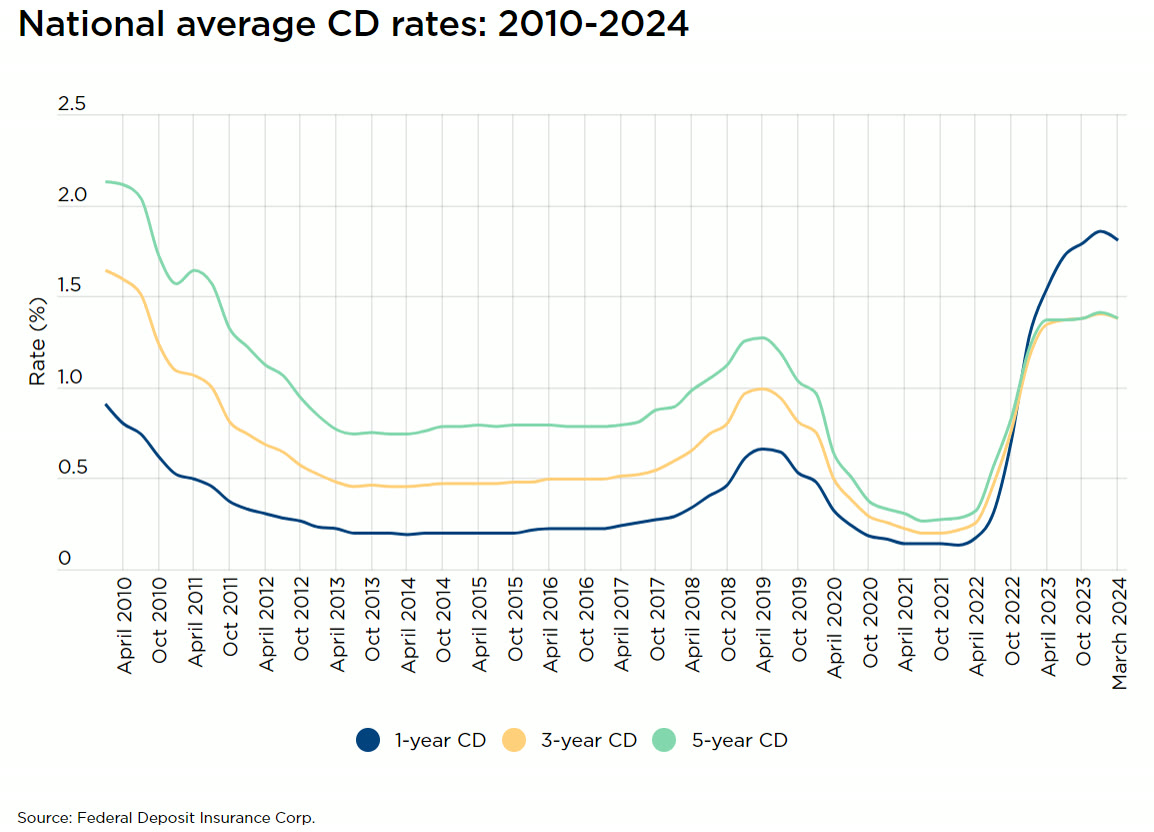
National average CD rates, 2010–2024. Source: FDIC.
For the year ending March 31, 2024:
ICSH (BlackRock Ultra Short-Term Bond ETF) returned 5.64%.
PULS (PGIM Ultra Short Bond ETF) returned 6.61%.
FLTB (Fidelity Limited Term Bond ETF) is a solid option for slightly longer maturities: a bit more interest rate risk, but still very low.
All three are actively managed, as are most funds in this article, because it’s widely known that active bond managers beat their indexes much more easily than active stock managers. If you prefer the cheapest passive option, it’s BSV (Vanguard Short-Term Bond ETF) at 0.04%.
Not convinced active managers can consistently win in bonds? Here’s BSV against the three active funds since April 2018, when PULS launched. BSV (dark blue) returned about 9%.
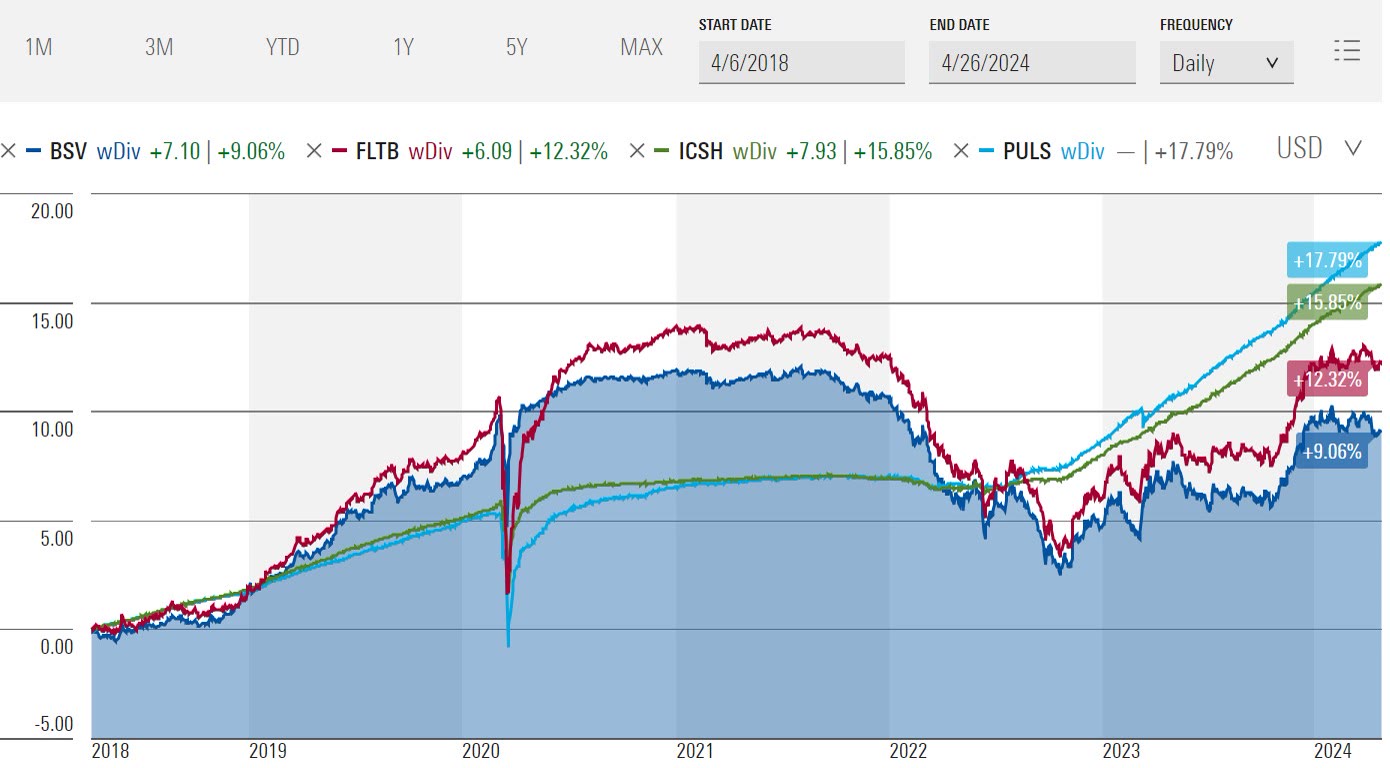
BSV (dark blue) versus FLTB, ICSH and PULS since April 2018.
ICSH and PULS hold shorter-term bonds, so they lagged when the yield curve was normal (short bonds paying least) and have done better with the inverted curve (short bonds paying most). They also carry a bit less rate risk, so they should hold up better when rates rise. While the curve stays inverted, these are the most attractive short-term taxable bond ETFs to me; if rates fall, the other two could do better.
A fairer comparison for BSV is FLTB, which has a similar rate profile. Since FLTB launched in October 2014, it’s been ahead nearly the whole time. It costs 0.25% versus 0.04%, but even after fees it beat the Vanguard fund by about 4.5% over nine and a half years. That’s significant for a high-quality, low-risk short-term fund.
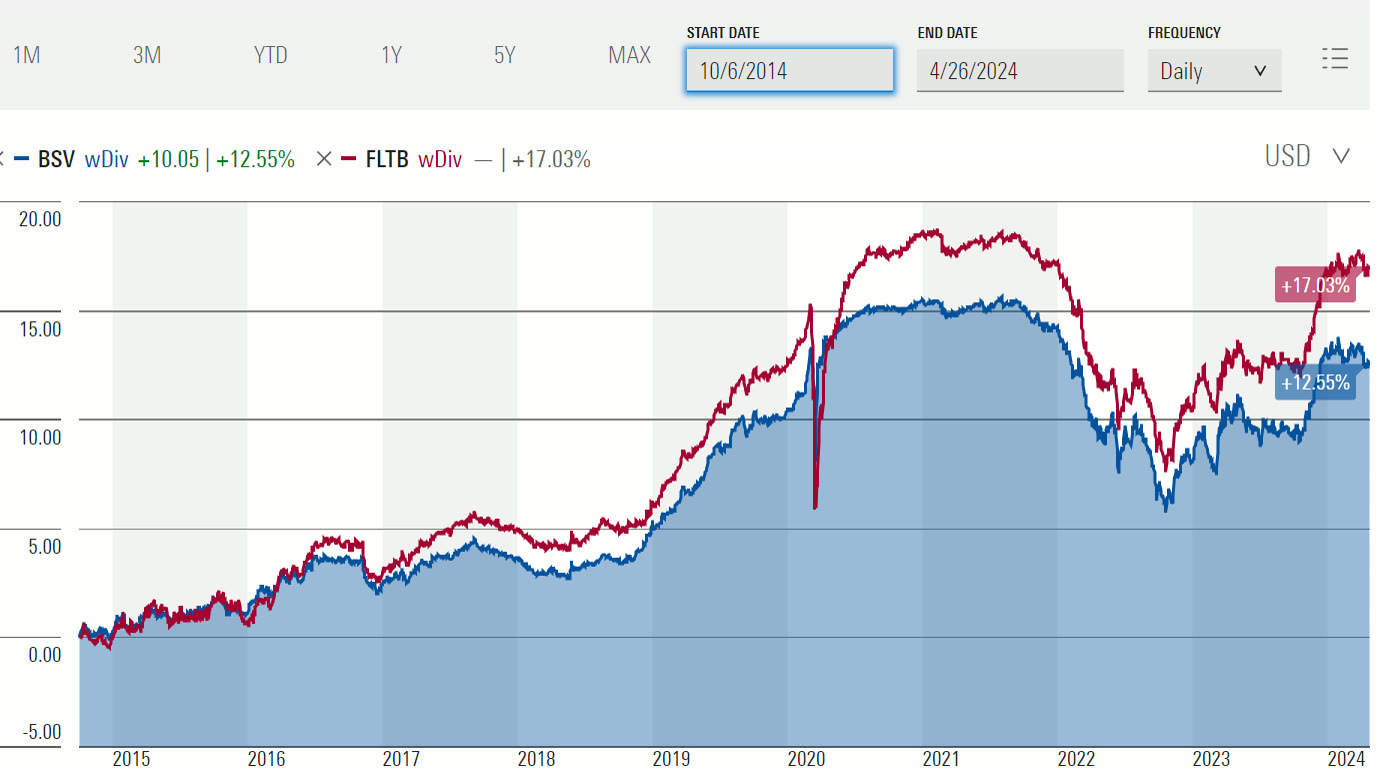
FLTB (red) versus BSV (blue) since October 2014.
Short-Term Municipal Bonds
Municipal bonds are issued by state and local governments and often come with tax benefits, which mainly help higher-income investors. My top passive option here is SUB (iShares Short-Term National Muni Bond ETF, 0.07%), and my top active option is MEAR (BlackRock Short Maturity Municipal Bond ETF, 0.25%). As with taxable bonds, the active MEAR has pretty consistently beaten SUB.
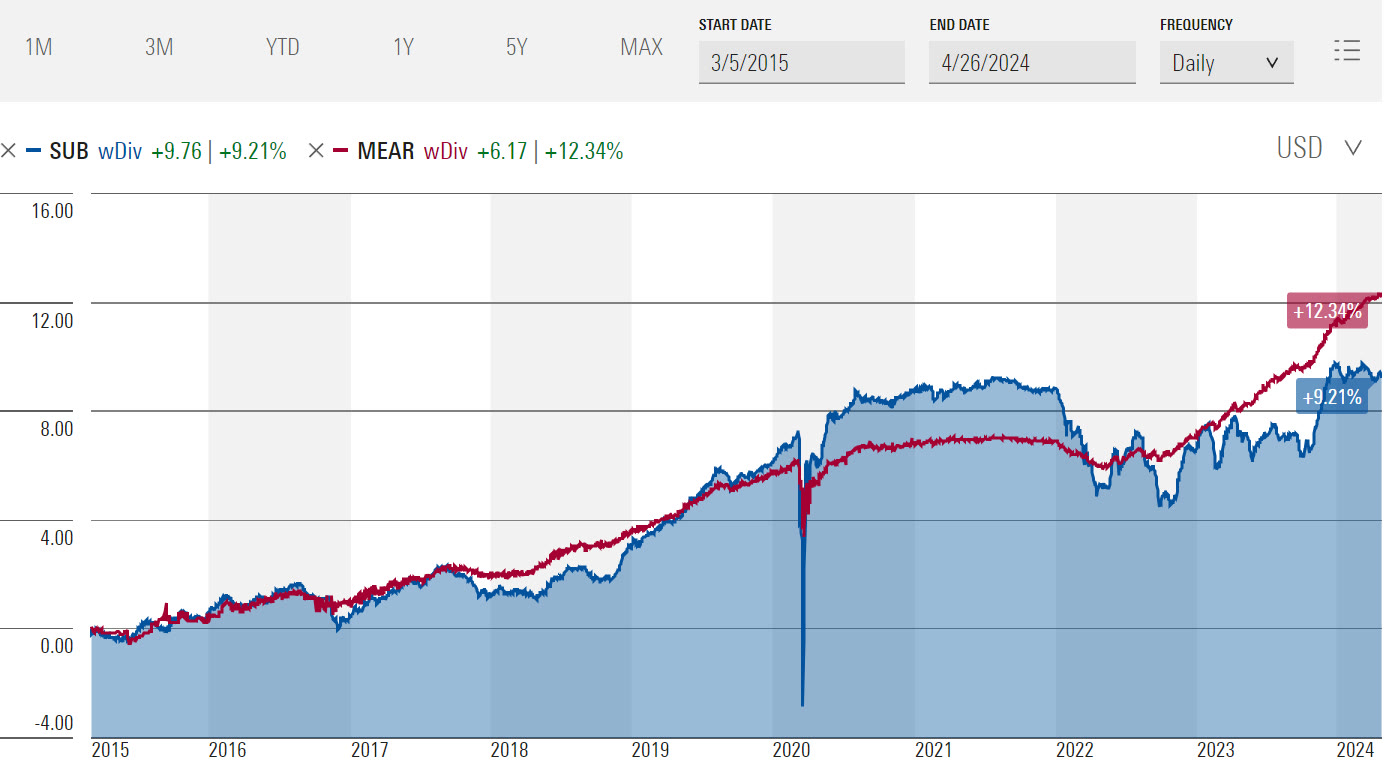
SUB (blue) versus MEAR (red). Note SUB’s sharp spike down in March 2020.
Notice SUB’s sharp drop in March 2020. Liquidity broke down in parts of the bond market, and some ETFs’ prices drifted far below the value of what they held (their NAV). It recovered almost immediately, but many people panic-sold at the bottom and locked in losses. Measured by NAV, the drop was much smaller.
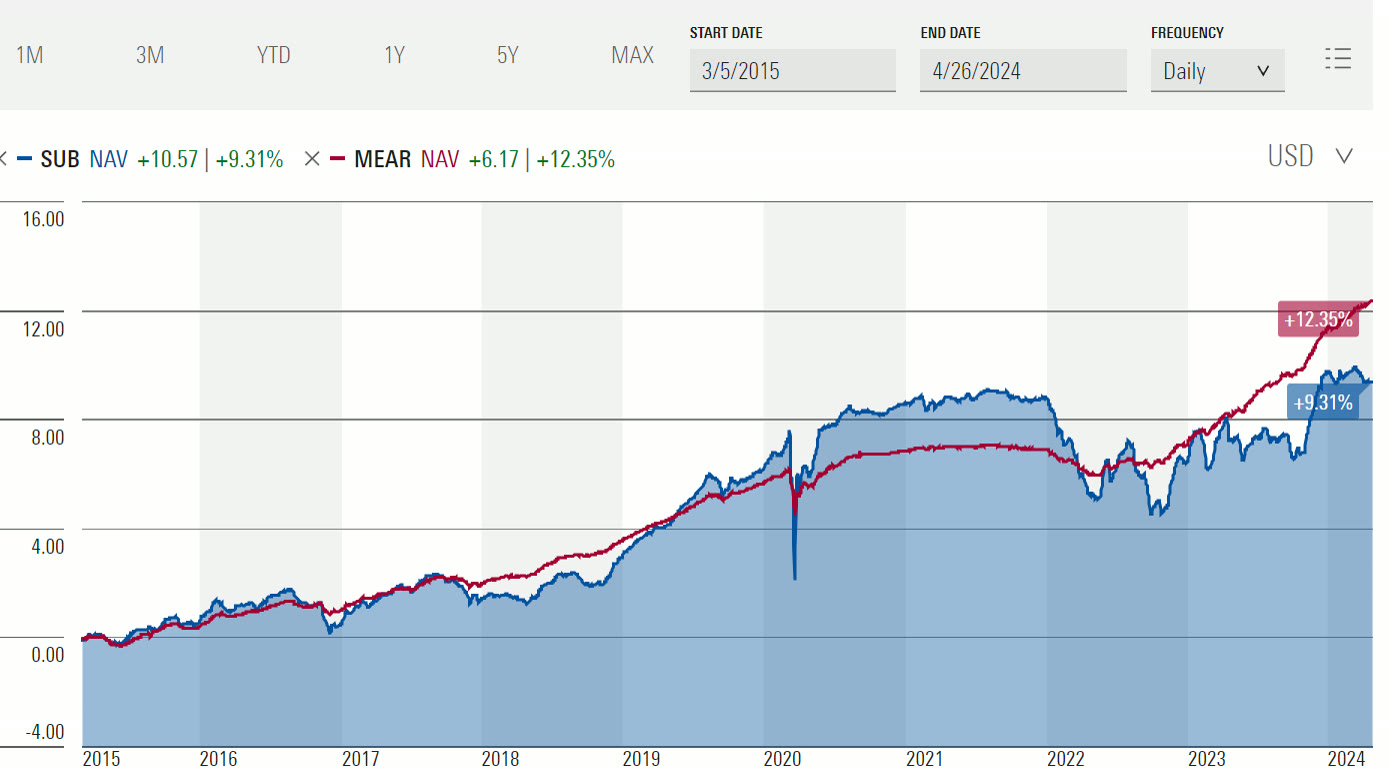
The same comparison using NAV returns: the March 2020 dip is much smaller.
That can happen to any ETF, so it isn’t a reason to avoid SUB. It’s a lesson: if a high-quality bond ETF suddenly plunges, check its NAV. If the gap is far wider than normal, it’s likely to snap back once markets calm down.
Intermediate Core Bonds: The “VOO of Bonds”
These are standard, all-in-one U.S. bond funds holding a mix of short and long maturities, corporates, Treasuries, mortgages and more.
Passive: the one to know isn’t the one you’d expect. BKAG (BNY Mellon Core Bond ETF) costs 0%. Is free that much better than 0.03% ($0.30 a year per $1,000)? No, but they’re all much the same, so why pay extra?
Active: despite the cost advantage, with my own money I’d prefer an active option. Active ETFs are fairly new, so it helps to look at mutual funds run the same way.
VCRB (Vanguard Core Bond ETF), actively managed for just 0.10%. It isn’t identical to the Vanguard Core Bond mutual fund, but it’s run by the same team with the same benchmark. That mutual fund beat Vanguard’s own passive BND by about 4% over eight years. Past results don’t predict the future perfectly, but I’d rather trust this team with my money than buy BND.
CGCB (Capital Group Core Bond ETF, 0.27%), which closely resembles its mutual fund cousin, American Funds Bond Fund of America. The ETF only launched in September 2023, but the mutual fund dates to the 1970s and beat BND in 8 of the last 10 years, for nearly 6% more return over 10 years with a very similar risk profile.
Honorable mentions: PAB (PGIM Active Aggregate Bond), DFCF (Dimensional Core Fixed Income) and HCRB (Hartford Core Bond).
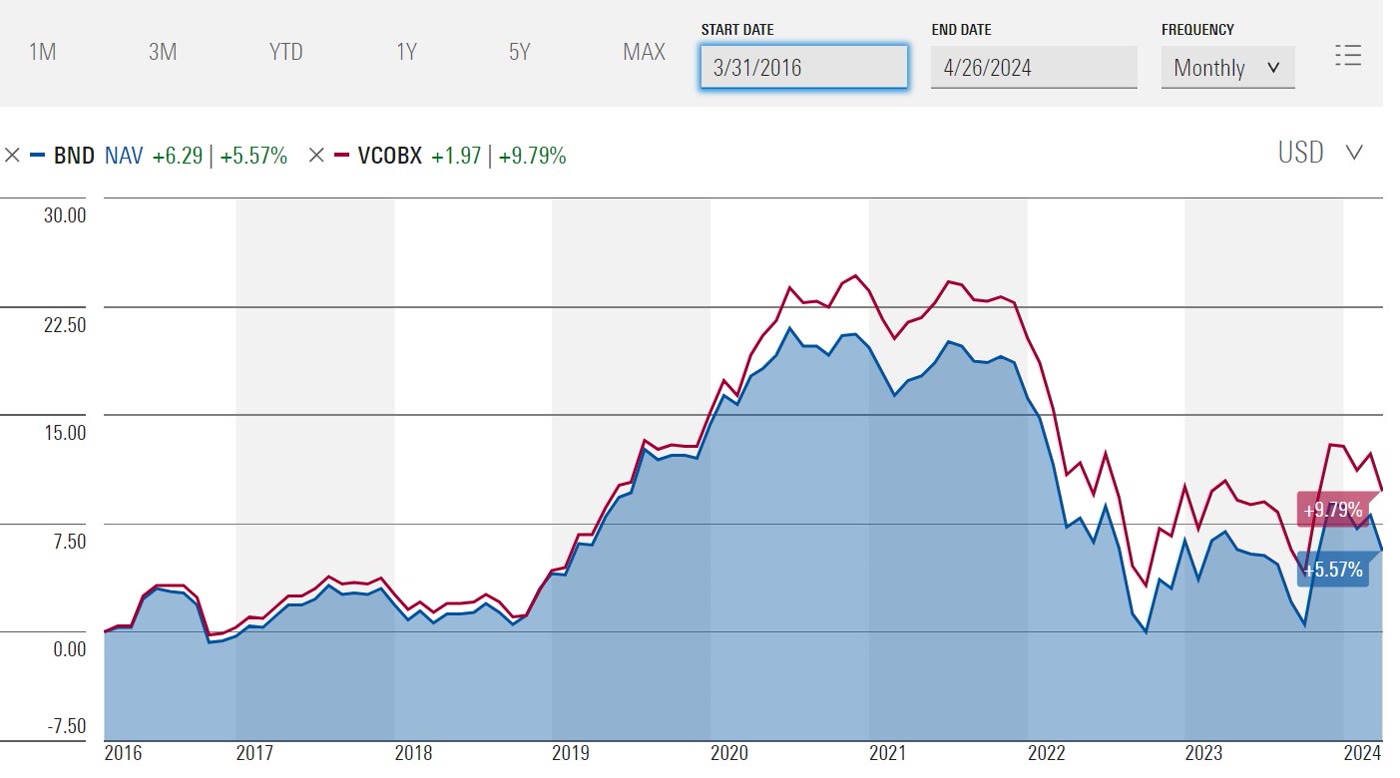
The actively managed Vanguard Core Bond fund (red) versus passive BND (blue).

Bond Fund of America beat BND in 8 of the last 10 calendar years.
Intermediate Municipal Bonds
Again, the cheapest passive option isn’t the most popular one: SCMB (Schwab Municipal Bond ETF) gives similar exposure for 0.03%. If you prefer the Vanguard or iShares versions at 0.05%, go for it; they’re all very similar.
On the active side, my pick is MUNI (PIMCO Intermediate Municipal Bond Active ETF), mainly because it’s one of the few that avoids bonds subject to the alternative minimum tax (AMT). My thinking: people usually buy munis for the tax benefit, which mostly helps higher earners, and higher earners are more likely to face the AMT, which can erode that benefit. (The passive funds above also avoid AMT bonds.)
Since MUNI launched, the most popular passive option, MUB, has actually done better, but largely by taking more risk. On price alone, MUB had bigger drops in nearly every downturn. Both are solid; it comes down to your preference for active or passive.
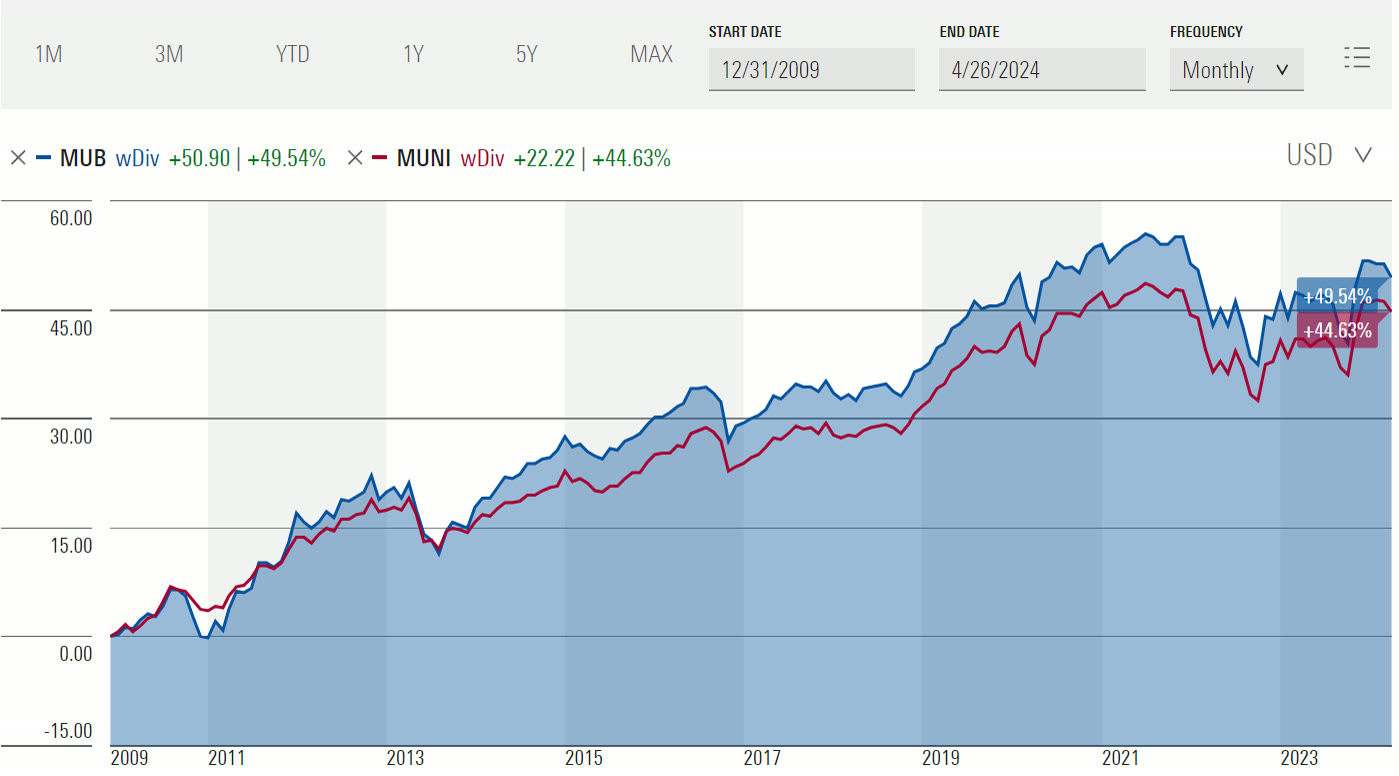
MUB (blue) versus MUNI (red) since MUNI’s launch.
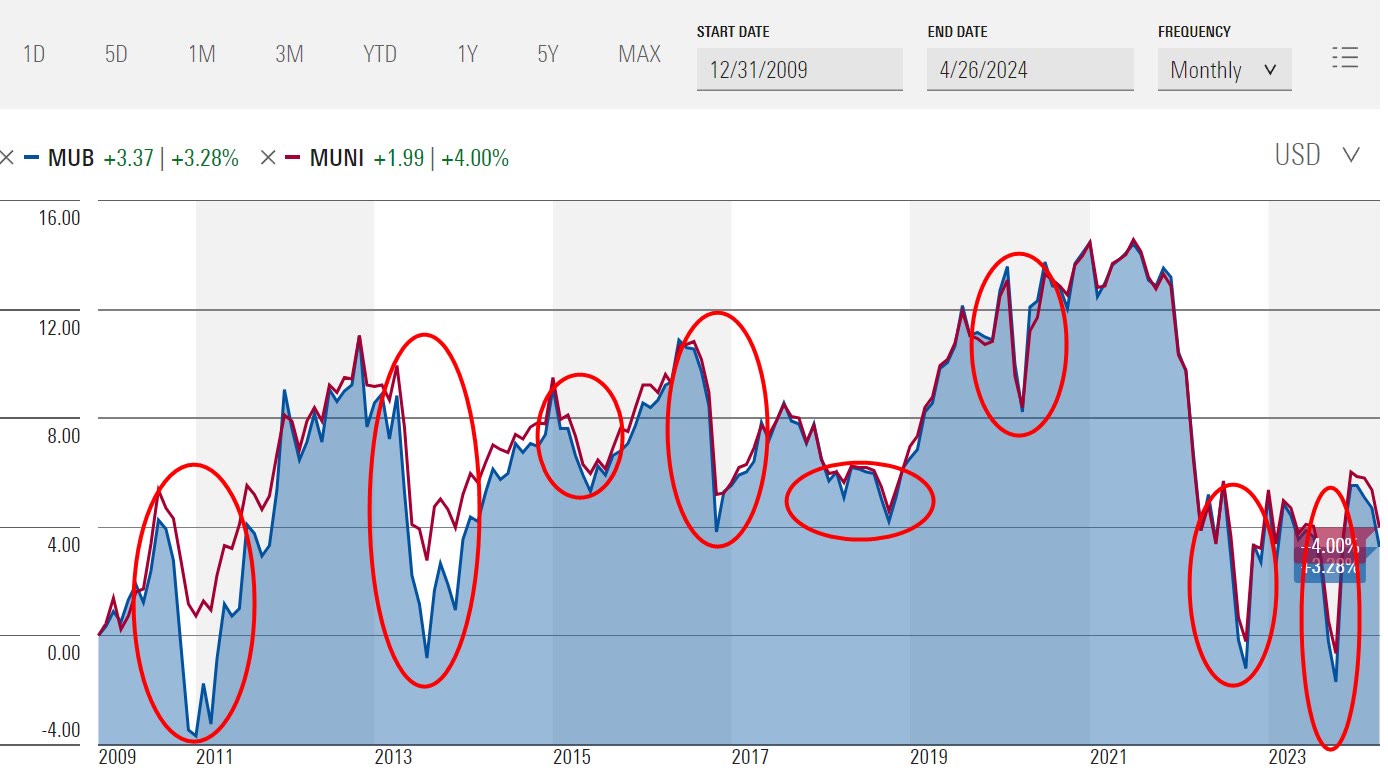
On price alone, MUB (blue) fell further in almost every downturn.
Target Maturity Treasury ETFs
These passive ETFs hold bonds, usually Treasuries, at specific maturities like 3 or 10 years. They differ mainly in cost and in how long their bonds are. Shorter bonds have lower duration, so less interest rate risk; in a normal market they also pay less, though in 2024 they were paying the most.
Why accept more rate risk for less yield? Because if you want a true hedge for stocks, longer-term Treasuries likely have the most upside in a stock market sell-off. In 2008, long-term Treasuries (TLT) rose while the S&P 500 plunged.
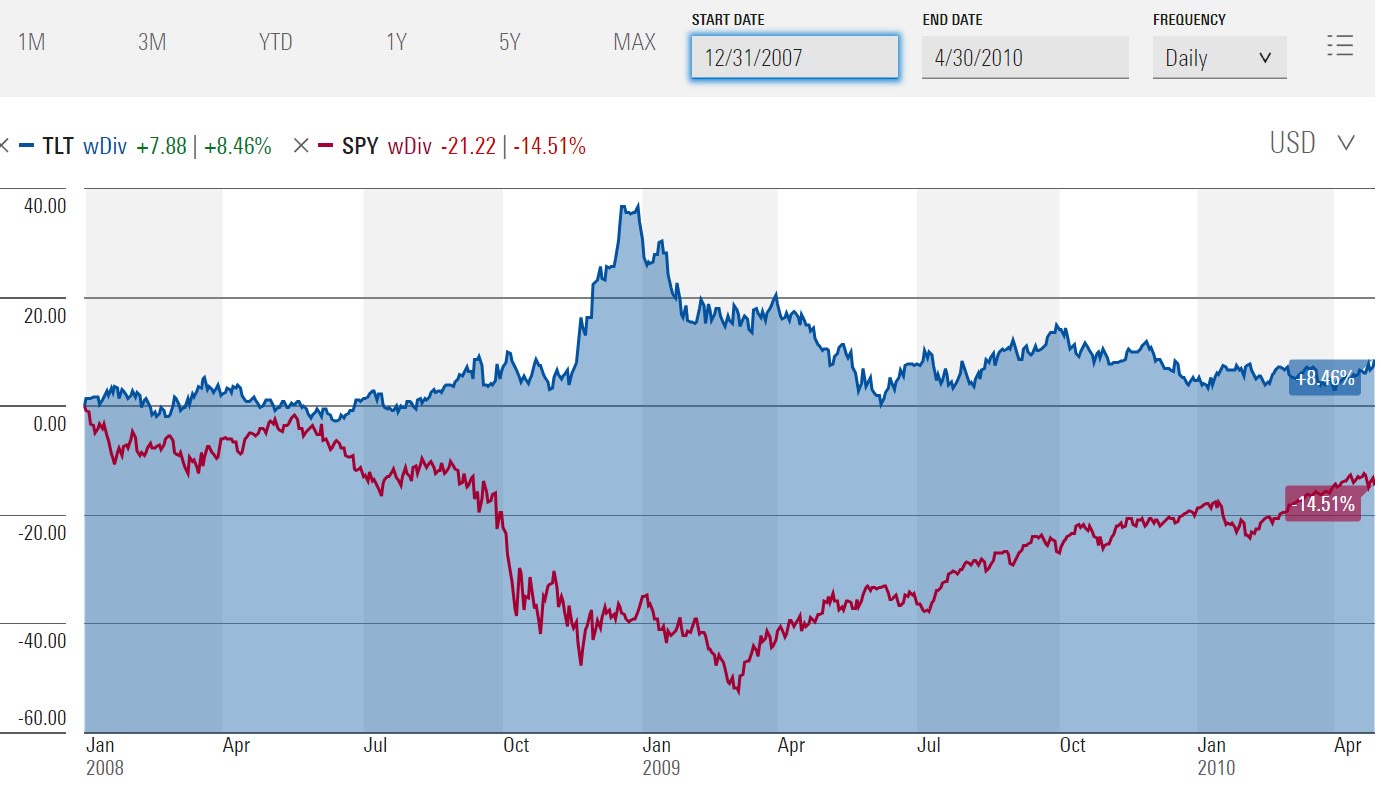
2008: long-term Treasuries (TLT, blue) rose while the S&P 500 (SPY, red) fell sharply.
But you don’t have to look far back to see how risky long bonds are when rates rise: a 25-plus-year Treasury ETF lost more than half its value from 2020 to 2024. In a bear market driven by almost anything other than rising rates, though, people rush to Treasuries, which can cushion a falling stock portfolio.
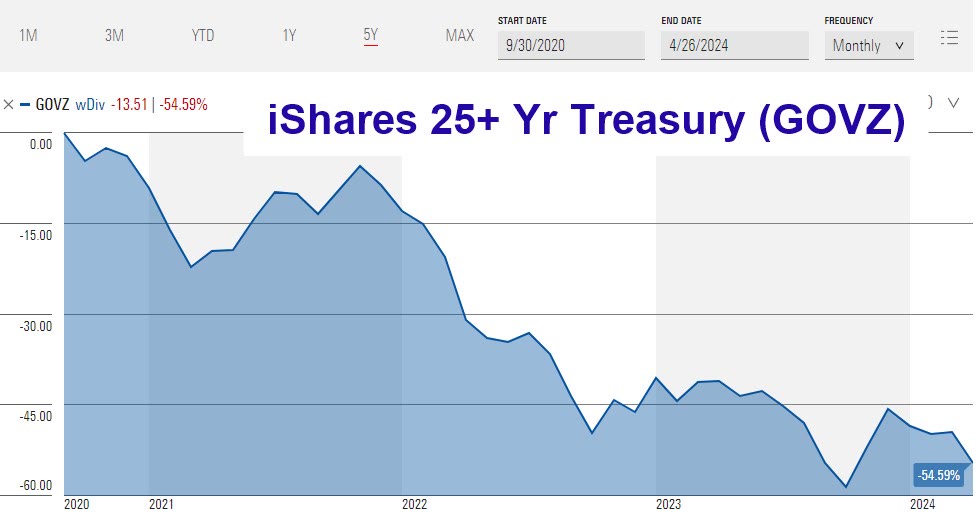
The iShares 25+ Year Treasury ETF (GOVZ) fell about 55% from 2020 to 2024 as rates rose.
Target maturity funds give you two things: precise control over how much interest rate risk you take, and a way to position on the part of the yield curve you find most attractive. In March 2024 I argued short-term Treasuries were the better bet. Since then, fewer rate cuts were priced in, short-term yields held steady, and intermediate and long-term yields rose.
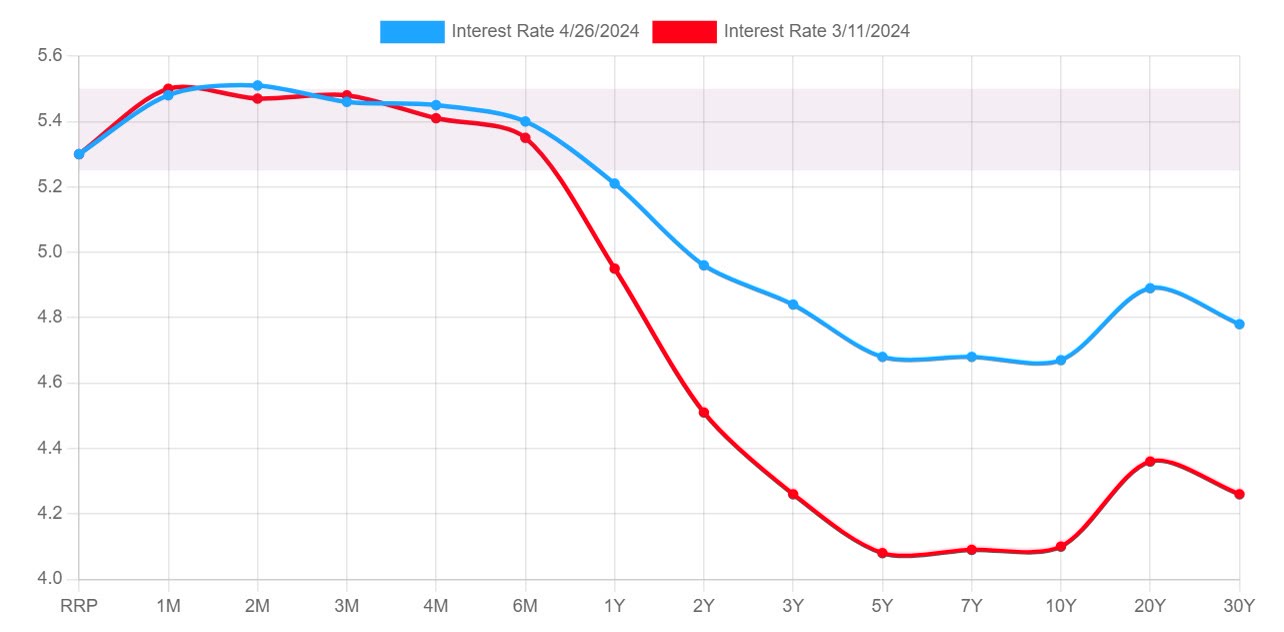
The yield curve on March 11, 2024 (red) versus April 26, 2024 (blue).
That’s why short-term bonds like those in XHLF (blue) did much better than the intermediate bonds in IEI (red) or the long-term bonds in BBLB (green).
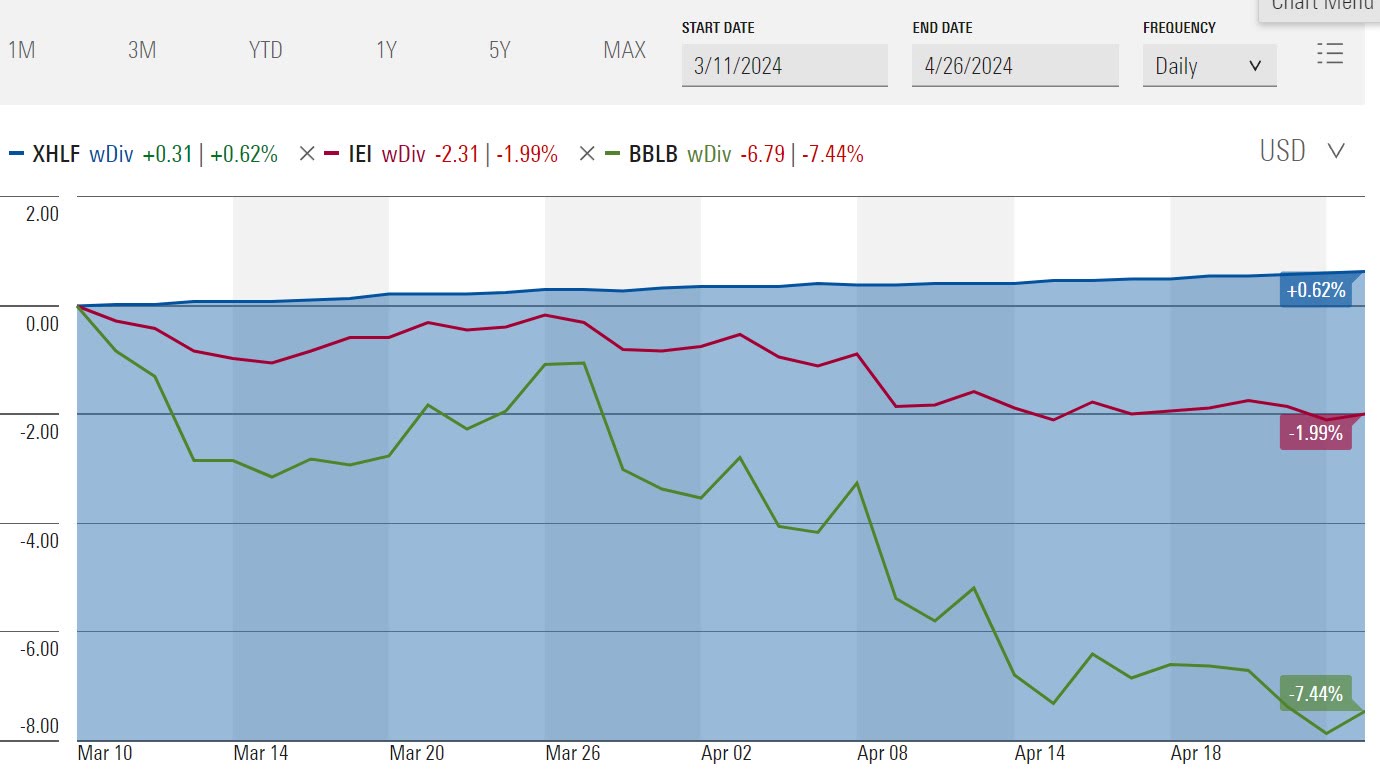
March to April 2024: short-term XHLF (blue) beat intermediate IEI (red) and long-term BBLB (green).
Special Situations
A weaker dollar: international bonds, like the shorter-term ones in ISHG or longer-term ones in IGOV, would benefit. The dollar strengthened massively over the previous 10–15 years, so these did terribly, but a weakening dollar would boost them.
Green bonds: GRNB (VanEck Green Bond ETF). Green bonds often pay a little less, and this fund takes a bit more credit risk than the others here, but it’s an option if that matters to you.
My personal favorite: TMF (Direxion Daily 20+ Year Treasury Bull 3X). Huge upside if long-term rates fall, and huge downside if they rise. I made a lot of money on it in 2019–2020 and sold in mid-2020. I wouldn’t touch it in April 2024, but if long rates kept rising and the economy weakened, that could create an attractive entry point.
For more on how bonds fit alongside stocks, read Asset Allocation: The Ultimate Guide.
Watch the Full Video
Want to Go Deeper? In the Fundamentals of Finance Academy, Ethan breaks down funds and current market events on a live call every other week, and members get the full archive of recorded calls. Learn more about the Academy →
This article is for educational purposes only and is not investment advice. Ethan is a CFA charterholder, but nothing here is a recommendation to buy or sell any security, and it does not take your personal situation into account. Past performance does not guarantee future results. Charts of index returns are for illustration only and don’t reflect the fees, expenses or taxes of any actual investment. Performance data and fund details are as of 04/30/2024 and will change; check each fund’s website for current figures.
