7 Investment Impacts from the Midterm Elections
About this article: This article is based on Ethan’s video on the 2026 midterm elections. Prices and one-day moves are as of November 4, 2026, the day after the election, and have likely changed since.
If you’re looking for excitement, anger or any other emotion about the midterm election results, you’ve come to the wrong place. This is about investing, and as I always say, you may care about politics, but your investments don’t. So regardless of which side of the aisle you sit on, here’s an objective, practical view of how the results could affect seven key investment areas.
The Short Version
Interest rates: a divided government could ease some debt and policy fears, which would likely help lower Treasury yields.
Health care: a possible winner, especially services companies. Pharmaceuticals could lag.
AI: widely seen as a loser, but I think the impact will be minimal compared with everything else facing AI.
Crypto: possibly the biggest loser long term, even though Bitcoin and Ethereum rose on the news.
Trade: some consumer-focused tariffs could get whittled away, which could help homebuilders.
Defense: stocks fell, but I’m not sure I agree with the panic.
Broad market: I don’t think the post-midterm rally pattern has much predictive power this year.
1. Interest Rates
One obvious impact of a Democratic Congress and a Republican president, or vice versa, is that it’ll be harder to get things done. That includes a lot of things investors feared would worsen the country’s debt problems, like $5,000 tariff checks, further tax cuts and basically any presidential priority the other side of the aisle doesn’t agree with. Some impacts could go the other way, which we’ll get to in a moment, but on balance I think this is likely to ease some of the debt-related fears about the next couple of years.
Another result of it being harder to get things done is that we might get less volatile policymaking. Tariffs on, tariffs off. We’re close to a deal. We’re gonna destroy their civilization.* I’m not saying that’s going away entirely, but I do expect some limits on it.
*Paraphrased from President Donald Trump’s April 7, 2026 statement on Iran.
Besides inflation, which has mainly resulted from the Iran war, those are the other two factors that have been pushing interest rates up this year: fears of worsening debt and uncertain government policy. People buy Treasuries for stability, so restoring some of that would likely help lower the interest rates on them. Anything that improves the debt situation, or at least keeps it from getting worse, is also likely to help lower rates.
TLT, TLH and IEI, three ETFs that invest in Treasury bonds and do well when interest rates fall, all had good days on November 4. Their recent rallies had been more about a flight to safety on rising fears of the AI bubble bursting, but this time I think it’s a sign that the midterm result is generally expected to be good for bonds and interest rates.
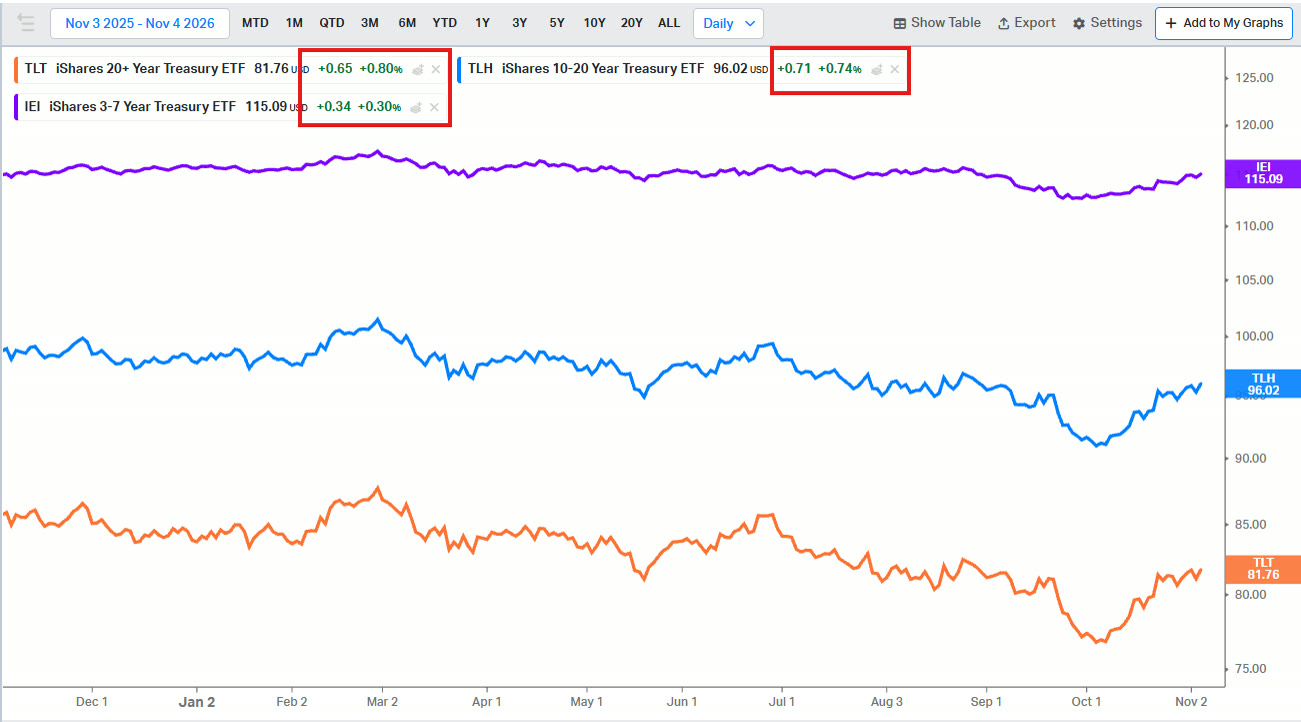
Treasury ETFs on November 4, 2026: TLT +0.80%, TLH +0.74%, IEI +0.30%. Daily prices, 11/03/2025 to 11/04/2026.
2. Health Care
Health care could be another key winner. This is one area where spending could increase, because the One Big Beautiful Bill Act included significant cuts to Medicaid and SNAP benefits, which might now be delayed, reduced or even reversed as part of negotiations around raising the debt ceiling or other deals later on.
Health care stocks broadly were up over 3% on November 4, but there are some differences within the sector. I think health care services companies could be the more direct beneficiaries of increased spending, and those were up over 5%.
Pharmaceuticals, on the other hand, might actually be hurt, because we might see more headlines about cuts to drug prices, one of the few issues both sides can agree on. Pharmaceutical stocks also rose, but not as much as the broad health care industry, and I can’t help but wonder how much of that was just broad index fund buying that propped up the whole sector.
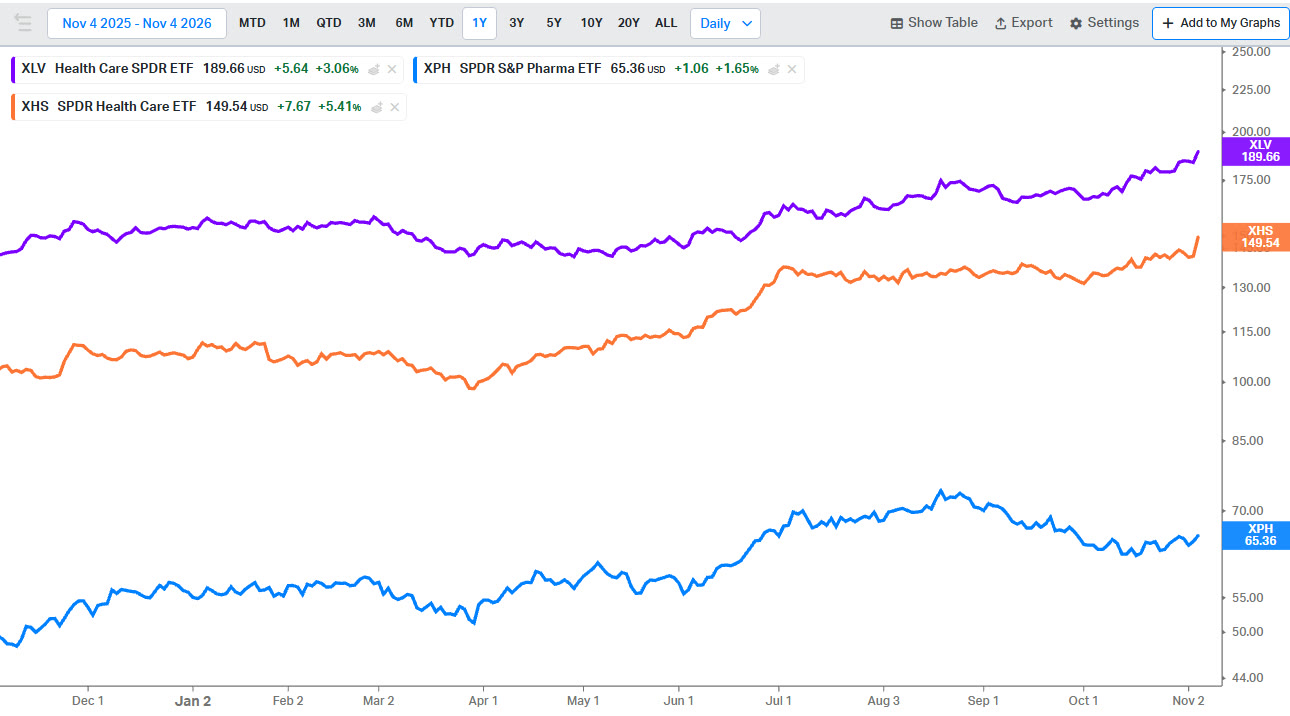
Broad health care (XLV) +3.06%, health care services (XHS) +5.41% and pharmaceuticals (XPH) +1.65% on November 4, 2026. Daily prices, 11/04/2025 to 11/04/2026.
Regardless of the midterms, an interesting wrinkle is that health care has been one of the best hedges against weakening AI sentiment this year. AI, represented here by the iShares A.I. Tech ETF, went on a tear from April to mid-June, and health care stocks were pretty much left out of the party. But as the shine started to come off AI over the last few months and people rotated into more defensive sectors, health care stocks have been key beneficiaries. I’d expect health care to keep providing a nice complement to AI exposure within an equity portfolio.
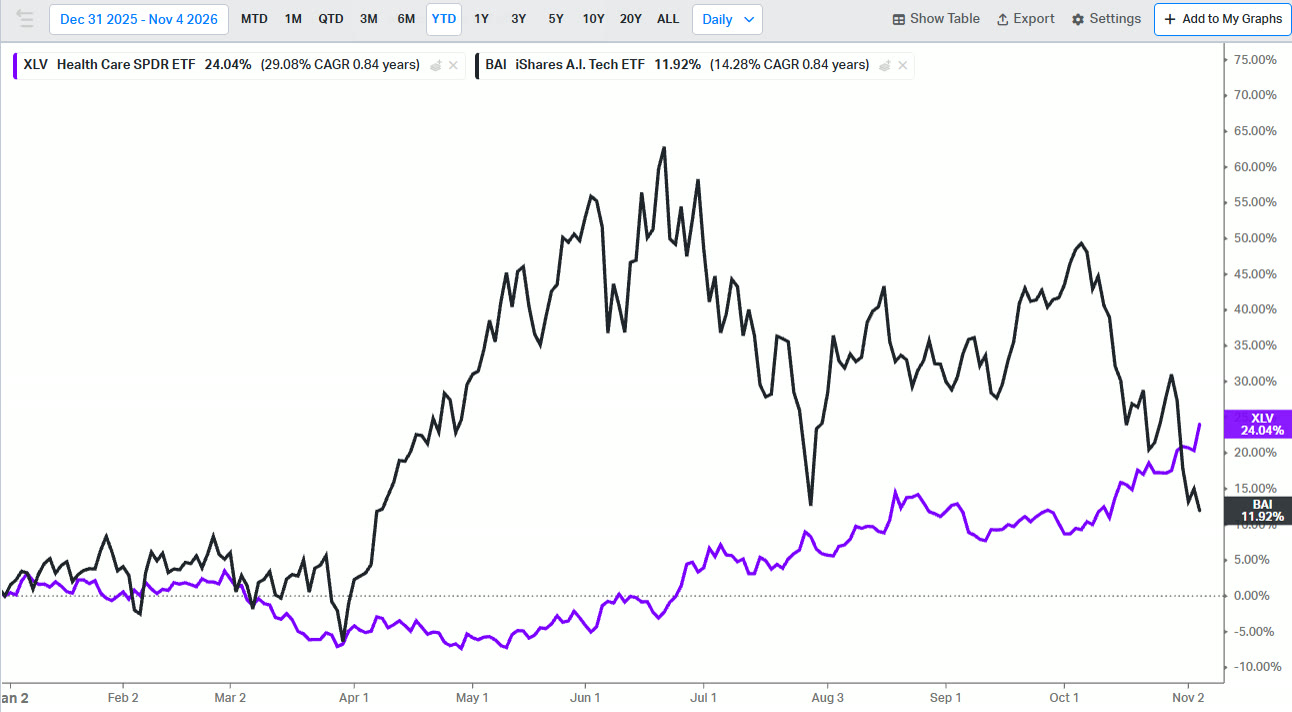
Health care (XLV, +24.04%) versus AI tech (BAI, +11.92%), 12/31/2025 to 11/04/2026.
3. AI
AI is generally considered a loser from this election, but I personally don’t think the impact will be that significant. The logic goes like this:
Data centers are extremely unpopular with voters on both sides of the aisle, so Democrats are likely to put forward more legislation that tries to limit them.
If Trump wants to veto that legislation, it puts Republicans on the unpopular side of a key issue heading into the 2028 presidential election.
If fewer data centers get built, there will be less spending on the AI supply chain.
That would be bad for the companies that have been taking in all that AI spending, which I’m representing with the DRAM ETF, which basically invests in memory chip makers. It fell over 5% on November 4, continuing its recent decline.
Ironically, it could be a good thing for the hyperscalers, which I’m representing with the Magnificent Seven ETF. (Yes, I know they’re not all hyperscalers, but this is a simple proxy.) One of the key worries about AI spending is whether it’s been too much, too fast, and whether it will actually pay off. If the big spenders can’t spend as much, that helps ease the concern, and it means less compute supply coming online, so all else equal they can charge more for their existing capacity. The Magnificent Seven ETF was up over 2%.
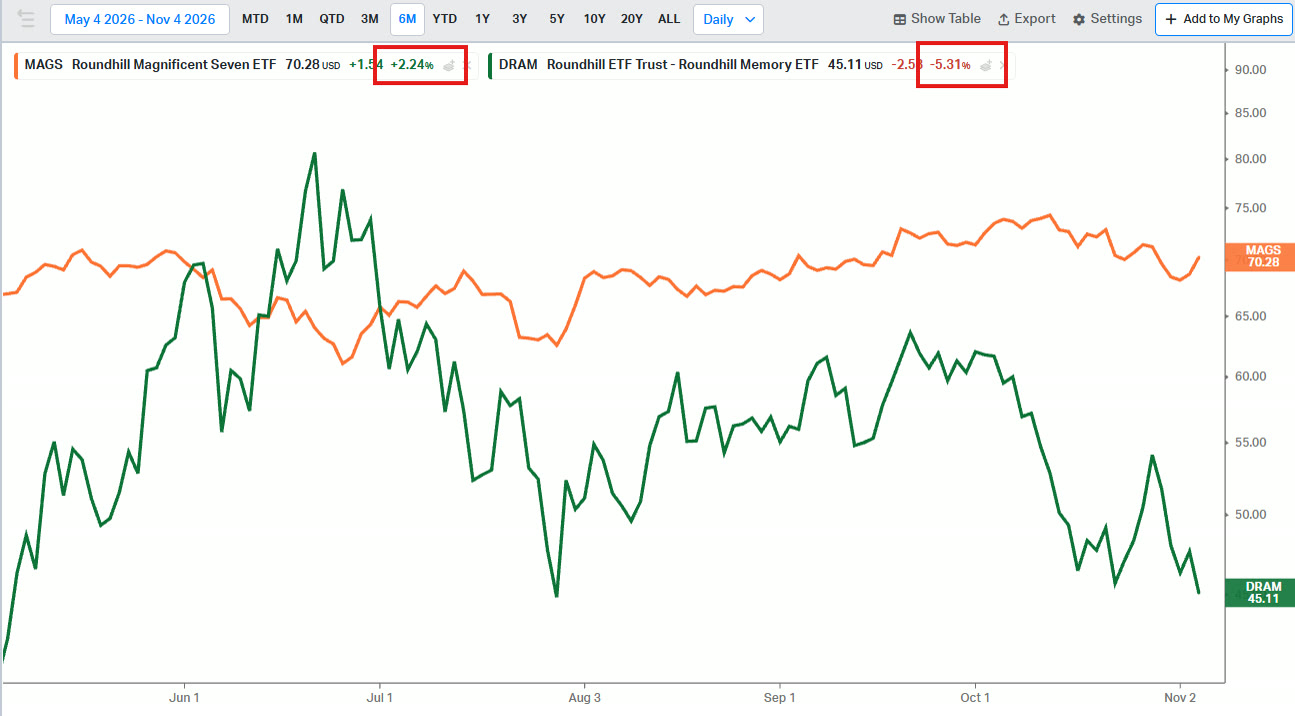
Roundhill Magnificent Seven ETF (MAGS) +2.24% and Roundhill Memory ETF (DRAM) −5.31% on November 4, 2026. Daily prices, 05/04/2026 to 11/04/2026.
I wouldn’t be surprised to see some slowing of data center building from the midterms, but I think we’re missing the forest for the trees here. Big picture, I think the midterms are likely to have a very minimal impact on AI compared with many other things. Will there be enough demand? Is there enough funding? Can AI be contained? Is there enough power supply and other components? Do we need a major reset of expectations? Or, on the flip side, maybe everything is better than most people expect. I’m definitely more in the bearish camp myself, but the midterms aren’t very high on my list of reasons for that.
4. Crypto
Crypto is possibly the biggest loser from the midterms. Granted, Bitcoin and Ethereum both rose on the news, so maybe I’m off base on this one. But given how much money crypto companies raised for Republicans, I think they probably wanted them to win. I’d assume that’s because they want more of a regulatory framework in place to bring the industry into the mainstream and encourage wider adoption in the long term. That seems pretty unlikely to happen now, at least in the next couple of years.
Of course, that doesn’t mean crypto will be a bad investment from here. It’s just a setback to the industry’s long-term goals. As the speculative asset it is today, I don’t see much impact, and that might be why it’s still up since the elections.
5. Trade
Trade is another interesting area to watch. On the one hand, Trump really didn’t rely on Congress much for his tariff policies, so the midterms shouldn’t affect them very much. But I think that’s a bit overly simplistic.
Like it or not, Trump will have to work with Congress to get basically anything done now, and I wouldn’t be surprised to see some whittling away of tariffs that directly affect affordability for consumers, like food-related tariffs that are driving up grocery prices or tariffs on construction materials that are driving up housing prices. Tariffs are basically a tax on the American consumer, so any help there would be a boost for consumer spending.
An interesting possible beneficiary of those reductions, if they come on construction materials, could be the homebuilders, which have already been rallying for the last couple of weeks as interest rates have fallen. It’s obviously not the bottom anymore, but for believers in lower interest rates and falling tariffs boosting home construction, there could be more room to run. Even after a 7% rise on November 4 and roughly 20% over the past couple of weeks, they’re still about 20% below their peak from 2024.
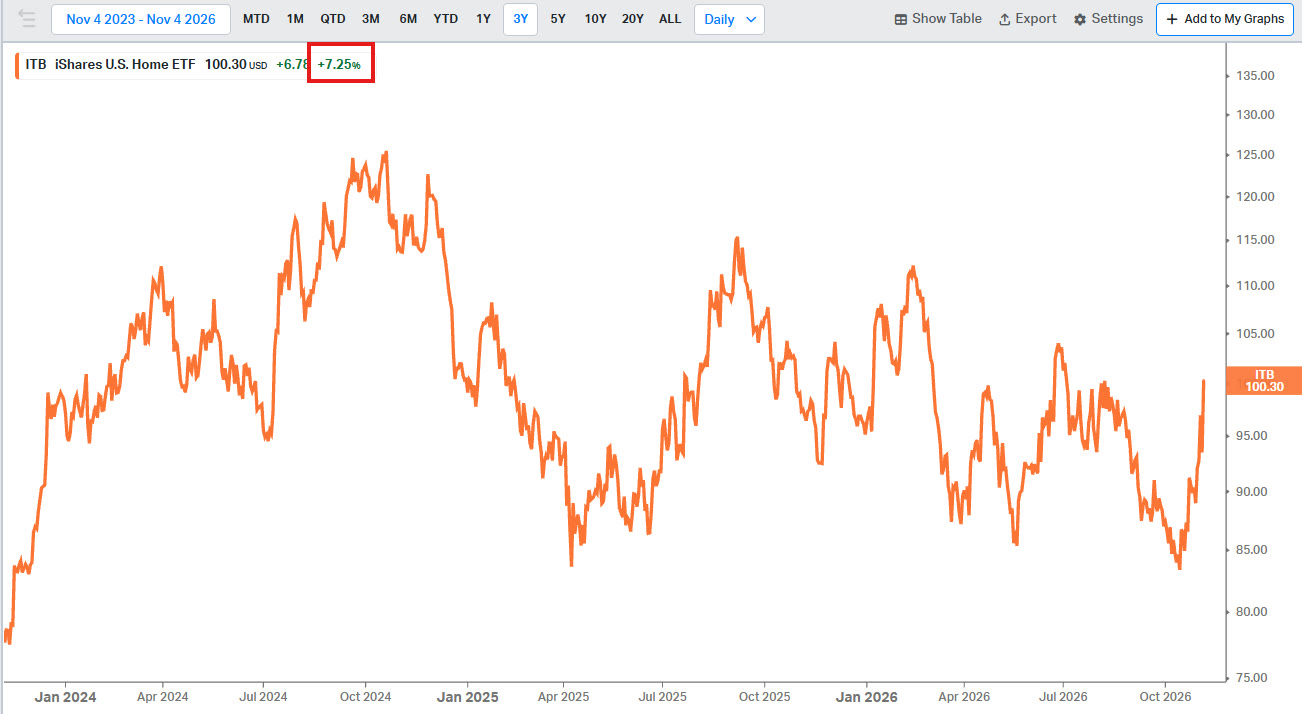
iShares U.S. Home Construction ETF (ITB) +7.25% on November 4, 2026. Daily prices, 11/04/2023 to 11/04/2026.
6. Defense Spending
A lot of people think defense spending is likely to suffer because of the election results, and defense stocks were broadly negative on November 4.
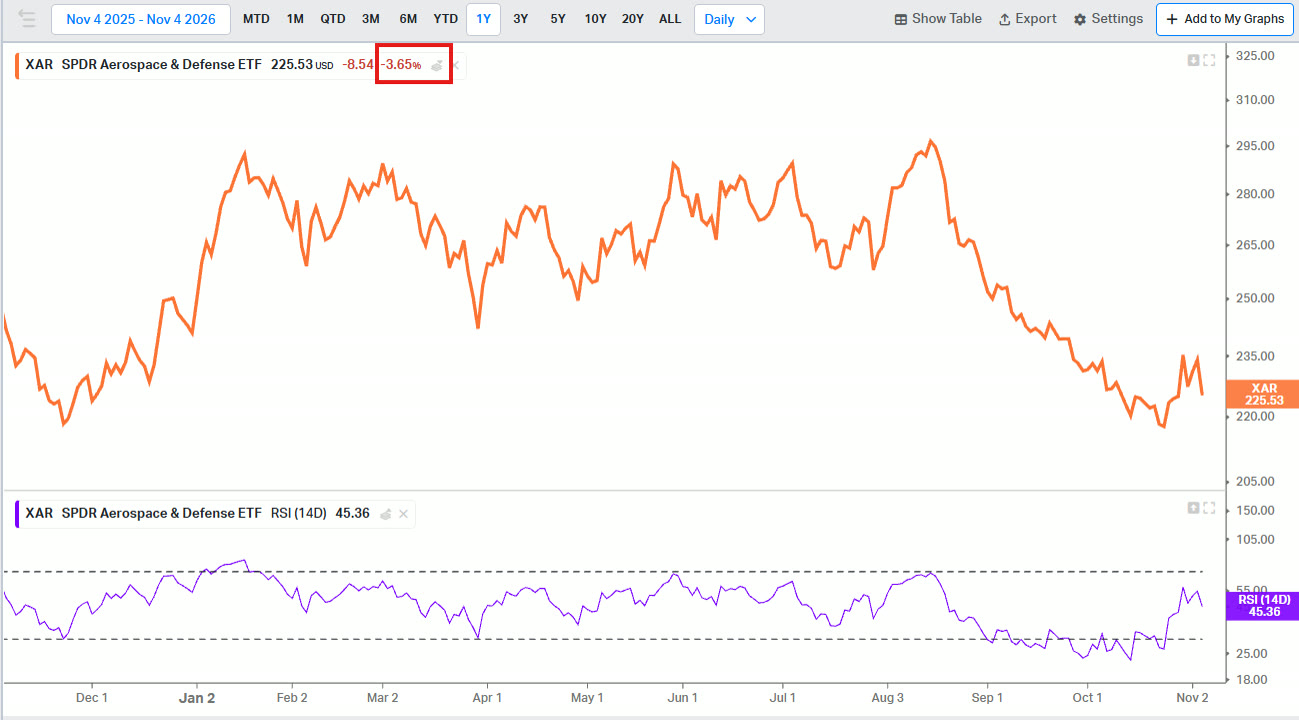
SPDR Aerospace & Defense ETF (XAR) −3.65% on November 4, 2026. Daily prices and 14-day RSI, 11/04/2025 to 11/04/2026.
This is another one I’m not so sure about. Would Republicans have spent more? Sure, probably. But I’m pretty confident both sides will want to replenish our very depleted stockpiles of weapons and improve our drone technology, and that’s going to take years and a lot of defense spending. So I’m not sure I agree with the panic investors seem to be in when it comes to the defense industry.
I don’t have a strong view on whether the midterms make it more or less likely that the war in Iran ends sooner or later. But even if it ended tomorrow, we’ve got a lot of defense spending to do to protect ourselves from potential threats in the future.
7. The Broad Market
There’s a general narrative out there that the stock market tends to rally after midterm elections. Can we expect that to happen again? Well, maybe, but unfortunately I don’t think there’s much predictive power here.
One reason it’s historically been true is that the market is typically down for the year when we get to the midterm election. Presumably that’s because there’s some fearful scenario investors are worried about. Then the midterms pass, that fear eases, and the market recovers.
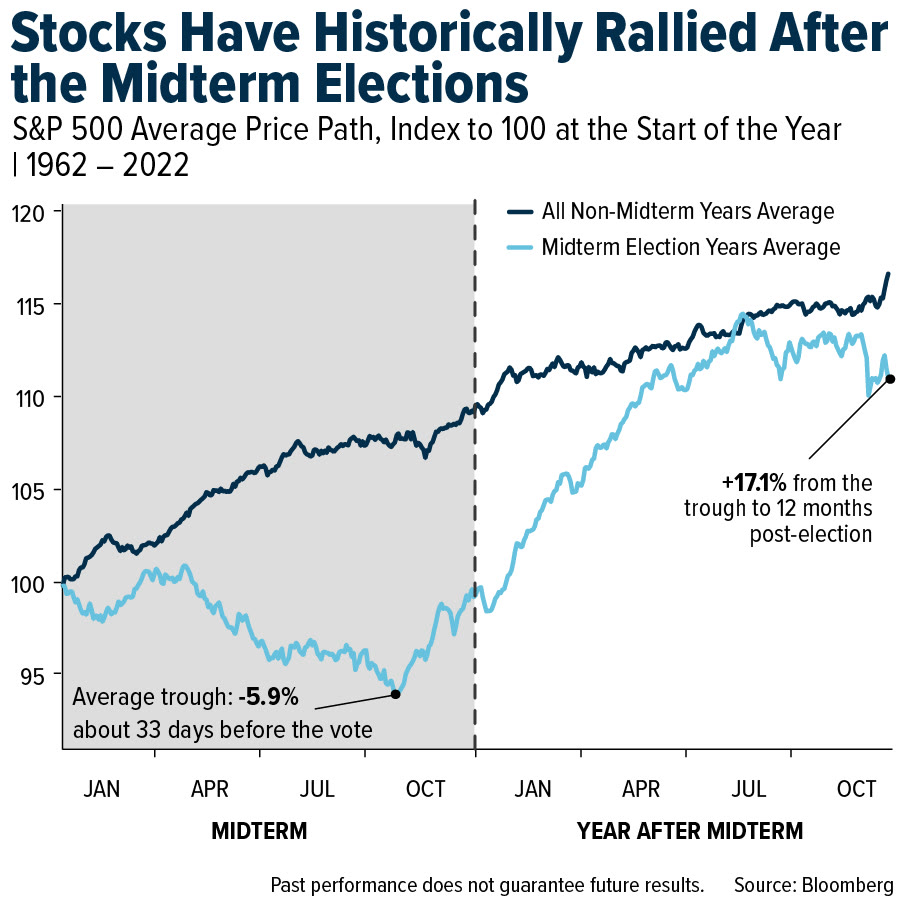
Average S&P 500 price path, midterm years versus non-midterm years, 1962–2022. Source: Bloomberg. Past performance does not guarantee future results.
I don’t think that really applies this year. Both U.S. and international stocks were solidly positive heading into the midterms, better than the long-run average full-year return with two months still to go.
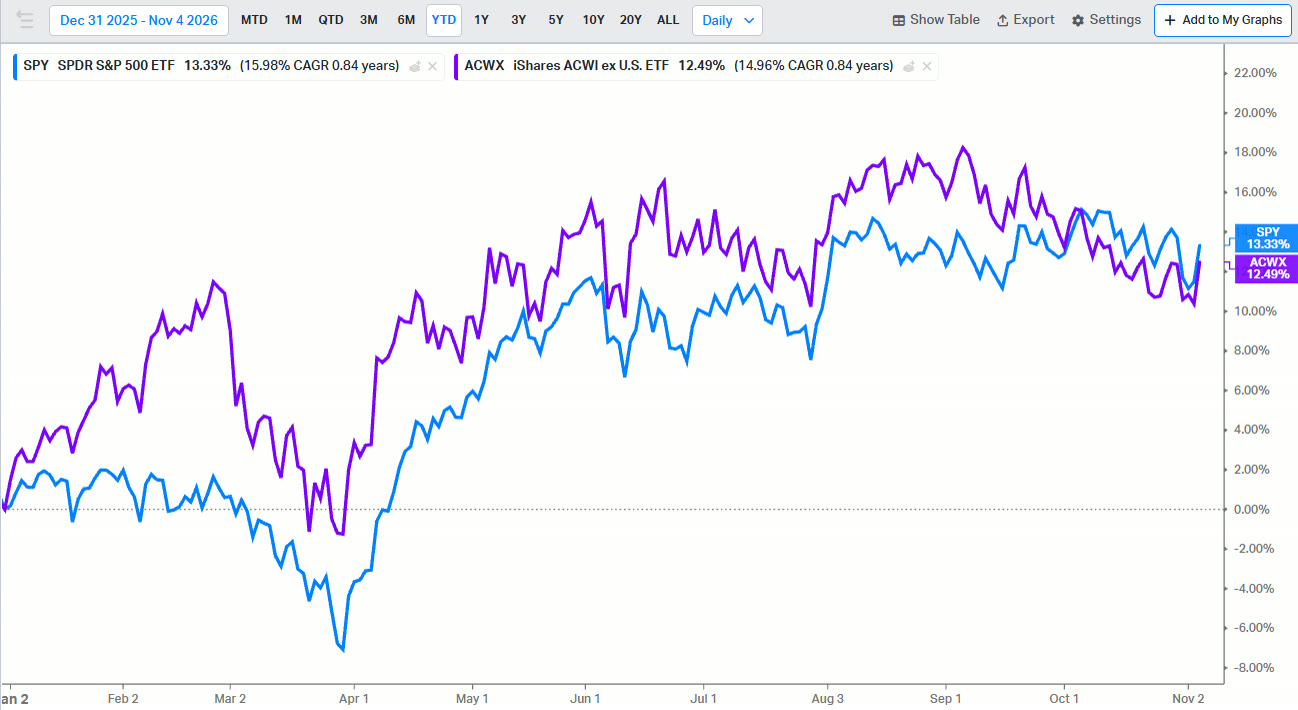
U.S. stocks (SPY, +13.33%) and international stocks (ACWX, +12.49%), 12/31/2025 to 11/04/2026.
So could the market rally from here? Sure. But if it does, it’s probably not going to be because of the midterms. It’s much more likely to be something related to AI, the war in Iran, or both, and those could take the market either way.
Nothing here should be taken as advice, but I will not personally be investing based on the expectation of a market rally from here due to the midterms passing. If anything, I’m thinking about getting more conservative, and that, as you probably expected, also has nothing to do with the midterms.
Watch the Full Video
Want to Go Deeper? In the Fundamentals of Finance Academy, Ethan breaks down funds and current market events on a live call every other week, and members get the full archive of recorded calls. Learn more about the Academy →

This article is for educational purposes only and is not investment advice. Ethan is a CFA charterholder, but nothing here is a recommendation to buy or sell any security, and it does not take your personal situation into account. Past performance does not guarantee future results. The ETFs named here are simple stand-ins for each market area, not recommendations. ETF prices and returns are as of 11/04/2026 and will change. The historical midterm chart uses Bloomberg data for the S&P 500, 1962–2022; index charts are for illustration only and don’t reflect the fees, expenses or taxes of any actual investment.
