Fidelity Contrafund Beat the S&P 500 for 50 Years (Here's How)
About this article: This article is based on Ethan’s video, originally published on September 7, 2025. Because the written version was published later, returns, yields and fund details reflect data available at the time of the video and have likely changed since. Please check each fund’s website for current figures.
Fidelity Contrafund is one of the largest, oldest and most successful mutual funds of all time. It has dominated the S&P 500 for over half a century, generating almost 20 times more wealth. In this article I’ll analyze it with the three-step process I use for evaluating any active fund: how did they do, how did they do it, and most importantly, can they do it again?
The Short Version
Contrafund beat the S&P 500 and its growth peers over 1, 3, 5 and 10 years, and by a huge margin since 1967.
It’s less growth-heavy than a typical growth fund, but very concentrated: over 17% in Meta.
Much of its success comes from one manager, Will Danoff, in charge for about 35 years. Two co-managers added in 2025 look like succession planning.
Ethan’s view: fine to keep while Danoff runs it, but he’d monitor it closely and look elsewhere for a new fund.
How to Evaluate an Active Fund
If you want to learn to evaluate funds like a professional, this part is extraordinarily valuable. If you just want the Contrafund details, skip ahead.
I’ve evaluated funds professionally for almost two decades, and I developed this process because looking only at past results, which is what most people do (even many financial advisors), simply doesn’t work. Past results by themselves lack context. “The team won 17 games this year” sounds fine, but in the NFL that’s an undefeated season, and in Major League Baseball it’s 17 and 145, the worst season ever.
Step 1: How did they do? The results.
Step 2: How did they do it? The context. A very aggressive fund should shine after a big market run, but that’s probably not the time to buy it, since it would likely do badly in a downturn, which becomes more likely after a strong run. The reverse is true too: a fund whose approach was simply out of favor may still be worth owning.
Step 3: Can they do it again? The most important step, because you can’t buy past results. Many factors drive a fund’s success (the managers, the process, the market environment, the fees), and some are repeatable while others aren’t. Telling them apart is what improves your odds of picking future winners, and that’s all that matters.
Step 1: How Did Contrafund Do?
Since its 1967 launch, Contrafund has generated nearly 20 times the return of the S&P 500. “Extraordinary” is probably an understatement.
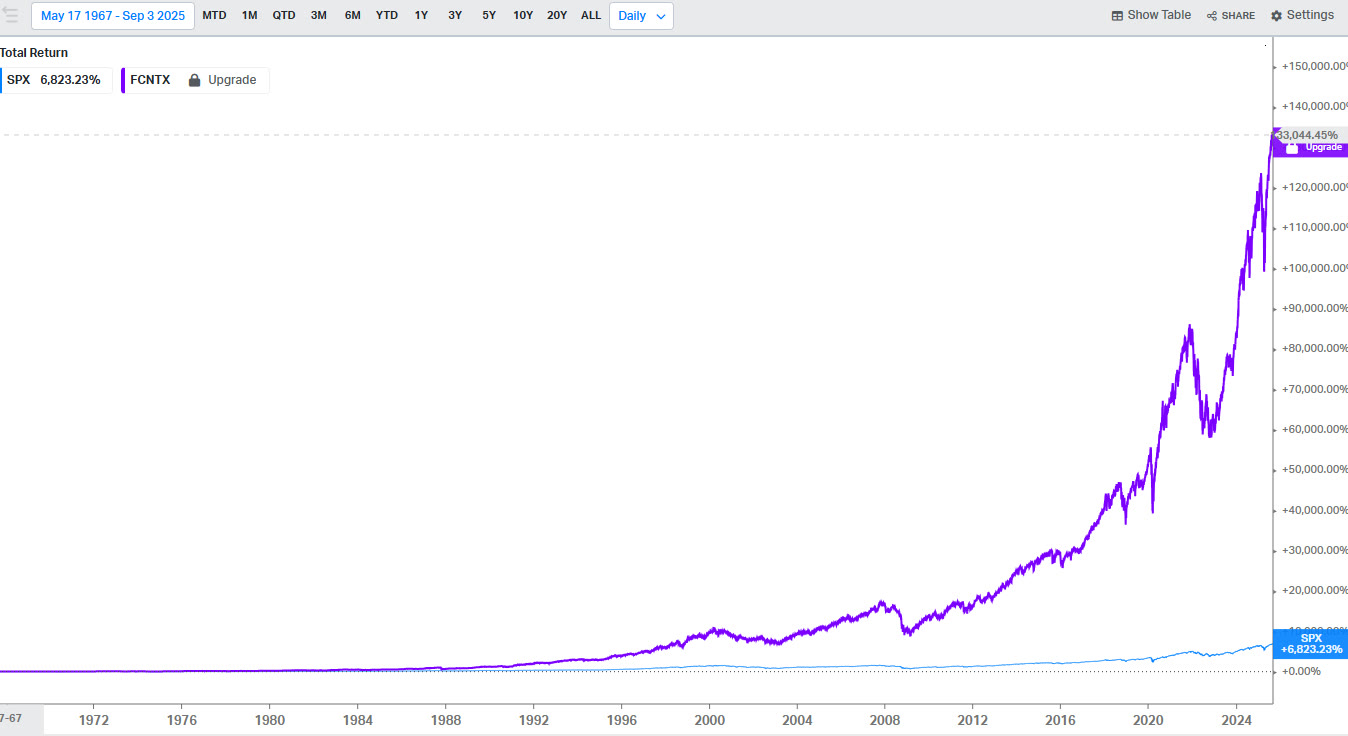
Fidelity Contrafund (purple) versus the S&P 500 (blue) since 1967.
It has done well recently, too. It beat the S&P 500 over the past 1, 3, 5 and 10 years, and also beat the average fund in Morningstar’s Large Growth category. That context matters: over 1, 3 and 10 years, growth funds (the ones owning more tech) have generally beaten the S&P 500, so beating the S&P alone doesn’t prove much for a growth fund. It also suggests this style has been in favor for a long time, and since markets are cyclical, that could mean it’s less likely to stay in favor over the next 10 years, unless you believe AI and the Magnificent 7 make this time different.
The key point: Contrafund didn’t just win because it’s a growth fund. It beat other growth funds, and it even beat the S&P 500 over the last five years, when most growth funds trailed it.
Step 2: How Did They Do It?
This step can also tell you whether a fund fits your portfolio. Maybe a fund succeeded by being aggressive and you’re conservative. Maybe it’s tech-heavy and you already hold lots of tech through your employer’s stock. Understanding how it’s managed helps you judge both its odds and its fit.
The Portfolio
Using the free version of Morningstar.com (search any ticker, then open the Portfolio tab), Contrafund’s asset mix is plain vanilla for a U.S. stock fund, nothing that would warrant further digging. Its style box shows it’s actually less growth-oriented than the typical growth fund, with holdings spread across a fairly broad range. It isn’t really a pure growth fund like the Russell 1000 Growth; it’s more diversified, and more of a candidate to replace an S&P 500 index fund.
Its five-year factor profile shows it’s consistently growth-oriented, low-yield and high-quality. Its momentum exposure is high at the moment but has moved around a lot, while quality hasn’t. So it’s unlikely to load up on low-quality, unprofitable companies, and with over $170 billion in assets it can’t really invest in small caps. On momentum and style, the managers appear more flexible.
Concern #1: Concentration
This is the first thing that would personally concern me: over 17% in a single company, Meta. That’s nothing against Meta; it’s just a lot of concentration for my taste. The counterargument is fair: if you trust the manager, don’t you want them to bet big on their best ideas? In theory, yes, but it’s a personal preference. This is a higher risk, higher reward strategy, likely to be more boom or bust depending on Meta and the Mag 7. It isn’t universally good or bad, but it makes me a little uncomfortable.
Concern #2: The Manager
This is really the first thing I check in step 2, because it can save you from wasting time on everything else. The number one repeatable driver of active success is the management team. If the team was replaced yesterday, the past record is basically meaningless to me, and I won’t consider the fund.
For about 35 years, Contrafund has been run by one man: Will Danoff. A significant amount of its long-term outperformance is due to him; nothing else about the fund is unique. We all know most active managers can’t consistently beat the market. He can.
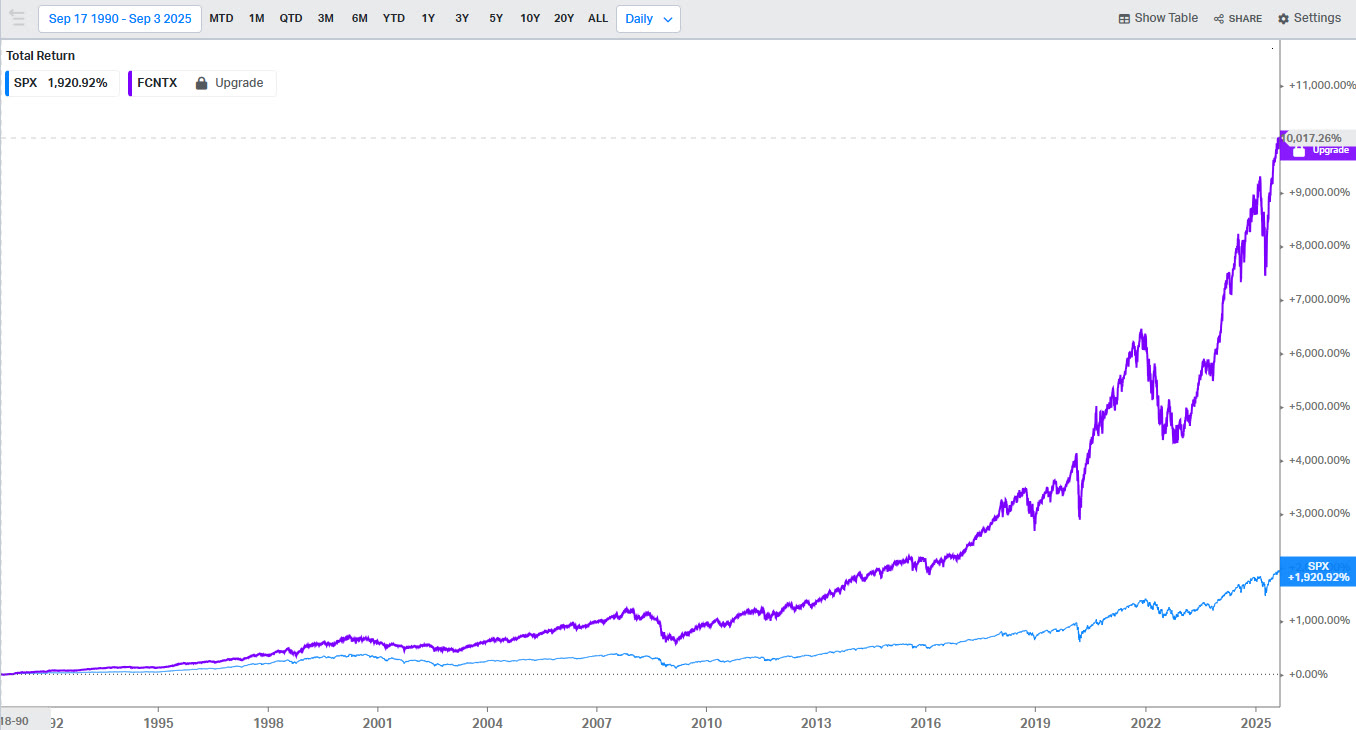
Contrafund (purple) versus the S&P 500 (blue) since Will Danoff took over in 1990.
We’ve seen what can happen when a legend leaves. Fidelity Magellan did extraordinarily well in Peter Lynch’s roughly 13 years in charge.
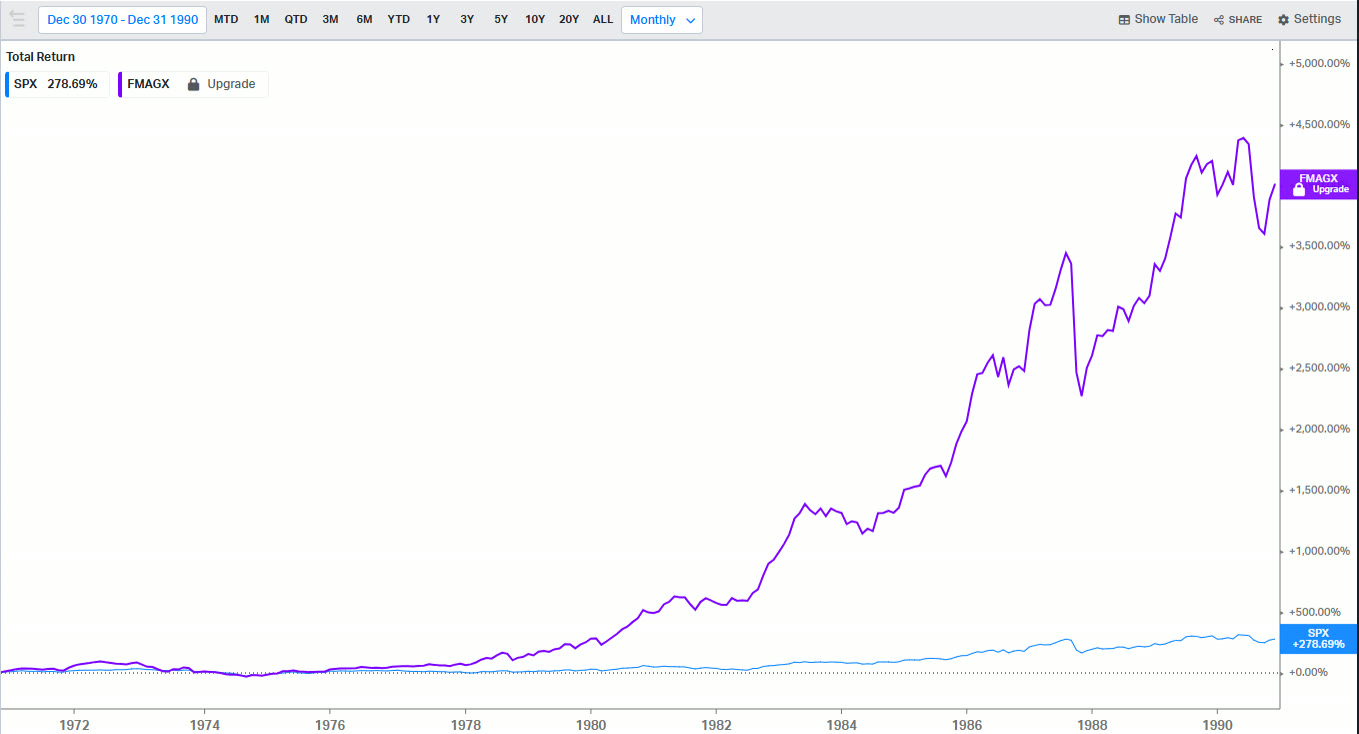
Fidelity Magellan (purple) versus the S&P 500 during Peter Lynch’s tenure.
The 13 years after he left were still good, but nowhere near what investors expected.
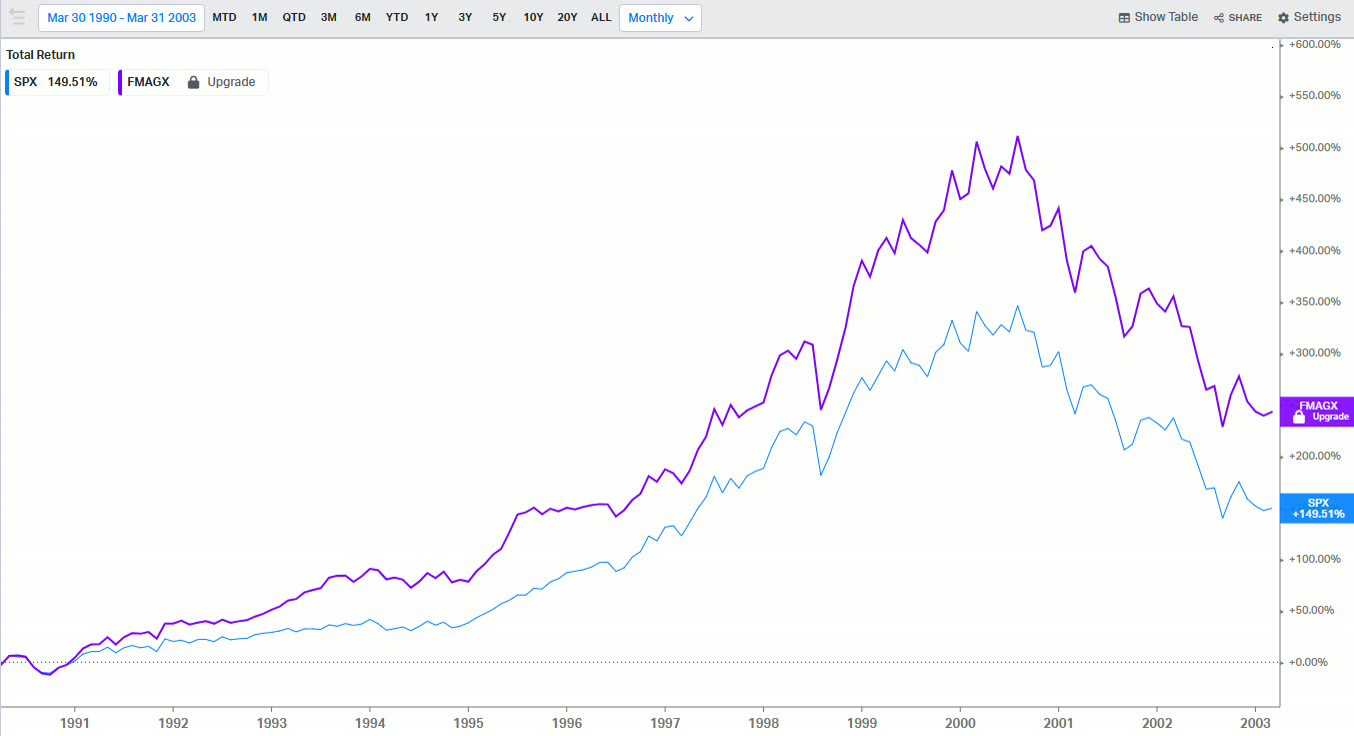
Magellan in the 13 years after Lynch.
A more recent example: Virtus Emerging Markets dominated its benchmark (using the EEM ETF as a proxy) under legendary manager Rajiv Jain from 2006 to 2016. After he left, the new managers gave up that entire lead and then some.
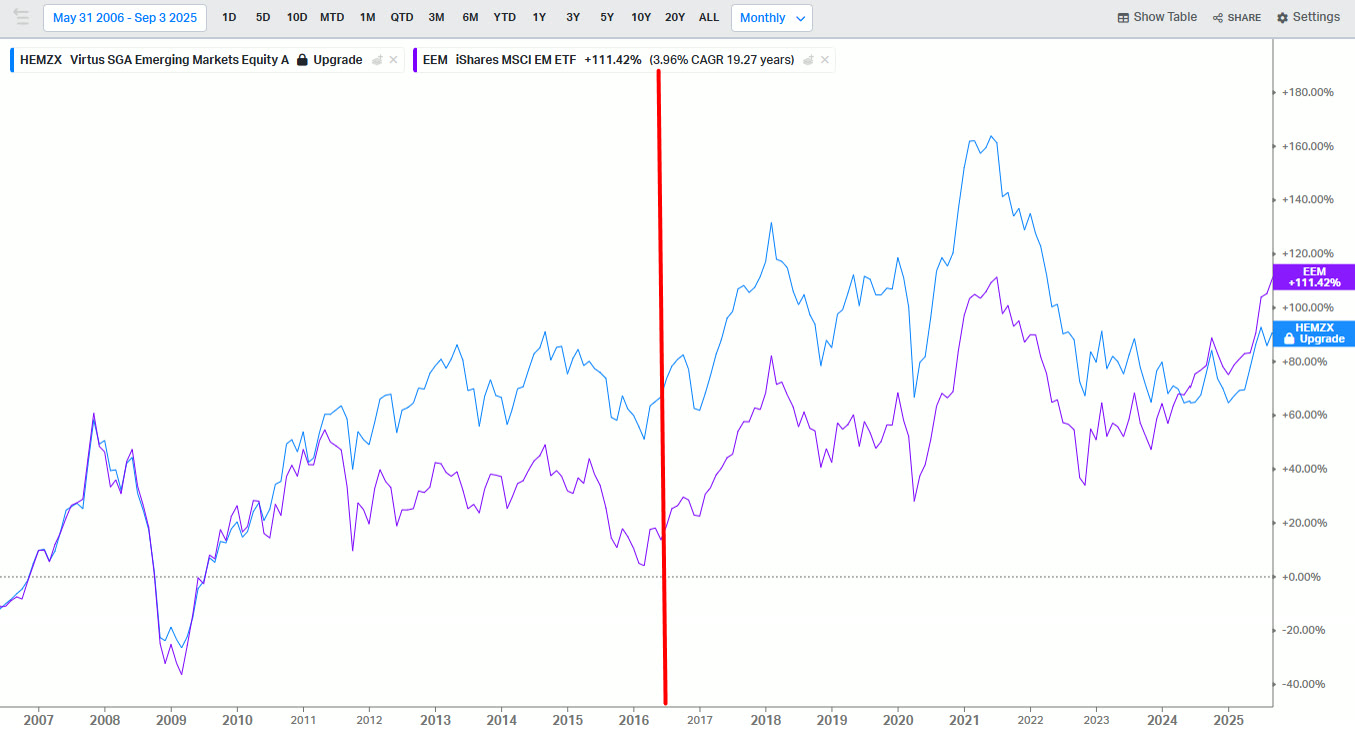
Virtus Emerging Markets (purple) versus EEM (blue). The red line marks Rajiv Jain’s departure.
That’s my worry with Contrafund. Danoff is still there, but he’s in his mid-60s. Could he manage into his 80s? Sure. But then why did Fidelity name two additional portfolio managers, Asher Anolic and Jason Weiner, for the first time in 2025? They’ll manage only about 10% of the fund, so they won’t move results much at first, but it looks a lot like succession planning. I haven’t seen any retirement announcement, but I wouldn’t be surprised by one in the next couple of years. That would concern me, unless the likely successors also had strong records running U.S. stock funds.
The Potential Successors’ Track Records
According to Morningstar, Asher has been a portfolio manager, mostly of U.S. growth funds, since July 2017: less than 10 years as a PM, though he spent more than 10 years as an analyst before that. Jason has been at Fidelity since 1991 and a portfolio manager since 2006, nearly 20 years, almost all on U.S. growth funds. They co-manage a few funds, so let’s look at those.
Fidelity Advisor Equity Growth has trailed the Russell 1000 Growth (the closest match to its Russell 3000 Growth benchmark; the two are about 92–93% the same) since Jason took over. It has slightly beaten Contrafund, but Contrafund is less growth-oriented, and growth has been heavily in favor almost this entire time. The pattern is similar since Asher joined in 2017.
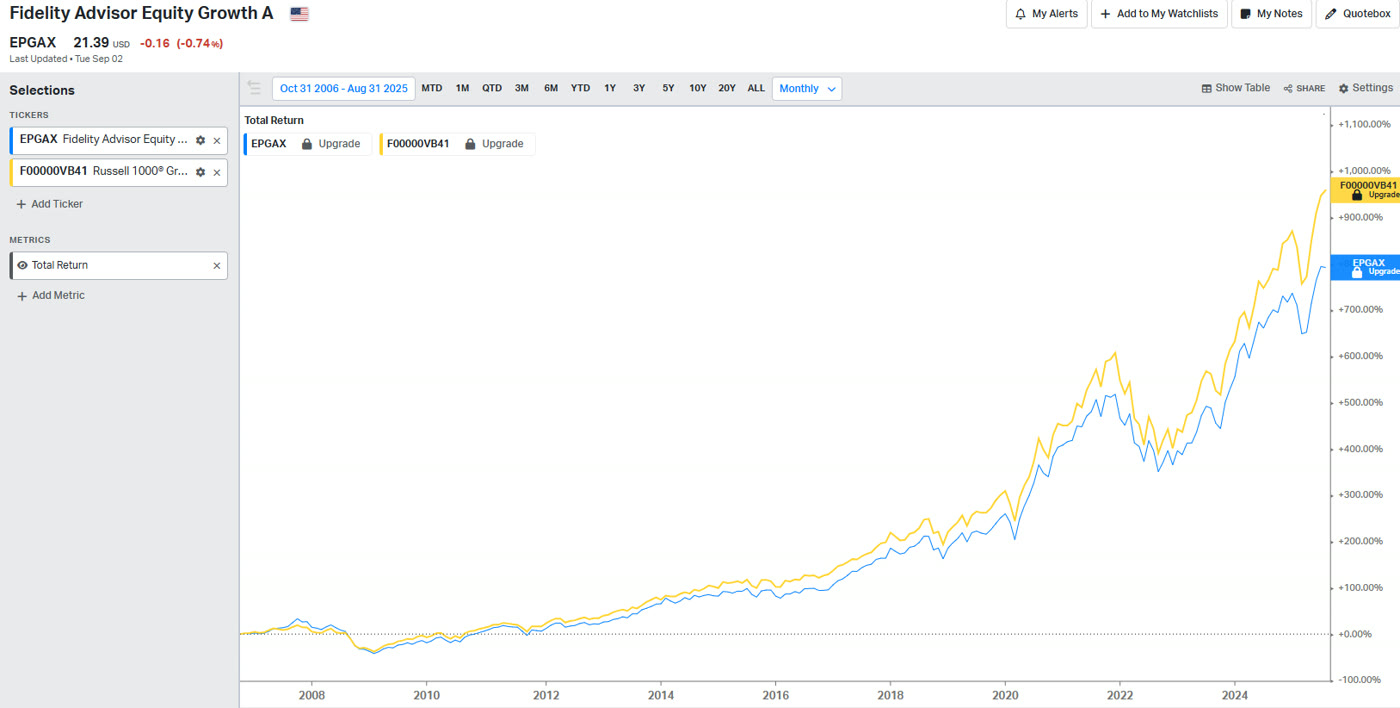
Fidelity Advisor Equity Growth versus the Russell 1000 Growth (yellow) and Contrafund (purple).
Fidelity Growth Discovery, which they each joined a few months later, shows the same thing since 2007: behind the growth index, ahead of Contrafund. Those are the only two funds where Jason has a 10-year record.
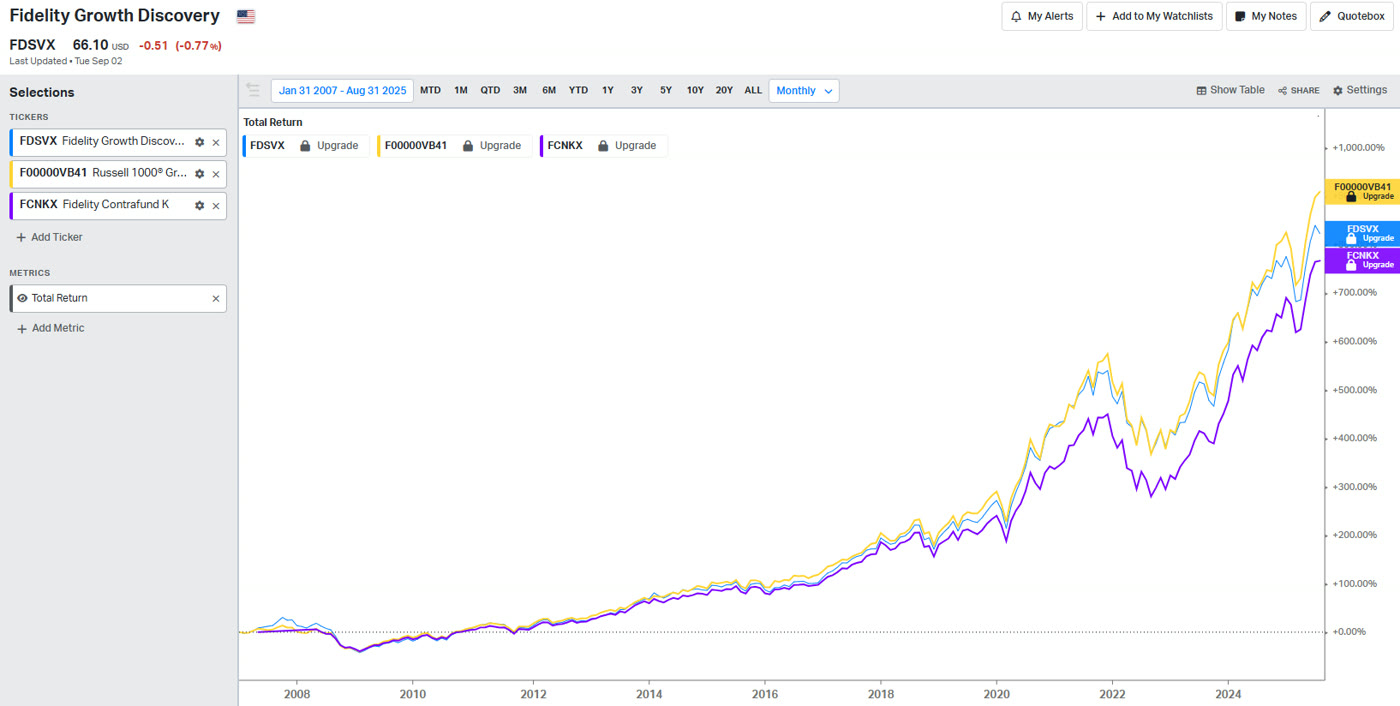
Fidelity Growth Discovery since 2007: behind its growth index, ahead of Contrafund.
To see how big an advantage it’s been to lean toward growth, add the S&P 500 (orange), Contrafund’s benchmark, since Jason’s first fund. The growth index those funds are measured against has dominated it.
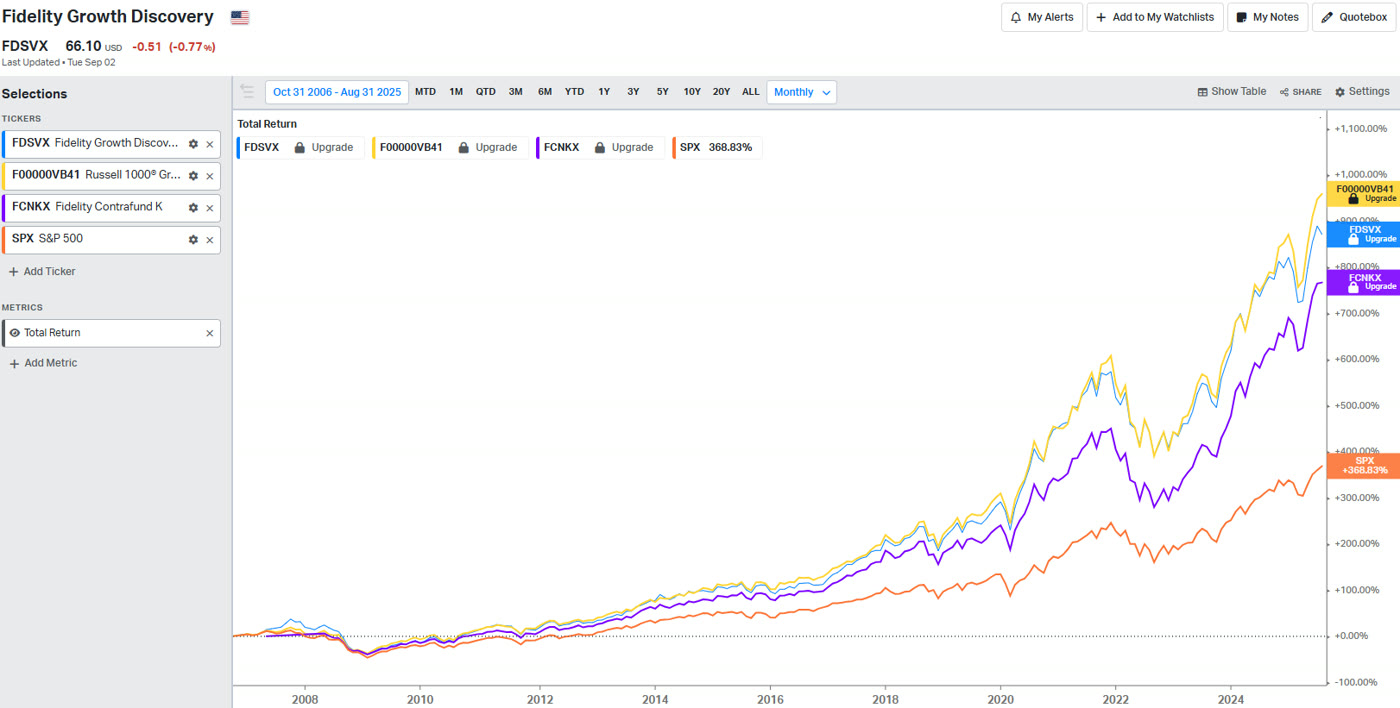
Since 2007, the growth index (yellow) has dominated the S&P 500 (orange).
Step 3: Can Contrafund Do It Again?
As long as Will Danoff is at the helm, I feel pretty good about it. Two co-managers running 10% of the assets doesn’t change much for me.
I think he’s an extraordinarily talented manager, one of very few who consistently beat their benchmark. I’m not convinced Asher and Jason are. Their funds beat Contrafund, but they’re more growth-oriented during a long stretch when growth was in favor, a factor that influences results but isn’t repeatable. Some say you can’t predict which style will lead; others, like me, think markets are cyclical and value is likely to return to favor at some point after a long run for growth.
Either way, there’s no clear reason to count on growth staying in favor, and we don’t know whether they’d run Contrafund the same way. What we do know is they haven’t shown Danoff’s ability to consistently beat their benchmark. For me, that would be enough to move on once Danoff retires.
Given his age and what looks like succession planning, if I were looking for a new U.S. stock fund, I’d prefer one with more longevity ahead of it. If I already owned Contrafund, I wouldn’t rush to sell while Danoff is still in charge, but I’d definitely keep an eye on it. Whether you own it, are considering it, or just want to learn how to evaluate funds, I hope this framework helps.
Watch the Full Video
Want to Go Deeper? In the Fundamentals of Finance Academy, Ethan breaks down funds and current market events on a live call every other week, and members get the full archive of recorded calls. Learn more about the Academy →
This article is for educational purposes only and is not investment advice. Ethan is a CFA charterholder, but nothing here is a recommendation to buy or sell any security, and it does not take your personal situation into account. Past performance does not guarantee future results. Charts of index returns are for illustration only and don’t reflect the fees, expenses or taxes of any actual investment. Performance data and fund details are as of 08/31/2025 and will change; check each fund’s website for current figures.
